


KnowBe4 has released its Phishing Threat Trends Report, Vol. 8, highlighting a significant change in cybercriminal tactics as attackers move away from broad, low-effort phishing campaigns toward highly targeted identity-based attacks. The findings point to increased exploitation of trusted cloud infrastructure, AI platforms, and authentication mechanisms to evade conventional security defenses.
Published on October 29, 2026, the report draws on threat intelligence from KnowBe4 Defend, the company’s Inbound Email Security solution, which processes approximately 1.15 billion event signals each day.
The research found that overall phishing activity increased 29.8% year-over-year, with organizations encountering an average of one dangerous email for every 733 messages received. Despite this growth, traditional mass phishing techniques are becoming less prevalent.
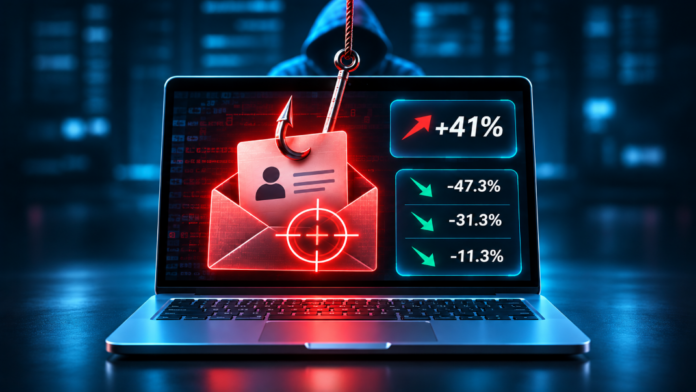
Mobile-focused scams declined 47.3%, while 419 (advanced-fee) fraud dropped 31.3% and missed message lures decreased 11.3%. Meanwhile, cybercriminals are placing greater emphasis on reconnaissance and personalized attacks. Spear phishing rose 41.1%, pre-attack scouting increased 33.7%, and company impersonation climbed 28%.
“For years, security advice has focused on a predictable checklist; check the sender address, hover over the link and look for the padlock,” said Jack Chapman, SVP of Threat Intelligence at KnowBe4. “While still foundational, that guidance is becoming less useful by the day. Modern phishing has no need to fool security filters with lookalike domains if attackers can sit directly on trusted ones. Attackers can now borrow legitimate infrastructure, harvest permissions instead of passwords, and react to news headlines at machine speed. Trust signals alone are no longer proof of safety and organizations must rethink where trust belongs as they protect their workforce.”
The report also identifies a growing reliance on legitimate digital services and AI infrastructure to distribute malicious content. During Q3 2026, phishing attacks were twice as likely to originate from legitimate infrastructure compared with Q2 2026, underscoring the increasing difficulty of distinguishing malicious activity from trusted online services.
Attackers are exploiting native AI platform domains to host fraudulent developer consoles, authentication prompts, and software download portals. By operating within recognized environments, these campaigns can take advantage of established trust signals that users and security systems traditionally rely upon.
Generative AI and agentic technologies are also accelerating phishing campaign development. According to KnowBe4, threat actors can now transform breaking news stories into operational phishing lures 5.4 times faster than in 2022, enabling more timely and convincing social engineering attacks.
Commercial phishing toolkits are contributing to the expansion of these campaigns. Toolkit-driven phishing increased 54%, representing 29.2% of all inbound malicious email. The report found that just three major toolkits were responsible for 90.2% of toolkit-based phishing activity, indicating a high concentration of malicious activity around a limited number of widely used tools.
Another emerging concern is the growing use of authentication phishing techniques that bypass traditional password theft. Attackers are exploiting device-code authentication workflows on platforms such as Microsoft Teams and abusing OAuth consent mechanisms to compromise active sessions and obtain permissions associated with AI agents.
The findings also reveal clear patterns in attack timing and organizational targeting. Approximately 90.4% of phishing emails are delivered during the standard Monday-to-Friday workweek, with Monday accounting for the highest share at 20.6%.
Business Email Compromise (BEC) represents 51.2% of phishing types, with HR, Finance, and Executive Leadership identified as the departments most frequently targeted.
Taken together, the findings illustrate how phishing operations are evolving beyond conventional credential-harvesting campaigns. The increasing use of trusted infrastructure, AI-assisted social engineering, and permission-based attacks presents new challenges for organizations relying primarily on traditional email filtering and authentication safeguards.
The report emphasizes the importance of reassessing digital trust and strengthening security controls around identity, access permissions, and workforce interactions with cloud and AI services.
The full Phishing Threat Trends Report, Vol. 8 is available from KnowBe4.
About KnowBe4
KnowBe4 empowers the whole workforce to make smarter security decisions every day. Trusted by more than 70,000 organizations worldwide, KnowBe4 is the pioneer of digital workforce security, securing both humans and AI agents. The KnowBe4 Platform provides attack simulation and training, email & collaboration security, and agent security powered by AIDA (Artificial Intelligence Defense Agents) and a proprietary Risk Score. The Platform leverages 16 years of behavioral data to combat advanced threats including social engineering, prompt injection, and shadow AI. By securing humans and agents, KnowBe4 leads the industry in workforce trust and defense. More info at knowbe4.com. Follow KnowBe4 on LinkedIn and Instagram.
FAQs
Q: What is KnowBe4’s Phishing Threat Trends Report Vol. 8?
A: KnowBe4’s Phishing Threat Trends Report, Vol. 8 examines real-world phishing activity, inbound email threats, and emerging attack techniques. The latest edition documents the growing use of targeted identity attacks, compromised trust in AI platforms, and the rapid exploitation of breaking news for phishing campaigns.
Q: What are the key findings of KnowBe4’s Phishing Threat Trends Report Vol. 8?
A: The report identifies a 29.8% year-over-year increase in phishing volume, a 41.1% rise in spear phishing, and a 54% increase in toolkit-driven attacks. It also finds that generative AI has helped attackers turn breaking news into phishing lures 5.4 times faster than in 2022. Additionally, the likelihood of phishing attacks originating from legitimate infrastructure doubled between Q2 and Q3 2026.
Q: What is KnowBe4 and who is it for?
A: KnowBe4 provides digital workforce security solutions designed to protect employees and AI agents. Its platform combines security awareness training, attack simulation, email and collaboration security, and AI agent protection through AIDA (Artificial Intelligence Defense Agents) and a proprietary Risk Score based on 316 indicators.
Founded in 2010, the company has provided AI-powered security capabilities since 2016 and holds more than 50 patents, supports over 70 deep integrations, and draws on more than 15 years of behavioral data. KnowBe4 serves over 70,000 organizations globally and has trained more than 100 million people, including approximately one-third of full-time U.S. workers.
Its solutions are intended for CISOs, compliance leaders, security operations teams, and security awareness administrators seeking improved visibility, automated security processes, and measurable changes in workforce security behavior.
Join our LinkedIn group Information Security Community!