




Numbers have always interested me because we use them in so many ways. An individual’s buying power, how long they’ve been on this planet, and even how well they see are all measured with numbers. Sometimes a small variance in the number is critical – for example, when talking about speed or blood work details. Sometimes that same variance is meaningless – for example, when talking about national debt or the number of cells in the human body. This is why we often speak in percentages and percentage differences rather than raw numbers.
The numbers that interest me most have always been vulnerability related. After 20 years in the industry, thinking about vulnerability metrics is as normal to me as eating and breathing. Over the past few years, we’ve really seen these numbers change. We’re quickly approaching 70,000 CVEs in 2026 and the year isn’t over, we’ve never crossed 50K CVEs in a single year before. Over the past few years, we’ve seen varied percentage increases year over year:
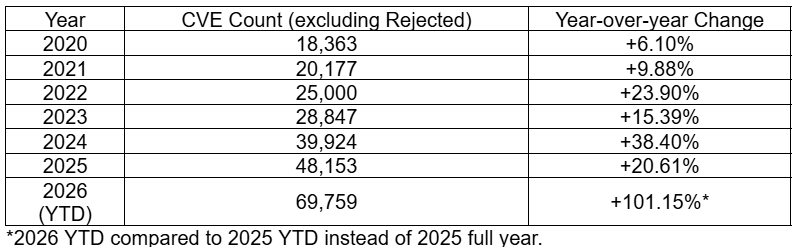
Let’s be honest, if an enterprise was pulling that sort of growth, they’d be incredibly happy, but in terms of vulnerabilities, that’s not a great look. Interestingly, this is not the largest percentage increase that we’ve seen, from 2016 to 2017, we saw a +126.76% increase in vulnerabilities.
If we dig into a single vendor, Microsoft, we see more of the same, near constant growth. Although we do have 2021 as an outlier here:
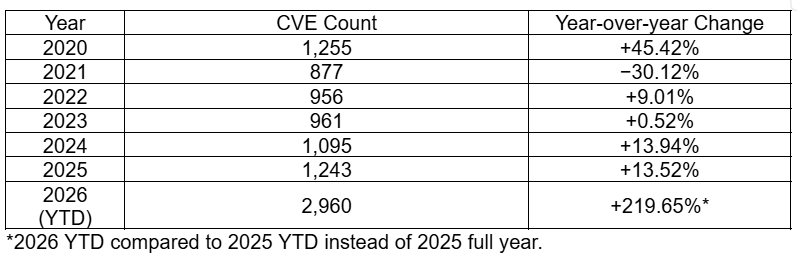
So, it is clear that in 2026, we’re seeing vulnerability discovery at a scale that we really haven’t seen in the past. I think we’re getting to a level of discovery where the numbers no longer matter. At least, not these numbers. For years, everyone has cared about how many vulnerabilities were released. Vulnerability Management vendors bragged about how many CVEs they covered, which meant that enterprises demanded 100% CVE coverage and executives demanded that every vulnerability be patched. Those are unrealistic expectations, but the numbers were low enough that nobody cared about realism.
Today, that has changed. We need to be realistic. I thought it would be interesting to look at how many vulnerabilities appear in the CISA KEV as a way to be more realistic.
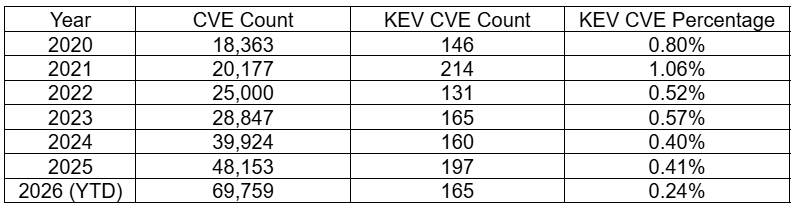
These numbers are very telling, because we’re not seeing a massive spike in the number of vulnerabilities appearing in the CISA KEV. In fact, when we look at the percentages, we’re decreasing, while the numbers are staying relatively flat.
So, does it matter that we’re seeing patch drops of 500+ vulnerabilities from vendors if we’re not seeing an increase in exploited vulnerabilities? Probably not. So, to me, these numbers are meaningless. Instead, we need to make sure that we’re prioritizing what matters and patching the important stuff. Can a team patch 70K vulnerabilities in a year. No. Can they patch 165? Yes. When you add in bulk cumulative patches, you’ll probably take care of a lot of additional issues as well.
So, I shared a lot of numbers, but did I really say anything? Not really. I only wanted to leave you with one takeaway. You cannot patch everything. You will not patch everything. Patch what matters in your environment and patch the systems that you care about.
_______
About Tyler Reguly:
 Tyler Reguly is Associate Director of Security R&D at Fortra, where he leads the Content Guild – an organization that provides detection engineering for Fortra’s Data Protection, Integrity Monitoring, Compliance, and Vulnerability Management solutions. The guild also builds Fortra’s Human Risk Management training content and phishing simulations and provides technical writing capabilities across all Fortra’s cybersecurity products. A member of the FIRE team, he joined Fortra in 2022 after its acquisition of Tripwire, where he spent more than 15 years in security research.
He’s also passionate about teaching and mentoring, working closely with Fanshawe College in the past to develop and teach courses on topics like hacking techniques, malware, evolving threats, and Python.
As the co-host of The Art of Security podcast, Tyler shares practical insights, informed perspectives, and real-world context to help security professionals and tech enthusiasts build smarter, more resilient defenses.
Tyler was a co-founder of the IoT Hack Lab that, for 7 years, provided SecTor attendees hands-on experience with hacking and securing IoT devices. He’s contributed to standards like CVSSv3 and served as a technical editor on several books, helping make complex security topics more accessible.
Join our LinkedIn group Information Security Community!