


Gartner predicts that by the end of this year half of all Security Operations Centers (SOCs) will use AI-driven decision support. The latest Gartner Hype Cycle for Security Operations also marks the shift: SOCs are evolving into autonomous exposure engines powered by AI SOC Agents.
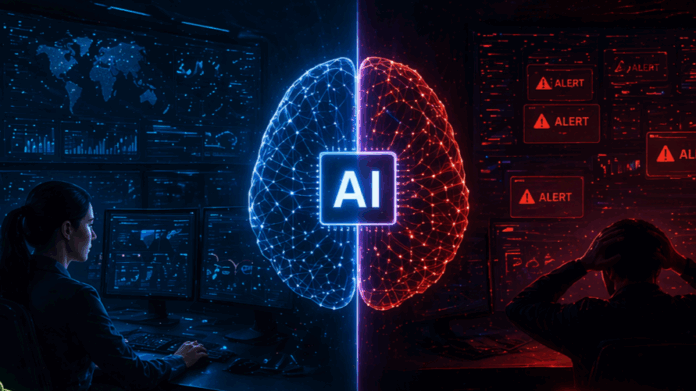
The SOC, which constantly monitors and analyzes security information inside and outside the company, is essential for responding quickly to threats and minimizing damage. A recent survey conducted by Software Analyst Cyber Research of over 300 U.S. CISOs found that their SOC teams experienced an average of 982 alerts per day. Larger organizations reported over 3,000 alerts daily via 28+ different security tools. Alarmingly, 40% of alerts never get reviewed by the team. Mean time to investigate an alert takes up to 70 minutes.
The human capacity to process the current volume of attacks that an organization faces on a daily basis simply does not exist. Adding to the frustration, the average SOC must manage often dozens of security tools to assist with the process. Each tool in a SOC is designed to excel at detecting specific types of threats. There are email security gateways (the “mail sniffer”), EDR tools monitoring suspicious processes (the “surveillance camera”), ITDR systems watching for lateral movement (the “vault security guard”), DLP solutions tracking data exfiltration (the “your bag looks heavy observer”), and SASE and proxy tools monitoring network traffic (the “speeding ticket giving traffic cop”) – all operating and reporting independently. This is too much information gathered in a siloed manner.
As security attackers rapidly expand their use of AI, cyber threats continue to increase in both quantity and sophistication. For many organizations, existing security measures are unable to adequately address these threats. Organizations are required to analyze huge amounts of security data and speed up incident response in an increasingly complex security environment, while facing a serious shortage of security personnel. This is what is driving organizations to add AI-powered tools to their SOC.
What is the best roadmap for SOC teams to embrace AI? Consider the following:
- AI SOC tools don’t replace humans – Instead of spending hours investigating individual alerts, L1 analysts now oversee AI-driven investigations, validate high-risk decisions, and focus on understanding business impact. L2/L3 analysts shift from tactical firefighting to strategic threat hunting and security architecture work.
- The need to move to next gen SIEM – AI SOC integrates with your existing tools and environment. You do not need to modernize your entire stack. In fact, AI SOC often makes legacy tools more effective by utilizing them better than humans can.
- Evaluating AI SOC tools – There are some key questions to ask when evaluating tools. Know before you buy if a platform is a chatbot wrapper, or has hidden drawbacks or operational blind spots that most vendors won’t discuss.
- Build a map for AI SecOps – Mapping the critical evolution from today’s overloaded SOC to AI-powered SOC platforms to the proactive, agentic Security Operations of the future is a must for success.
Human analysts that thoughtfully look for new threats are simply not able to stay ahead of malicious actors who have equally thoughtfully broken up their attack into a series of what looks like benign action. The main goal of AI SOC is to make even the stealthiest agentic attacks visible, and then respond at machine speed.
A unified AI SOC platform provides teams with the best defense: (1) A SOC agent that autonomously triages, investigates, and responds to 100% of alerts from SIEMs, XDRs, and other sources 24/7; (2) A pentest agent that transforms point-in-time penetration tests into a continuous, on-demand security practice, identifying and helping resolve vulnerabilities efficiently; (3) A threat hunt agent that automates hypothesis validation for detection of stealthy threats by leveraging existing telemetry and behavioral signals.
It’s not about adding more tools or dashboards; it’s about re-engineering how security thinks and operates. Security leaders need to embrace the era of foresight and stop firefighting. The challenge isn’t to detect faster anymore. It’s to think and act faster than the next breach.
Join our LinkedIn group Information Security Community!