


For decades, VPN was the default answer to remote access security – reliable, familiar, and deeply embedded in enterprise architecture. That era is ending. AI has accelerated attack timelines from weeks to minutes, automated credential theft at industrial scale, and given adversaries a speed advantage that human-led defense cannot match. VPN was built for a world where defenders had time to patch, investigate, and respond. That world no longer exists.
Our survey of 822 IT and cybersecurity professionals surfaces a persistent gap: organizations recognize VPN risk clearly, but the perimeter-based access architecture they still depend on cannot contain AI-driven threats that now move in minutes. The remaining question is how fast they replace it.
The VPN architecture itself is the constraint. Faster patching, better monitoring, and tighter policies help at the margins, but none address the underlying exposure VPN creates by design, and AI-driven attacks now exploit that exposure faster than any manual process can close it.
This report examines each risk in detail, quantifies the operational cost, and provides a readiness assessment structured around the CISA Zero Trust Maturity Model to help security leaders measure the gap and prioritize the path from Reactive to Resilient maturity levels. The window to act is measured in the same unit as the threats: minutes.
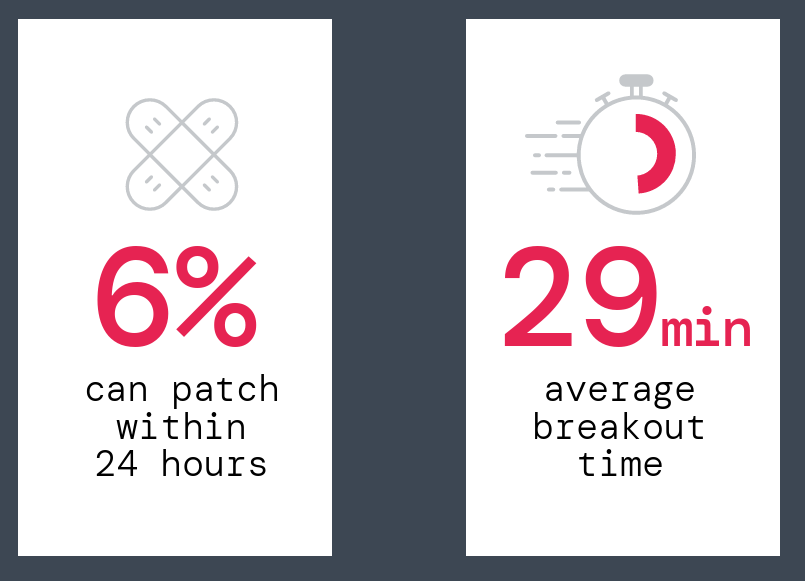
• The response window has collapsed. 79% say the greatest AI-driven risk is attackers weaponizing vulnerabilities faster than patches can be deployed. Only 6% can patch a critical VPN vulnerability within 24 hours; 54% need a week or more. CrowdStrike measured average eCrime breakout time at 29 minutes in 2025, with the fastest at 27 seconds.¹ Attackers operate in minutes. Most defenders still operate in weeks.
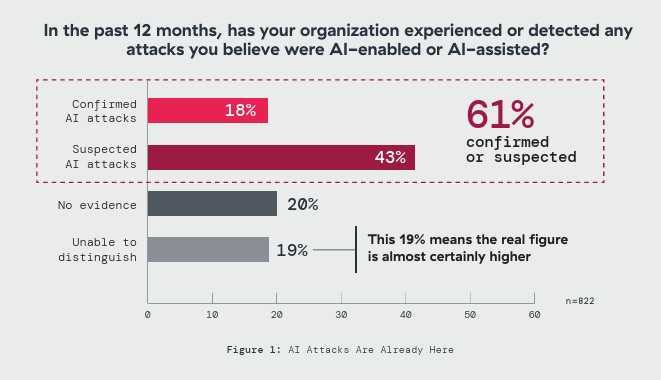
• Defenders are fighting AI with blindfolds on. 61% report confirmed or suspected AI-enabled attacks in the past twelve months, yet only 5% trust their VPN to detect and stop them. 70% report limited or no visibility into AI-enabled threats traversing VPN connections. With one in five unable to distinguish AI-assisted intrusions from conventional attacks, many organizations will not recognize an AI-powered attack until the damage is done.
• After compromise, containment fails. 84% express extreme or significant concern about lateral movement, yet 77% cannot contain it once it starts. Only 11% can restrict a compromised session to a single application, and in one-third of environments a single stolen credential opens the entire network. AI-driven speed makes the initial VPN compromise more likely; once inside, attackers find little to stop them. Ransomware operators exploit this gap systematically – the Akira group collected over $42 million from VPN-based campaigns confirmed by FBI and CISA.²
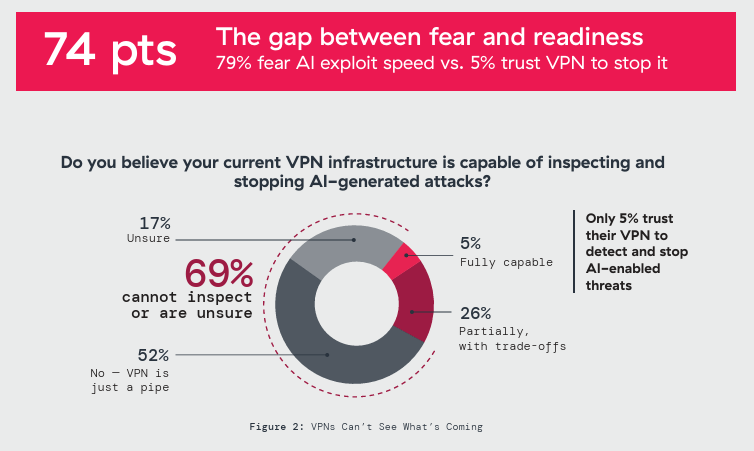
• Encrypted tunnels shield the attacker. Sixty percent inspect a quarter or less of encrypted VPN traffic. Fifty-two percent describe their VPN as a transport layer with limited or no inspection capability. Malware delivery, command-and-control, and data exfiltration all ride the same encrypted tunnel as legitimate traffic, indistinguishable and uninspected. Attackers don’t need to build covert channels when the VPN already provides one.
• Operational friction is eroding security. Seventy-three percent say VPN demands more effort than modern alternatives. Forty-five percent report significant or major productivity impact. The predictable result: 63% say users intentionally bypass VPN controls to reach applications faster. When the sanctioned path is the slowest path, the VPN generates the exposure it was designed to prevent.
• Zero trust adoption is accelerating, but the gap remains. Eighty-four percent are planning or transitioning to zero trust, up from 78% two years ago. Fifty-one percent report declining VPN usage. The drivers map directly to this report’s findings: lateral movement elimination (67%) and reduced operational overhead (62%). Hybrid VPN environments will persist for years, extending exposure during the coexistence period.
Fighting AI with Blindfolds
In this report, “AI-enabled attack” refers to attack activity where respondents observed AI being used to increase speed, scale, or sophistication – for example automated reconnaissance, AI-generated social engineering, rapid exploit adaptation, or evasion techniques. The classification reflects what defenders observed and attributed in their environments, not laboratory-grade certainty.
AI-assisted attacks have been building for years, but the last twelve months pushed them into day-to-day reality. 18% confirmed AI-enabled attacks in the past twelve months and another 43% suspected them. Together, that means 61% report confirmed or suspected AI-enabled attacks. Only 5% trust their VPN to detect and stop AI-enabled threats.
One in five organizations cannot distinguish an AI-assisted intrusion from a conventional attack. That 19% means the incident figures reported here are almost certainly an undercount.
Defensive readiness has not kept pace. Over half say legacy VPN infrastructure blocks integration of AI-driven security tools entirely, which is why only one in four has managed to deploy AI-powered monitoring. 79% fear AI will weaponize vulnerabilities faster than they can patch, yet only 5% trust their VPN to detect and stop AI-enabled threats when patching fails. That 74-point gap between fear and readiness defines the defensive crisis this report measures.
Closing that gap requires moving inspection and detection inline at the access layer, where defensive AI can match the speed of modern automated attack.
Every quarter that gap stays open, the advantage tilts further toward the attacker.
AI-powered Social Engineering: The Credential Theft Multiplier
Which AI-enabled attack techniques are organizations most concerned about targeting their VPN infrastructure? The clear leader is AIgenerated phishing or social engineering to steal VPN credentials (63%)—ahead of automated vulnerability scanning and exploitation at scale (57%) and adaptive attacks that evade traditional detection signatures (49%). That ordering matters: it signals that for many adversaries, the fastest path to VPN compromise isn’t “breaking in,” but logging in.
AI raises both the speed and success rate of social engineering. Pretexts can be customized in seconds, lures can be iterated continuously, and targeting can expand from executives to any user with remote access. In VPN environments, the outcome is the same: once an attacker obtains a valid credential, the VPN often treats that identity as trusted and extends broad connectivity into internal resources—turning a single successful phish into a high-confidence entry point.
Recent credential-theft campaigns show how rapidly VPN phishing is evolving. Since mid-January 2026, researchers reported a threat actor using SEO poisoning to lure VPN users to trojanized installers that display a fake login prompt to steal enterprise VPN credentials, then route victims to the legitimate site to reduce suspicion.
This is why credential theft remains one of the most structurally dangerous VPN risks. The perimeter-style model authenticates once and then grants access based on that moment in time. Anyone holding a valid credential can inherit the user’s reach—often beyond what the role requires, and often without continuous verification of device posture or behavioral signals. In that context, AI-powered social engineering isn’t just another technique; it’s the multiplier that makes credential compromise reliable, repeatable, and scalable.
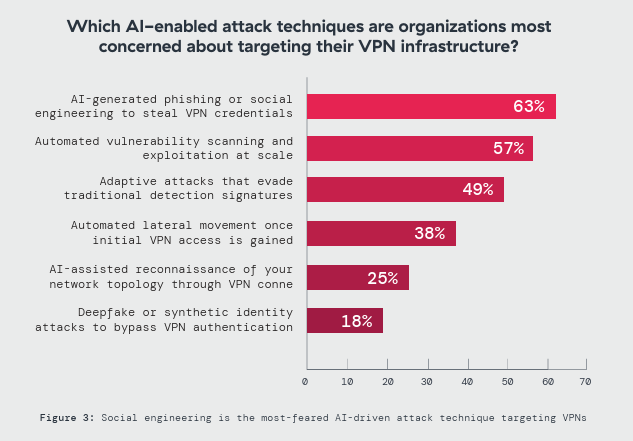
One phished credential. Full access. To break that chain, authentication must shift from a one-time perimeter event to a persistent control—continuously evaluating identity, device posture, and behavior on every request, not just at login.
The Response Window Has Collapsed
Every VPN vulnerability starts the same clock. But can defenders patch before attackers exploit? In 2026, that race is over for most organizations.
In January 2025, a critical Ivanti VPN zero-day (CVE-2025-0282) entered active exploitation before any patch existed; CISA and Mandiant confirmed that post-exploitation malware survived factory resets and firmware updates.
That was one incident. By year’s end, three Cisco ASA/FTD zero-days had been exploited by a state-sponsored actor over five months, a WatchGuard Firebox zero-day (CVE-202514733) had exposed 125,000 devices globally, and Arctic Wolf had confirmed a sustained SonicWall SSL VPN campaign with short intervals between initial access and ransomware encryption. The cadence is no longer episodic; it is continuous.
Only 6% of organizations can deploy a critical VPN patch within 24 hours. The majority, 54%, need a week or more. The CrowdStrike 2026 Global Threat Report measured average eCrime breakout time at 29 minutes in 2025, with the fastest observed at 27 seconds.¹ For many organizations, compromise occurs before their patch process clears the first approval gate.
Practitioners call it the CVE of the week: wake up to a CVSS 9.8 alert, scramble to deploy, do it again six days later. 56% rank patching as their top operational challenge, and 61% acknowledge that vulnerabilities are weaponized faster than fixes deploy. The defenders who spend the most time patching are also the ones who know it will never be fast enough.
Zscaler ThreatLabz analyzed 411 VPN CVEs over five years and found 82.5% growth in annual volume, with 60% of the most recent year rated high or critical. The vulnerability pipeline is structural, not episodic.
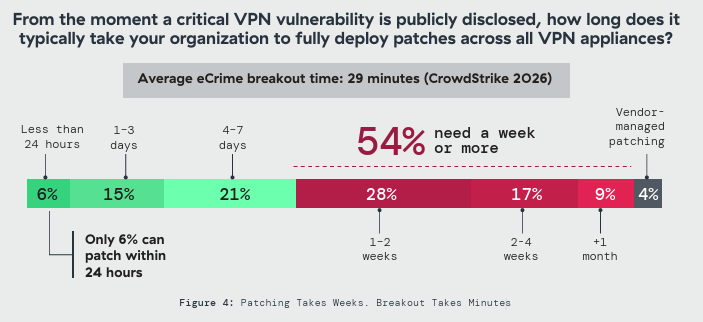
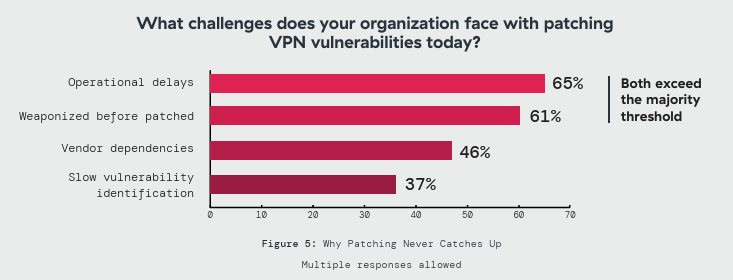
When the initial foothold is the access layer itself, compensating controls sit downstream of the compromise. A patched concentrator prevents the foothold, but once exploitation succeeds, containment depends on segmentation and inspection capabilities that this survey shows are weak across most environments. As long as remote access depends on a customer-managed appliance, every organization remains one unpatched CVE away from compromise. Removing the VPN concentrator from the equation eliminates one of the most exposed patch surfaces in remote access.
What the Tunnel Hides
The same encrypted tunnel that protects a legitimate session also shields every attack that crosses it. Whether the appliance is fully patched or not.
VPN was engineered to create encrypted tunnels, and at that task it performs exactly as designed. Encrypted transport has since become the primary delivery mechanism for modern threats, and VPN is rarely configured, or in many cases capable, of inspecting what the tunnel carries. Attackers embed payloads in SSL/TLS sessions, run command-and-control frameworks like Cobalt Strike through encrypted connections, and exfiltrate data through the same tunnels that carry legitimate traffic. The result is a blind spot that grows with every encrypted session. Adversaries can hide inside “legitimate” encrypted traffic and adapt their techniques faster than legacy controls can detect what’s moving through the tunnel.
In January 2026, Huntress documented an attack chain where a compromised SonicWall VPN provided initial access, enabling the attacker to pivot through to VMware ESXi hypervisors using an exploit toolkit developed over a year before disclosure.
The entire chain crossed encrypted tunnels that no inspection layer examined. When 52% describe their VPN as a transport layer with limited or no inspection capability, they are describing what the technology was built to do: systems performing according to design, in an environment that design never anticipated.
One-third of organizations inspect zero encrypted VPN traffic for threats. Add the 27% examining less than a quarter, and 60% of enterprises run remote access with minimal or no visibility into what crosses it. Only 8% can inspect virtually everything. 83% rank ransomware through VPN tunnels as a top concern, yet 60% barely look at what’s inside them. The gap is even wider for AI-enabled threats: 70% report limited or no visibility into AI attacks traversing VPN connections. The organizations with the most to fear have the least ability to see it coming.
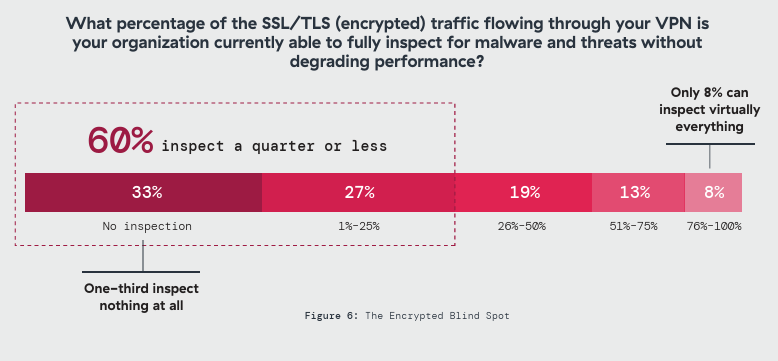
 A credential-stuffing bot, a C2 beacon, and a 3:00 AM exfiltration disguised as a file sync all cross the tunnel looking identical to legitimate traffic. The technology built to protect data in transit now provides cover for every stage of an attack.
Inspecting traffic inline at the point of access restores the visibility and control that encrypted tunnels strip away.
Lateral Movement Is the Multiplier Once Attackers Get In
Initial access is rarely the end of the story, it’s the beginning of expansion. With VPN-based remote access, a single authenticated session often lands a user on the internal network, turning one compromised credential into broad reach across systems and services.
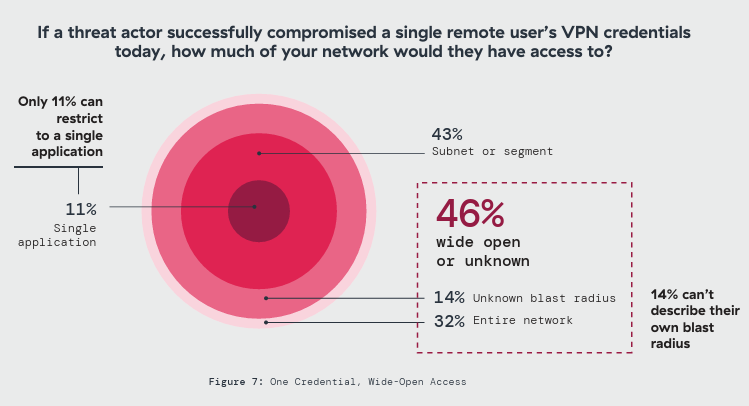
The report shows how limited containment still is in most environments: only 11% of organizations can restrict a compromised session to a single application. In 32% of environments, a single stolen credential opens the entire network and 14% can’t describe their own blast radius.
Nearly half of enterprises can’t confidently predict what an attacker could reach after login.
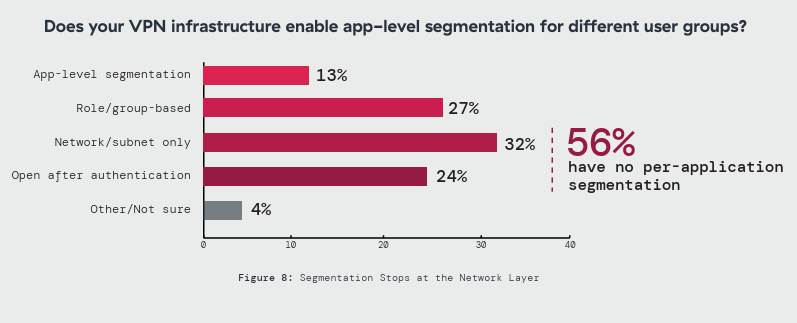
Segmentation gaps make lateral movement easier to operationalize. 56% have no per-application segmentation through VPN, and 24% provide entirely open access after authentication. The result is a structural mismatch: defenders may detect an intrusion, but lack the access controls to contain it quickly.
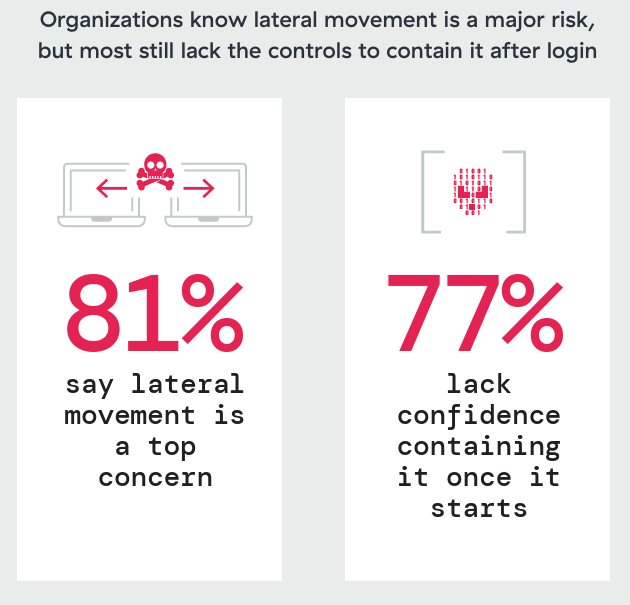
That tension shows up clearly in priorities: 81% flag lateral movement as a top concern, yet 77% lack confidence in containing it. When remote access grants network-level connectivity instead of app-level containment, lateral movement becomes the multiplier that turns one compromise into many.
The Hole In the Firewall
The perimeter was supposed to be the hard boundary. For most organizations, VPN turned it into an open door, and the uninspected traffic documented earlier flows straight through it.
Networking teams have grown vocal about the irony: you spend millions on firewalls, then punch a giant, persistent hole in it for VPN to listen on. Every VPN session passes through the perimeter, places the remote user directly on the internal network, and bypasses the inspection layers the organization spent years building.
Only 11% can restrict a compromised session to a single application. In 32% of environments, a single stolen credential can open the entire network. Another 14% cannot describe their own blast radius. Nearly half of all enterprises cannot predict what an attacker would reach after login.
56% have no per-application segmentation through VPN, and 24% provide entirely open access after authentication. Almost everyone who recognizes the threat also lacks the means to address it: 81% flagged lateral movement as a top concern, yet 77% lack confidence in containing it.
Site-to-site connections amplify the exposure: 61% report limited or no visibility into traffic flowing across permanent tunnel links between offices, data centers, and partner networks. 41% still route vendor and contractor connections through this same infrastructure, typically granting the same access as employees. Every one of these connections extends the blast radius of a single breach.
In contrast, an access model that connects each session only to its intended application leaves a compromised credential with nowhere to go.
One Credential, Full Access
In most breach investigations, the root cause lands in the same place: a stolen credential that opened the front door. VPN makes that credential uniquely dangerous.
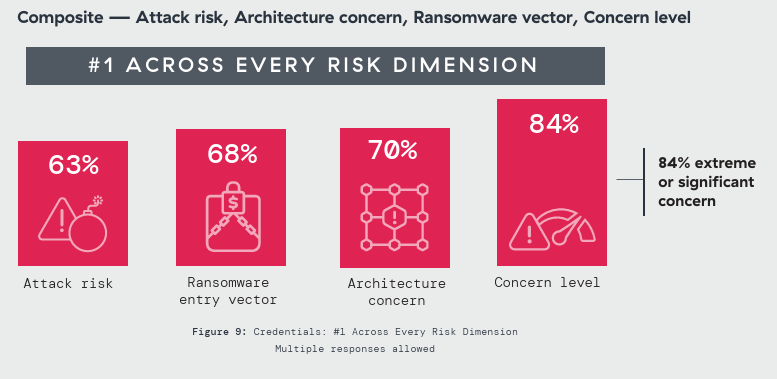
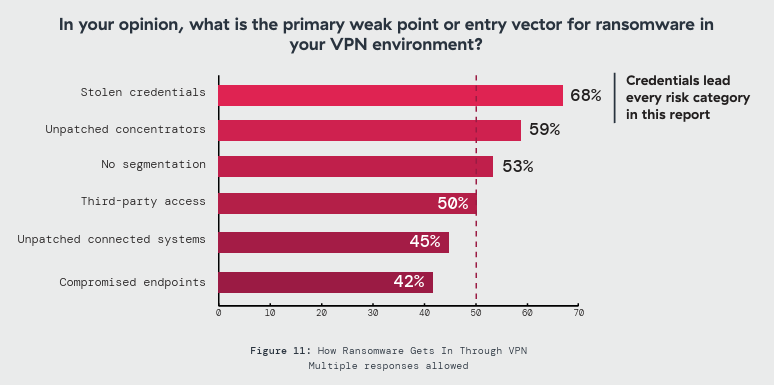
Credential theft dominates every risk dimension the survey measured. As the greatest VPN attack risk, 63% named it first. As an architecture concern, 70% ranked it the top threat. As a ransomware entry vector, 68% placed it above all alternatives. 84% expressed extreme or significant concern. No other finding achieved that consistency.
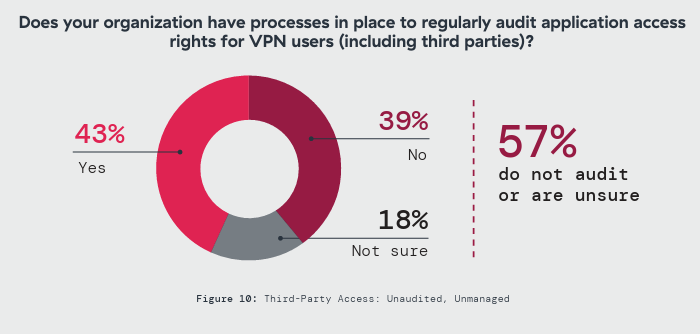
The reason is structural. VPN authenticates once at the perimeter and extends network access from that single event. Anyone holding a valid credential inherits whatever access the legitimate user had, often far more than the role requires. Yet 57% of organizations do not audit the third-party access those credentials unlock.
AI has industrialized the supply side. Infostealer malware now harvests VPN credentials at scale, feeding access broker marketplaces where verified logins are sold with bulk pricing and customer service for ransomware affiliates. In December 2025, GreyNoise detected a coordinated brute-force campaign targeting Cisco SSL VPN and Palo Alto GlobalProtect portals, with over 10,000 unique IPs probing exposed authentication endpoints in a single week.
Dormant vendor accounts, provisioned months ago, never audited, still active, rank among the most valuable listings on access broker forums. Every unaudited credential is an open invitation that never expires.
Ransomware’s Favorite Door
A ransomware operator needs three things: a way in, room to move, and time to work. VPN provides all three.
The credential exposure and patching gaps documented in this report converge here. Once inside, the attacker lands on a segment with access exceeding what the role requires. Without meaningful segmentation, the pivot from entry to encryption is unobstructed.
The Fog ransomware group completed full chains from VPN login to encryption in under two hours.⁷ A joint FBI and CISA advisory confirmed Akira collected over $42 million from VPN exploitation campaigns; the group surged again in mid-2025 targeting SonicWall SSL VPN devices.² Black Basta’s leaked internal communications read like procurement documentation: vulnerabilities ranked by exploitability, credential pricing from access brokers, target lists filtered by internet-facing portals.
Multiple campaigns in 2024 and 2025 demonstrated that implanted malware can survive reboots and firmware upgrades on VPN appliances, meaning a compromised concentrator maintains access indefinitely through a tunnel designed never to close.
The survey data maps onto this kill chain precisely: broad access in 56% of environments, flat topologies in 32%, zero inspection in a third. 83% rank ransomware through VPN as a top-tier concern – yet 53% report no meaningful segmentation to slow it down. The concern is nearly universal; the capability to act on it barely exists.
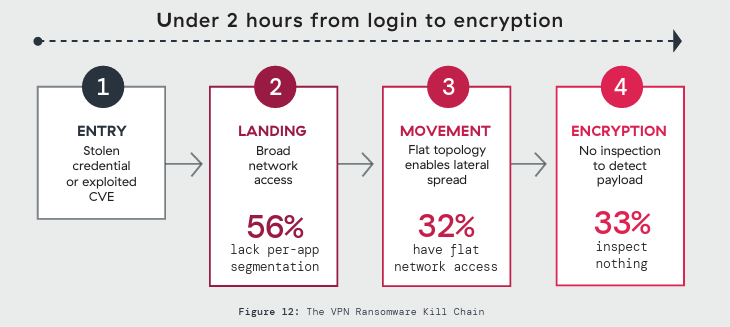
Until every stage of that kill chain meets a control that stops it – continuous identity verification, inline traffic inspection, per-session application access, and automated threat detection – the path from first credential to final payload stays clear.
The Operational Tax
Beyond the security risks, VPN imposes an operational cost that adds up quietly in help desk tickets, user frustration, patching cycles, and the workarounds that emerge when the sanctioned access path becomes the slowest one available.
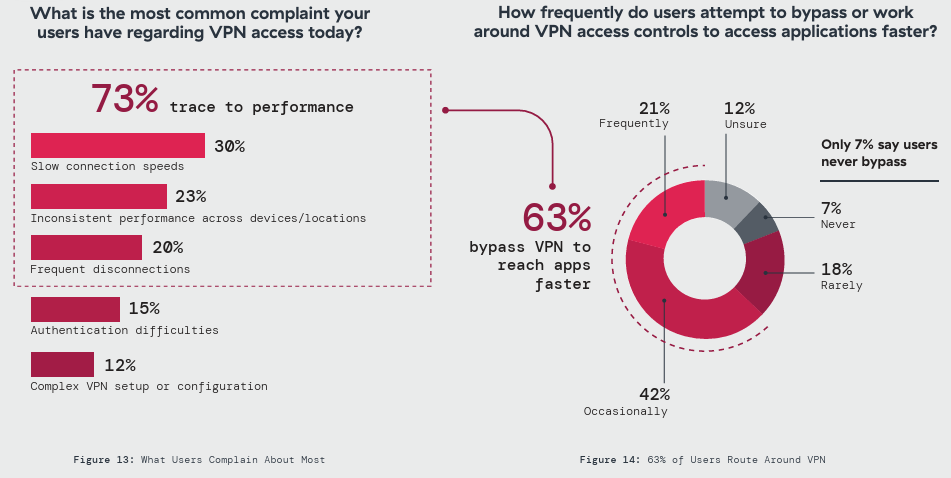
63% report that users intentionally bypass VPN controls to reach applications faster. When nearly two-thirds of the workforce routes around the security perimeter, every bypassed session flows uninspected and unmonitored. Controls that users consistently route around do not meaningfully reduce risk.
The bypass has roots in measurable friction. Slow connections top the complaint list at 30%, followed by inconsistent device behavior at 23% and frequent disconnections at 20%. All three are performance problems, accounting for 73% of complaints. Forty-five percent report significant or major productivity impact. These are real costs: delayed projects, missed collaboration windows, frustrated employees working around their own security tools.
Security teams spend more time maintaining VPN than defending what sits behind it. 73% say VPN demands more operational effort than modern alternatives. The top drivers: patching complexity (56%) and integration struggles with modern security stacks (50%). As one survey respondent put it, more time goes to patching the entry point than securing the actual data behind it.
VPN now creates more exposure through workarounds than it prevents through protection. That is no longer a security problem; it is an operational failure.
Nation-States Inside the Perimeter
VPN has become a national security concern. The campaigns disclosed in 2024 and 2025 made that clear.
Volt Typhoon, confirmed by CISA and multiple intelligence agencies, targeted critical infrastructure across communications, energy, transportation, and water sectors, maintaining access within some networks for years before discovery.9 Salt Typhoon achieved deep penetration of U.S. telecommunications providers, compromising the lawful intercept systems used by law enforcement. The FBI characterized it as one of the largest intelligence compromises in American history.
These were not isolated incidents. A Chinaaligned group designated UAT4356 exploited three Cisco ASA/FTD zero-days from May through September 2025, targeting government networks worldwide with firmware-level persistence that survived reboots and upgrades.¹¹ Additional Chinese state-sponsored groups exploited Ivanti VPN zero-days throughout early 2025, deploying malware designed to persist despite standard remediation.
The CrowdStrike 2026 Global Threat Report found that 40% of vulnerabilities exploited by China-nexus actors targeted edge devices such as VPNs, firewalls, and gateways.¹
In this survey, 51% of organizations reported a VPN-related security incident in the past twelve months – a figure that spans every sector, not just the critical infrastructure these campaigns targeted.
CISA issued consecutive emergency directives in January 2024 and January 2025, ordering federal agencies to disconnect affected appliances after malware proved capable of surviving factory resets and firmware updates.
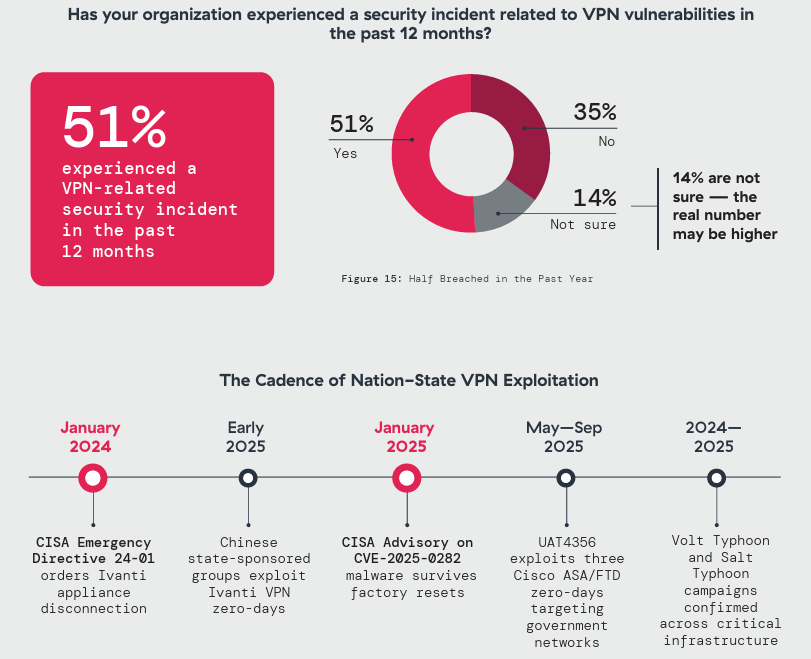
When standard recovery fails and the government orders disconnection, the security device itself has become the threat – ordered off the network it was purchased to protect.
Against adversaries with nation-state capability, the only viable defense is an architecture that never exposes the appliance in the first place.
The Clock Is the Risk
Every finding in this report reduces to one variable: time. Time to patch, time to detect, time to contain.
Only 6% can patch a critical VPN vulnerability within 24 hours, while 79% say their top AI-driven risk is attackers weaponizing vulnerabilities faster than patches can be deployed. The exposure window is structural, not temporary.
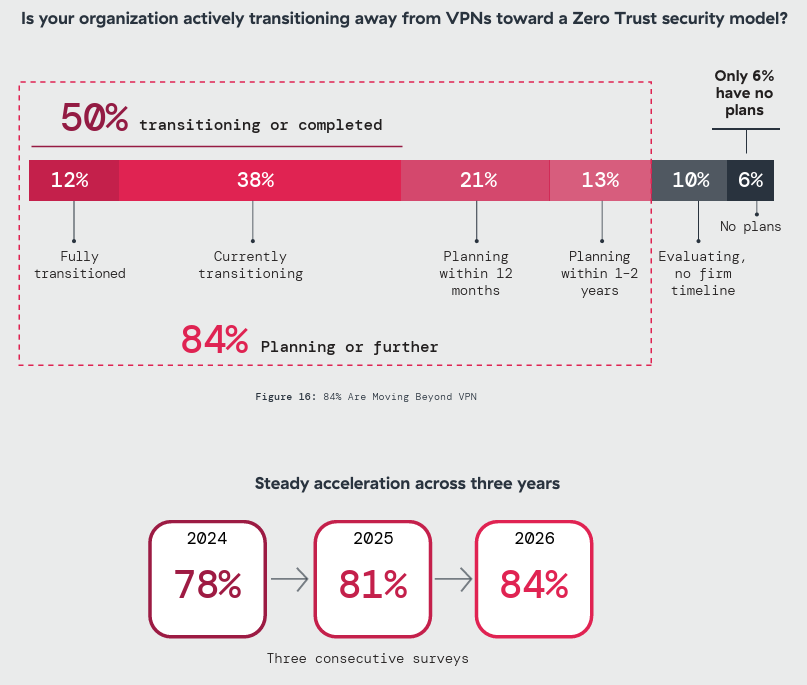
With 38% transitioning and 34% planning zero trust, hybrid access will persist for years. During that coexistence period, broad network exposure remains in production.
The priority is speed of containment: shrinking reachable surface area, enforcing per-application access, and restoring inspection at the point of connection.
A CISA-aligned readiness assessment quantifies how much exposure remains. The decisive question is whether your access architecture can contain the next compromise before it spreads.
From Reactive To Resilient
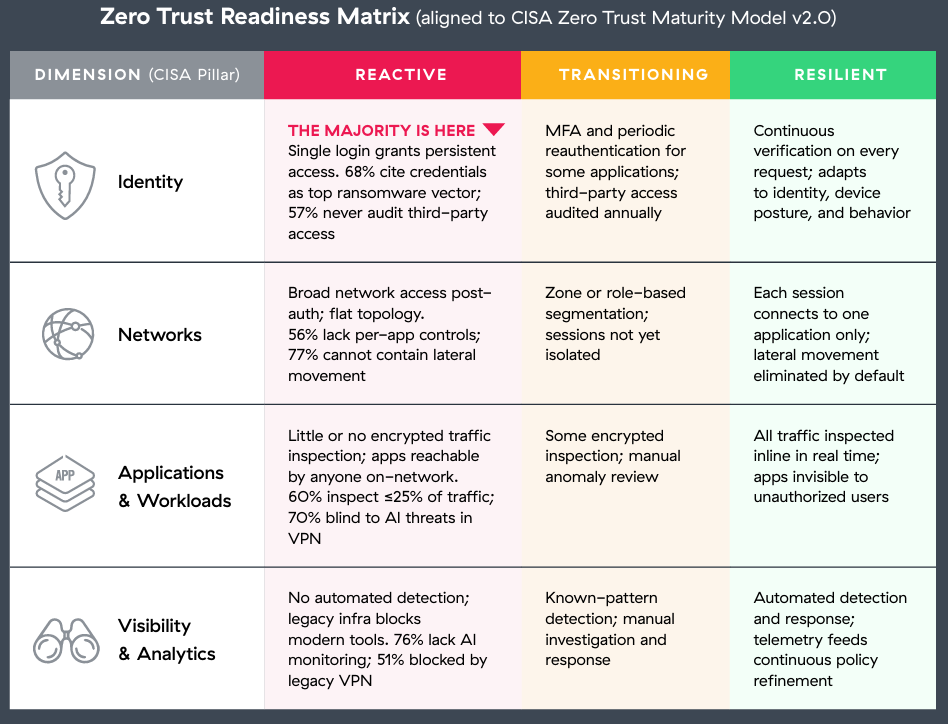
Most organizations in our survey placed themselves in the Reactive column across every dimension. That position is not sustainable when breakout times are measured in minutes and AI-enabled attacks are reported by 61% of respondents.
These four changes define the shortest path from Reactive to Resilient. Each maps to a CISA zero trust pillar and is ordered by impact.
 1. First: Eliminate broad network access (Networks): 32% still grant flat network access after authentication, and 24% provide effectively open connectivity. Shifting to an access model that connects each session only to its intended application is both an architecture change and a segmentation fix in a single step: it collapses blast radius for credential compromise and sharply reduces lateral movement pathways. Least-privilege access is foundational, not a later phase. It directly addresses the risk that 67% cite as their primary reason for adopting zero trust.
2. Second: Make authentication continuous (Identity): 68% identify credentials as the top ransomware entry vector, yet most VPN architectures validate identity once and never again. Fifty-seven percent do not audit third-party VPN access or are unsure whether audits occur. Continuous verification that evaluates identity, device posture, and behavior on every request transforms authentication from a single checkpoint into a persistent control – closing the gap that credential-based attacks exploit.
3. Third: Inspect all traffic inline (Applications & Workloads): One-third inspect zero encrypted VPN traffic, and 60% inspect a quarter or less. Without inspection, every session is a potential channel for malware, C2, and exfiltration. Inline inspection at the access layer restores the visibility that encrypted tunnels strip away and makes applications invisible to unauthorized discovery.
4. Fourth: Automate detection and response (Visibility & Analytics): 24% deploy AI-powered monitoring today, yet 61% have encountered AI enabled attacks. Over half say legacy VPN infrastructure blocks integration of AI-driven security tools entirely. An access model built for automated detection and response removes the integration barriers that keep most organizations blind to the fastest-moving threats.
None of these changes require perfection across every dimension at once. Each one independently narrows the gap an attacker can exploit, and every week of delay keeps the full gap open.
Zero Trust The Execution Gap
The strategic debate over whether to move beyond VPN is effectively settled. The hard part now is execution: how fast organizations can transition, and how much exposure accumulates during coexistence.
VPN usage is declining in 51% of organizations, and only 10% report an increase. Half are actively transitioning to zero trust or report completion, and another 34% are in formal planning. Across three consecutive surveys, the share at least planning zero trust has grown from 78% to 81% to 84%. Only 6% report no plans.
The drivers map directly to this report’s findings. Eliminating lateral movement leads at 67% – the same threat that 81% identified as a top concern and 77% cannot contain. Operational overhead reduction follows at 62%.
Better segmentation at 58% and ransomware protection at 53% complete the picture. The alignment between what organizations fear and what drives their migration to zero trust is nearly exact.
Zero trust is a journey, and most enterprises will operate hybrid access environments for years as they migrate high-risk workforce access first while legacy VPN use cases persist. The practical objective is to reduce exposure in measurable steps by shrinking reachable network surface area and limiting blast radius during coexistence.
The contrast is architectural. VPN authenticates once and exposes the network. Zero trust verifies continuously and connects each session only to a single application, keeping the internal network unreachable. At its core, it’s the shift from putting users on the network to connecting them only to the specific app they need.
VPN to Zero Trust: Readiness Assessment
AI has compressed attack timelines across every dimension of enterprise security. Credential harvesting, exploitation, east-west movement, and exfiltration all operate faster than just twelve months ago. The readiness question is whether your infrastructure can operate at the speed these threats now demand.
This assessment is structured around the CISA Zero Trust Maturity Model v2.0, scoped to the access risks this survey measured. Two CISA pillars, Devices and Data, fall beyond this survey’s scope; organizations should assess those independently. The three maturity stages align to the progression CISA describes from Traditional through Optimal. In every dimension, the majority of respondents fall in the Reactive tier. The lowest-rated dimension typically represents the fastest path an attacker will take.
For each dimension, identify which column most closely describes your current operational state – not your planned state or your policy, but what is enforced in production today. Many organizations will find themselves in the Reactive column across multiple dimensions. That honest placement is the starting point for prioritization.
The next page maps the four changes that move each dimension from Reactive to Resilient, ordered by impact.
Predictions For 2026 And Beyond
1. Credential theft becomes a default VPN intrusion path.
AI-generated phishing/ social engineering will outpace exploitation because “log in” is faster, quieter, and more reliable than “break in.”
2. Attackers optimize for machine- speed time- to-compromise.
AI will continuously refine exploit targeting and follow on actions to compress the window from first contact to valid VPN access—from days to hours, increasingly minutes.
3. MFA, resets, and help desk flows become the new frontline.
AI-assisted social engineering will target push fatigue, one-time codes, device enrollment, and password reset workflows as aggressively as passwords.
4. Patch velocity won’t match exploitation velocity.
AI-assisted scanning and exploitation will shorten the time between disclosure and compromise attempts, widening the gap for organizations with slower patch cycles.
5. Defenders shift to continuous verification—and away from VPN.
Organizations will move from “authenticate once” perimeter trust to per request checks (identity, device posture, behavior) and least-privileged user to-app access to survive machine-speed attacks.
How Zscaler Transforms Secure Access
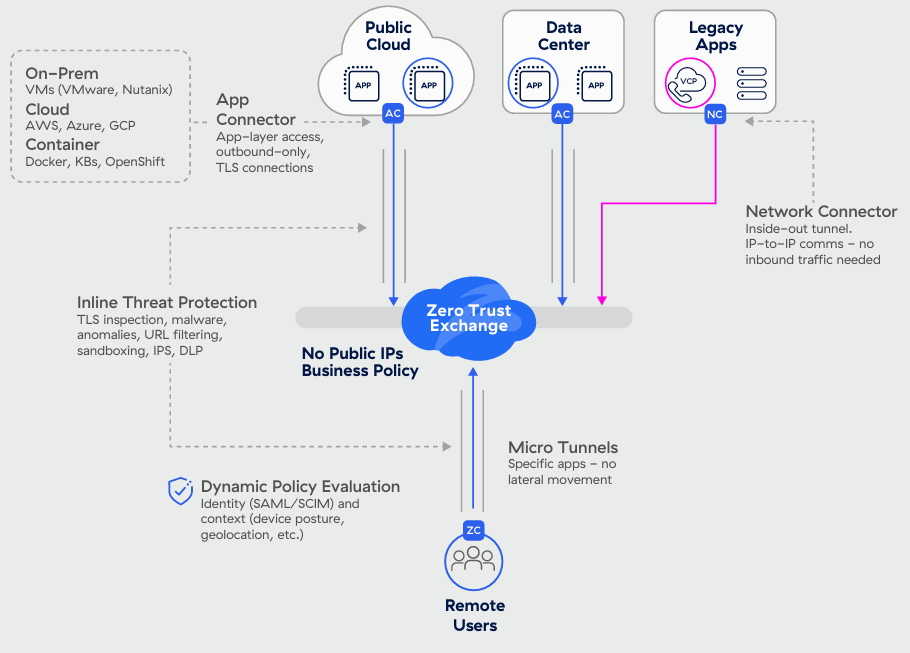
If time is the risk, then secure access has to reduce time everywhere it matters: time to expose services, time to move laterally, and time to contain. Legacy VPN does the opposite. It extends the network to the user, broadens the attack surface, and turns a single credential compromise into a pathway for lateral movement. Zscaler Private Access (ZPA), the industry’s first AI-powered ZTNA, replaces network-level access with direct user-to-application connectivity. Applications are made invisible behind the Zero Trust Exchange, and Autonomous User-to-App Segmentation enforces least-privilege access by default, collapsing blast radius and helping eliminate lateral movement.
ZPA supports the broadest set of private access use cases from managed and unmanaged (BYOD) devices to in-office users, third-party contractors, and privileged access (RDP, SSH, VNC) without reintroducing a flat network. Built to deliver Zero Trust Everywhere at scale, it provides consistent security and performance across branch, home, and cloud on a unified platform for users, workloads, and OT devices, backed by 160+ global data centers. And because fast attacks require fast containment, ZPA adds inline inspection plus integrated App Protection, deception, and rapid deployment and scaling so organizations can reduce exposure and improve resilience during the hybrid transition years.
Key Differentiators Of Zscaler Private Access (ZPA)
• Built from the ground up for least-privileged access
Connect users to approved apps—not the network— with policy-based access by default.
• Minimize the attack surface and lateral movement
Keep apps invisible and contain risk with user-to-app segmentation.
• Full inline inspection
Block threats and protect data with inline inspection and integrated DLP.
• Universal ZTNA
Deliver consistent access to any app (including legacy) from anywhere.
• Boost workforce productivity
Provide fast, direct access—no backhauling through the data center.
• Secure B2B connectivity
Give partners on-demand, zero-trust access— without added infrastructure.
• Accelerate M&A/Divestiture
Integrate or separate access quickly— without merging networks.
• Reduce operational complexity
Replace VPN/VDI/firewalls with a cloud-native access service.
• Automated business continuity
Maintain policy-enforced access through outages and disruptions.
• Centralized policy enforcement
Apply one policy model to all apps for remote and in-office users.
• Cloud-delivered solution
Connect users directly to apps without routing through the data center.
• 160+ global cloud edge locations
Deliver secure, local access with consistent performance worldwide.
Why Zscaler Private Access (ZPA)?
Minimize Attack Surface
Applications are invisible to the network making them impossible to discover or attack.
Boost Productivity
Fast, direct access from 160+ PoPs worldwide with no traffic backhauling.
Reduce Total Cost of Ownership (TCO)
Consolidate VPNs, firewalls, and load balancers into a single cloud-native platform.
__
About Zscaler
Zscaler (NASDAQ: ZS) accelerates digital transformation so customers can be more agile, efficient, resilient, and secure. The Zscaler Zero Trust Exchange™ platform protects thousands of customers from cyberattacks and data loss by securely connecting users, devices, and applications in any location. Distributed across more than 160 data centers globally, the SSE-based Zero Trust Exchange™ is the world’s largest in-line cloud security platform. Learn more at zscaler.com or follow us on X @zscaler.
Join our LinkedIn group Information Security Community!