




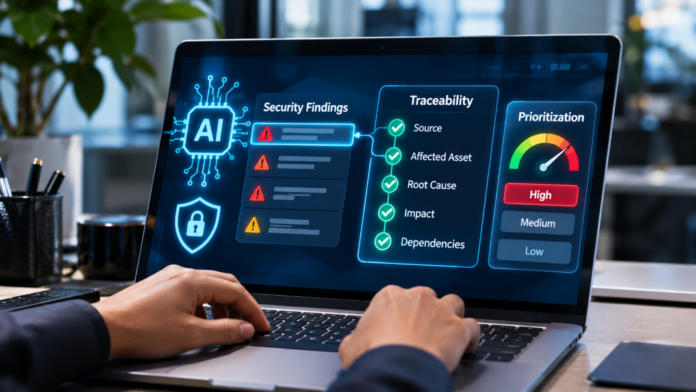
An AI security report needs to be read alongside the scope of the assessment. Before turning a finding into a deployment or remediation decision, establish what was examined, what evidence supports the observation and what the result does not establish.
Start with the system that was reviewed
Identify the application, model and integration versions described in the report. Look for the user role, environment and test conditions. Ask which components were excluded and how the conclusion depends on the conditions under which the behaviour was observed.
These details give technical owners a starting point for understanding an observation. They also give decision-makers the boundaries needed to interpret the result.
Keep observations separate from assumptions
For each finding, look for the observed behaviour and its supporting evidence. Record the conditions that mattered and the explanation of impact. If access was unavailable or a part of the system could not be tested, keep that limitation visible rather than treating an assumption as a demonstrated result.
This is also a question to ask before commissioning an assessment: how will the provider distinguish demonstrated behaviour from unresolved questions? Agreeing the expected coverage and exclusions makes the eventual report easier to review against the original scope.
Use a finding structure that supports review
A practical buyer-review structure includes the scope and conditions, the expected boundary, the observed behaviour, supporting evidence, impact and uncertainty, a proposed action, an owner and a retest status. This is a set of review prompts, not a promise that every assessment uses identical report fields.
The important connection is between the observation and the decision. A technical owner needs enough context to examine the issue. A business stakeholder needs to understand its relevance and limitations. Missing information should remain an open question until evidence supports a conclusion.
Agree what happens after the report
Clarify who owns each proposed action and what evidence would demonstrate a fix. Discuss whether the change needs retesting and whether follow-up testing is included in the engagement or agreed separately. Scheduling a change does not itself establish that a finding is closed.
When comparing providers, give them the same system description and questions. Ask what access, environments and test data they require, how those choices affect coverage, and how they will record exclusions and follow-up work. Discuss whether the output will help a technical owner reproduce an observation and a decision-maker understand its impact and limits.
SWSAM publishes a buyer guide covering these review questions
Join our LinkedIn group Information Security Community!