


How to Secure OT Devices as IT and OT Environments Converge
CISO Guide to Operational Technology (OT) Security helps CISOs understand how IT and OT convergence widens the attack surface and which security capabilities OT systems need. Written by Dr. Bill Anderson of MarketR, the guide covers the state of OT security, common attacks on OT systems, three key security capabilities and the design challenges that make OT security different.
72%
of industrial organizations were disrupted at least six times in a year, per a Trend Micro report
5
categories of attacks on OT systems, from protocol attacks to open maintenance ports
3
key capabilities: authentication, secure machine-to-machine communication, data and software integrity
Industry 4.0 and smart IoT devices connect operational technology to IT systems that it used to be separated from. That brings visibility and efficiency, but it also lets adversaries move from an IT access point or cloud vulnerability into internet-facing industrial control systems. Perimeter controls such as firewalls are no longer enough, and OT devices often run in remote, unsupervised environments with limited computing power and intermittent connectivity. Successful attacks chain small weaknesses together, so removing one link in the chain can keep a system safe. The guide explains how authentication, encryption and integrity controls close those gaps.
Inside the guide:
- The state of OT security as IT and OT converge, and the risks and customer demands that follow
- Hardware root of trust and machine identity, and why device data needs cryptographic protection
- Categories of attacks on OT systems, illustrated by STUXNET
- Preventing OT attacks, with lessons from the automotive supply chain
- Key capabilities: authentication, secure machine-to-machine communication, data and software integrity
- OT security design challenges, from unsupervised environments to constrained devices
What the guide recommends
The guide sets out the security capabilities OT systems need and how to design them in.
- Give every OT device an identity
- Start with identity-based security in every node, so the system recognizes trusted devices and excludes imposters.
- Encrypt machine-to-machine traffic
- Protect data end to end with standardized protocols such as TLS and IPSec rather than proprietary security protocols.
- Protect firmware and data integrity
- Sign firmware and verify it before use, and give each device enough secure storage for the manufacturer's root key and its own private key.
- Design for unsupervised operation
- Automate provisioning, updates and recovery, since there is no human in the loop and devices may be remote or only sporadically connected.
More recent research
The latest reports, CISO guides and product reviews from Cybersecurity Insiders.


More research on OT, IoT & Cyber-Physical Security
Reports, guides and reviews on this topic from other research partners of Cybersecurity Insiders.

Safous Privileged Remote Access
Product review with Safous
TXOne Stellar
Product review with TXOne Networks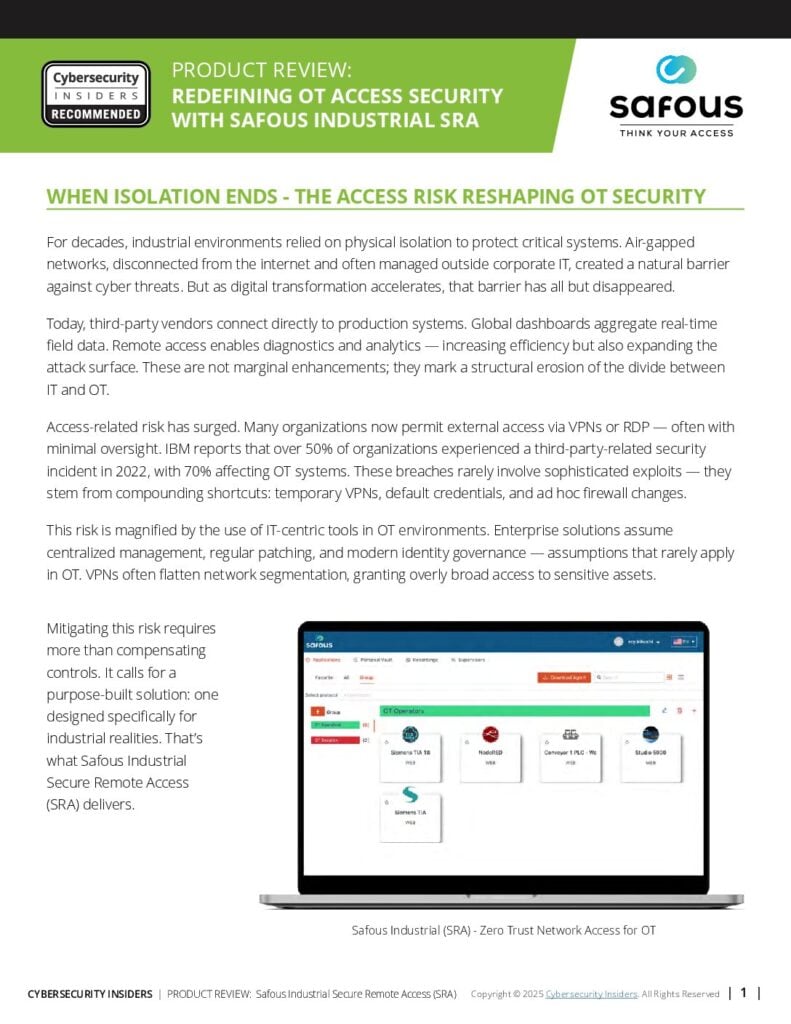
Safous Industrial SRA
Product review with Safous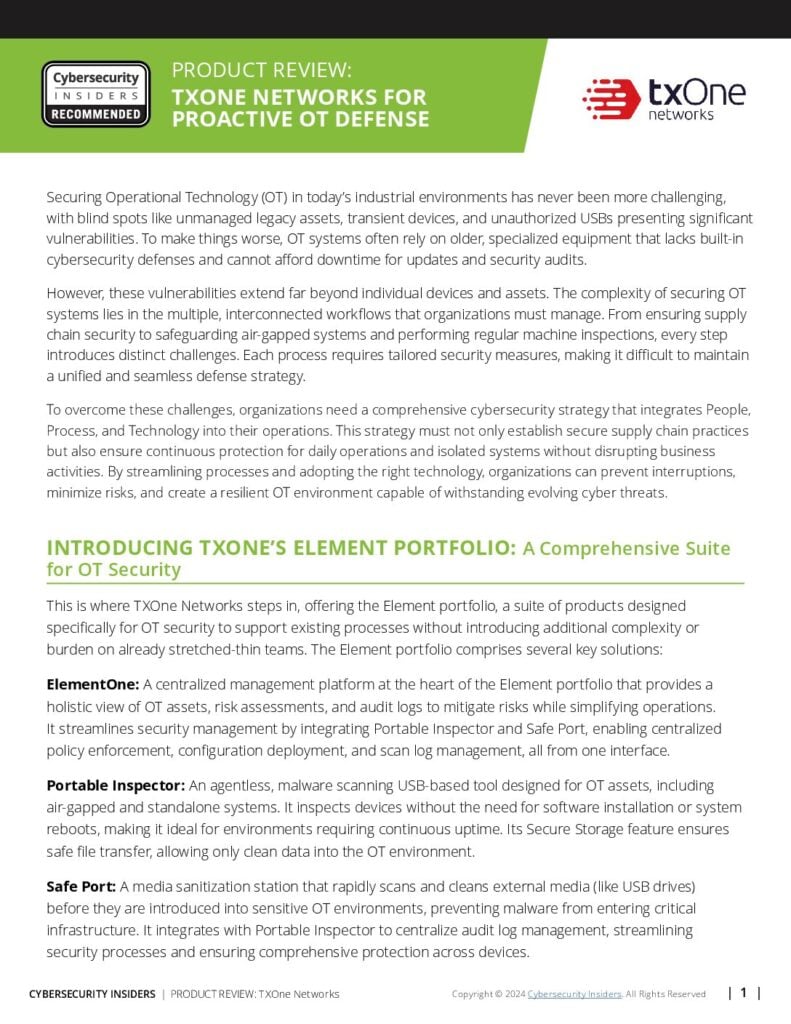
TXOne Networks for Proactive OT Defense
Product review with TXOne NetworksCommission a guide like this
Cybersecurity Insiders writes and publishes practical CISO guides with security vendors.
See how CISO guides workSubscribe to
Cybersecurity Insiders
Get new research reports, CISO guides and product reviews delivered to your inbox.
SubscribeResearch library
Practitioner surveys, CISO guides, product reviews and webinars
Browse the research libraryGet a CISO guide for your company
Cybersecurity Insiders writes and publishes practical CISO guides with security vendors. Cybersecurity Insiders runs the whole project, from outline and drafting to the finished guide and its promotion to a community of more than 600,000 security professionals.