


How to Turn DNS from a Blind Spot into a Real-Time Security Decision Layer
Mastering DNS Security: A CISO Guide to Proactive Threat Defense helps CISOs turn DNS from an overlooked infrastructure layer into a real-time security control. The guide covers why DNS security can no longer be ignored, the weaknesses of traditional DNS, BlueCat's approach to enforcement and detection at the first hop, real-world deployments, a five-step implementation path and best practices.
3
DNS attack techniques explained: tunneling, hijacking and malware using generated domains
5
implementation steps, from assessing DNS posture to continuously refining DNS policy
75%
less DNS malware traffic at a U.S. logistics provider after deploying BlueCat Edge
Every digital interaction, legitimate or malicious, starts with a DNS query, yet DNS is usually managed for uptime and scalability, not for insight. Attackers exploit that blind spot with DNS tunneling to exfiltrate data, hijacking to reroute traffic and algorithmically generated domains that outrun blocklists. Logs, where they exist, are fragmented, rarely tied to a user or device and seldom feed detection in real time. Regulators and cyber insurers increasingly expect DNS to be monitored and governed. The guide shows CISOs how to enforce identity-aware policy and detect threats at the point of resolution, and how to roll that out without disruption.
Inside the guide:
- How DNS works behind the scenes and why it has become a favored channel for evasion and stealth attacks
- The enterprise consequences of DNS blind spots, from silent data breaches to compliance failures
- The weaknesses of traditional DNS: no real enforcement, isolation from the security stack, compliance gaps
- BlueCat’s approach: first-hop enforcement, identity-driven policy, behavioral detection and enriched telemetry
- Real-world deployments at a global financial institution, a logistics provider and a medical university
- A five-step implementation path and best practices for making DNS a first-class security control
What the guide recommends
The guide sets out how CISOs can make DNS a first-class security control.
- Treat DNS as a control plane
- Enforce policy at the first point of resolution and treat DNS queries as intent signals, not just resolution requests.
- Tie every query to identity
- Correlate DNS queries with the user, device and role behind them, and apply least privilege to resolution.
- Detect behavior, not just blocklists
- Look for domain entropy, unusual query volumes and fast-flux patterns that reveal tunneling and DGA malware before indicators are published.
- Feed DNS telemetry into the SOC
- Stream enriched DNS logs into SIEM, SOAR and threat hunting, so DNS becomes a primary security signal, not a forensic fallback.
- Monitor first, then enforce
- Observe traffic first to surface what was invisible, then enforce against known malicious domains before moving to role-aware policies.
More research with BlueCat
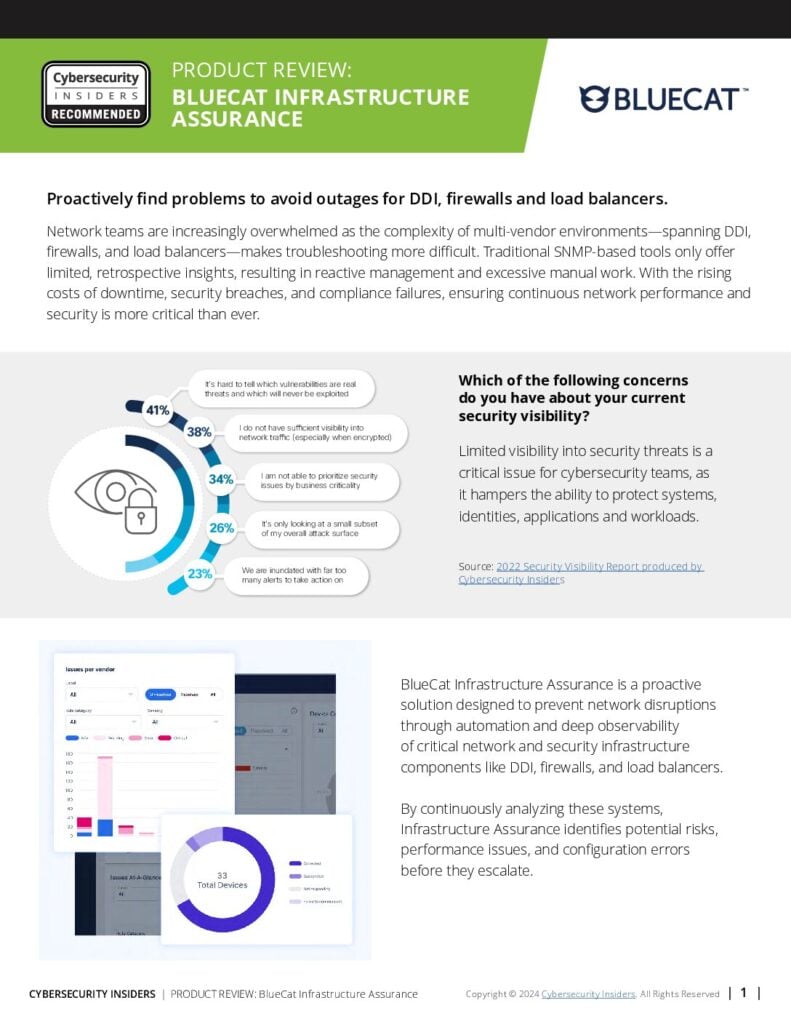
Reports, guides, reviews and webinars BlueCat has produced with Cybersecurity Insiders.
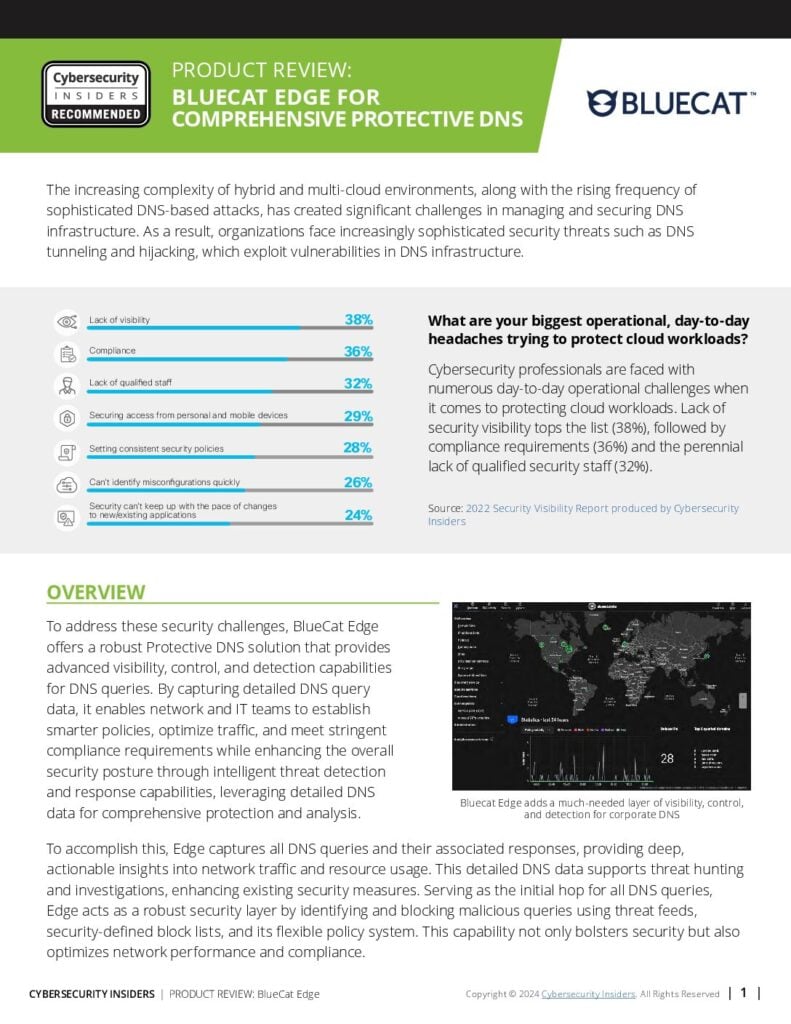
More research on Network Security and Zero Trust
Reports, guides and reviews on this topic from other research partners of Cybersecurity Insiders.

Safous Privileged Remote Access
Product review with Safous
The CISO Guide to Hybrid Mesh Firewall
CISO guide with Hewlett Packard Enterprise
A CISO Guide to Network Security Posture Management
CISO guide with Tufin
The CISO Guide to Executable SASE
CISO guide with Hewlett Packard Enterprise
2026 VPN Risk Report
Survey report with Zscaler
Commission a guide like this
Cybersecurity Insiders writes and publishes practical CISO guides with security vendors.
See how CISO guides workSubscribe to
Cybersecurity Insiders
Get new research reports, CISO guides and product reviews delivered to your inbox.
SubscribeResearch library
Practitioner surveys, CISO guides, product reviews and webinars
Browse the research libraryGet a CISO guide for your company
Cybersecurity Insiders writes and publishes practical CISO guides with security vendors. Cybersecurity Insiders runs the whole project, from outline and drafting to the finished guide and its promotion to a community of more than 600,000 security professionals.