




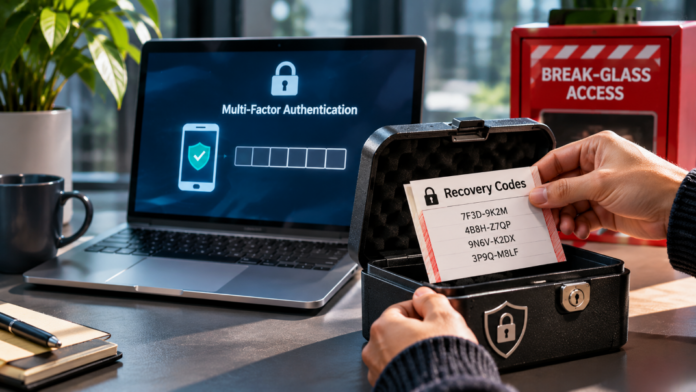
Multi-factor authentication can be strong while its recovery path remains weak. A saved recovery code is intentionally designed to work when the normal authenticator is unavailable. For an administrator, RMM technician, cloud owner, or other privileged user, that makes the code a break-glass credential rather than a harmless backup note.
NIST’s current digital identity guidance treats a saved recovery code as a fallback authenticator. That framing is useful: the question is not whether a recovery code “bypasses MFA,” but whether the complete recovery flow provides enough assurance for the access it restores.
Security teams should test the following eight controls before allowing recovery codes on privileged accounts.
1. Define exactly what one code authorizes
Document the state reached after a code is accepted. Does it complete a login, permit MFA reset, allow enrollment of a new passkey, generate a new recovery set, or restore a fully privileged session? A code that only proves one factor creates a different risk from a code that unlocks the entire account.
Map each recovery action to the roles that may use it. Keep shared administrator and routine help-desk workflows out of privileged recovery unless there is an explicit, audited reason for them.
2. Separate recovery material from the password
A strong recovery secret provides little protection when it is stored beside the password or synchronized through the same account an attacker may already control. Downloads folders, browser notes, tickets, chat, documentation, and scripts are poor storage locations.
For privileged accounts, store recovery material offline or in a separately controlled vault with audited access. Test whether endpoint backup or file-sync policies silently copy downloaded recovery files into the primary account’s trust boundary.
3. Verify generation, storage, throttling, and one-time use
NIST specifies that a saved recovery code should contain at least 64 bits from an approved random bit generator and should be stored securely offline. The service also needs protected server-side storage and controls against repeated guessing.
Do not rely only on documentation. In an authorized lab account, use one code and prove that it cannot be reused. Regenerate the set and prove that every older unused code is invalid. Check that repeated failures are throttled and produce security evidence without recording the submitted secret.
4. Treat factor replacement as a separate high-risk event
Signing in and replacing an enrolled factor are not the same operation. An existing browser session should not, by itself, authorize a new authenticator, passkey, recovery set, or MFA disablement.
Require fresh verification for factor changes and apply stronger review to platform administrators, billing owners, and technicians with cross-customer access. Record the old and new factor state without logging secrets.
5. Give administrators visible policy and revocation controls
Administrators should be able to see whether recovery codes are required, optional, disabled, or enforceable by role without revealing the codes themselves. Inventory which privileged users have recovery enabled and when their sets were last replaced.
The control plane must also support immediate revocation following loss, departure, suspected compromise, or an unsuccessful recovery drill. Policy changes should be auditable and tested on a noncritical account before broad rollout.
6. Notify and investigate every recovery event
Recovery should be rare enough that successful use, failed attempts, regeneration, factor replacement, and administrative resets are all meaningful signals. Send an independent notification through a channel that does not depend solely on the newly recovered session.
Alert on unusual source, device, time, geography, repeated failure, and any privileged-account recovery. Retain the actor, account, source, event, result, and investigation outcome—never the code itself.
7. Drill the path without exposing it
An untested break-glass plan may fail during an outage. A carelessly tested plan can leak the fallback credential. Use a dedicated lab account, two authorized participants, and a written stop condition.
The drill should verify sign-in, notification, factor replacement, code invalidation, and session revocation. Preserve the result evidence, not the code, QR image, screenshot, or secret-bearing file.
8. Revoke recovery during offboarding and incident response
Disabling a user is incomplete if recovery material, active sessions, alternate authenticators, API tokens, or delegated reset paths remain usable. Offboarding and compromise containment should revoke every one of those paths.
Finally, test that the removed account cannot recover itself. Reconcile all privileged identities and document any exception with a named owner and expiry date.
Judge the design and the workflow together
Recovery security is an end-to-end property. Strong randomness does not fix storage beside the password. One-time use does not fix silent factor replacement. Good audit logs do not fix an offboarding process that leaves a recovery path active.
The practical test is simple: can the organization explain what the code authorizes, where it is stored, how guessing is limited, how factor changes are verified, who is notified, and how every recovery path is revoked? If any answer is missing, the account is not ready for privileged rollout.
Primary guidance and optional worksheet
- NIST SP 800-63B — authenticator event management and account recovery
- OWASP Multifactor Authentication Cheat Sheet
- CISA and partners — identity and access management recommended best practices for administrators
- Vendor-neutral 24-control MFA recovery-code worksheet