



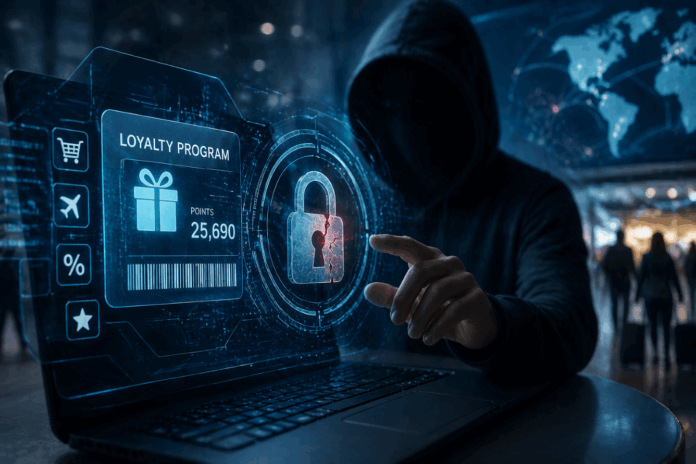
Loyalty programs are a core revenue driver for digital businesses, enabling repeat engagement and long-term customer value across industries like travel, retail, fintech, and e-commerce. But the combination of real monetary value and weaker authentication controls than traditional payment systems makes loyalty accounts an attractive and often easier target for cybercriminals. As EY notes, loyalty platforms now “mirror many of the same structural complexities and vulnerabilities of digital financial platforms, yet without equivalent security maturity,” making them particularly exposed to abuse.
How Loyalty Fraud Actually Happens
Points, miles, and rewards function as a form of digital currency. They can be redeemed for gift cards, flights, products, or services, and in many cases, resold on secondary markets with little traceability. That’s exactly why attackers want them. Many accounts are tied to reused credentials from past breaches, and multi-factor authentication (MFA) is either optional or not enforced, creating a high-reward, low-effort scenario for cybercriminals.
The mechanics behind these attacks are not particularly complex. In most cases, they rely on well-established identity-based techniques. The most common entry point is credential stuffing, where attackers use large datasets of leaked usernames and passwords to attempt logins at scale. Because many users reuse credentials across services, a percentage of these attempts will succeed.
In some cases, attackers don’t even need to log in directly. By hijacking active sessions or reusing authentication tokens, they can bypass login controls entirely and operate within what appears to be a legitimate user session. From there, the goal is to extract value as quickly as possible. This can include redeeming points for gift cards or travel bookings, transferring points to other accounts, or changing account details such as email addresses and phone numbers to maintain control.
Why Most Businesses Don’t Detect It Early
The challenge with loyalty fraud is that it rarely looks like fraud. Payment fraud triggers clear signals such as failed transactions or unusual card activity. Loyalty fraud has none of that. Logging into the system and redeeming your points is normal behavior, making detection significantly more difficult.
In many organizations, loyalty programs are owned by marketing or customer experience teams rather than security or fraud functions. As a result, there is a lack of monitoring and minimal integration with security tools that would otherwise trigger alerts. Until businesses start implementing security controls that can detect and prevent loyalty fraud with the same level of scrutiny as payment systems, these attacks will continue unnoticed.
Why the Problem Is Getting Worse in 2026
One of the main drivers is the surge in credential leaks and infostealer malware. Billions of compromised credentials (usernames and passwords) are for sale on the dark web, giving attackers a reliable entry point into loyalty accounts. Because many users reuse credentials, these attacks continue to succeed at scale.
With automation, attackers can use tools and botnets to test credentials, access accounts, and extract value in minutes. What was once opportunistic fraud is now a scalable, repeatable process. Social engineering is evolving as well. AI-generated phishing campaigns and impersonation tactics can trick users and support teams into giving up credentials or granting account access.
Identity has become the primary attack surface. Access to an account is often all that is needed to extract value, and in many cases, that access can be obtained without exploiting any technical vulnerability.
The business impact is significant. Fraudulent redemptions translate directly into financial loss, as points represent real liabilities on the balance sheet. At the same time, compromised accounts lead to customer frustration and increased support costs. Because the activity often blends into normal behavior, these losses accumulate over time, making them difficult to quantify but increasingly hard to ignore.
What Businesses Need to Do Differently
Addressing loyalty fraud starts with a shift in mindset. Loyalty programs are not only marketing tools. They are environments that hold real monetary value and require the same level of protection as financial platforms.
It all starts with stronger identity controls. Multi-factor authentication (MFA) and risk-based authentication can significantly reduce the success rate of account takeover attacks, especially those driven by credential stuffing.
At the same time, digital impersonation prevention solutions can help with session-level threats by identifying when attackers attempt to mimic legitimate users or hijack active sessions. Memcyco, for example, specializes in detecting impersonation attempts and unauthorized use of active sessions, even when the activity appears to come from a valid, authenticated user.
Businesses also need to improve how they monitor behavior within loyalty systems. Tracking unusual redemption patterns, such as rapid point usage, high-value transactions, or changes to account details, can help surface fraud early.
LexisNexis ThreatMetrix is a platform that analyses device intelligence, location data, and behavioral patterns in real time to build a baseline of normal user activity and detect deviations. This allows companies to track high-risk behaviors that may indicate account takeover. Such visibility is a must for timely fraud detection and prevention.
Conclusion
Loyalty fraud is a growing business risk hiding in plain sight. But the only reason it’s so effective is because it doesn’t receive the same level of attention as other high-risk systems. With proper security controls and monitoring in place, organizations can detect and prevent loyalty fraud early, closing the visibility gap that attackers rely on to operate unnoticed.
Join our LinkedIn group Information Security Community!