


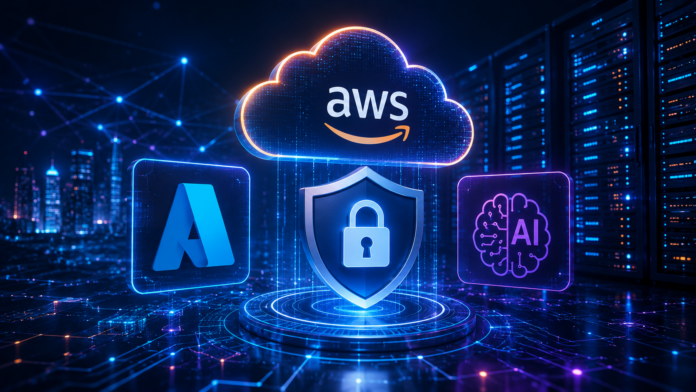
Much of security work involves painstakenly piecing together siloed data to validate an event from an incident from a major attack. This is why we reimagined AWS Security Hub to centralize security operations and correlate findings flowing across our detection services – trillions of log events daily – into prioritized insights. It stitches together events in near real-time to help security teams find and remediate attacks that might otherwise go undetected. Then this year, we answered the call to deliver multicloud security and secure their AI journey as they scale adoption.
Multicloud Security for Microsoft Azure
While AWS is the world’s largest cloud by revenue, customers have asked AWS to bring our security expertise to also cover the rest of their estate. As a starting point, we gave customers a single procurement path through Security Hub Extended for curating their security stack across 21 partners in nine major categories: endpoint, identity, email, network, data, browser, cloud, AI, and security operations.
This week, we announced an AWS native path for multicloud security. Security Hub now discovers Azure Virtual Machines, container images, Function Apps, and identities, then evaluates them for misconfigurations, internet exposure, and software vulnerabilities against the CIS Microsoft Azure Foundations Benchmark. Azure findings are prioritized alongside AWS findings using the same format, automation, and response workflows.
Protecting AI Workloads
Every customer I talk to is building with AI—generative AI on Bedrock, model training on SageMaker, agents on AgentCore. These workloads reach production faster than most security programs can keep up. One security leader told me his team only caught a compromised service account—one invoking a foundation model thousands of times—because finance questioned the bill. We’re addressing the gap with three innovations.
GuardDuty AI Protection delivers threat detection purpose-built for Bedrock and SageMaker. It detects anomalous model invocations, cost harvesting attacks where adversaries abuse stolen credentials to run inference at your expense, and prompt injection attempts through integration with Bedrock Guardrails.
Cost harvesting is accelerating. When credentials are compromised, attackers increasingly use them to invoke foundation models. Inference is expensive, demand is high, and stolen access converts straight to value without deploying any infrastructure. GuardDuty analyzes CloudTrail data events, learns what normal invocation looks like at scale, and flags the deviations that signal compromise or abuse. This is detection that only works at AWS scale, because you have to see the signal across millions of workloads to know what normal is.
GuardDuty AI-powered investigations automatically analyzes findings using knowledge graphs and threat intelligence—completing in minutes what used to take hours. Returns disposition assessments with confidence scoring, MITRE ATT&CK classification, and clear remediation steps.
Security Hub AI inventory provides a continuously updated, organization-wide view of AI assets and their security posture across managed services, self-hosted models, and external endpoints. As teams deploy models, agents, and pipelines, security needs visibility into what’s running to know what to secure.
Security Hub AI inventory discovers and catalogs AI workloads across AWS environments in two ways. For managed services, it inventories AWS Config resources across Bedrock, SageMaker, and AgentCore. For self-hosted and external workloads, it finds models running on EC2, ECS, and EKS through runtime analysis, and identifies the external model endpoints your workloads make calls to. It maps each asset to the infrastructure beneath it, including compute, networking, IAM roles, and data stores, and correlates it with security signals such as GuardDuty findings. So when GuardDuty AI Protection flags an anomalous invocation, AI inventory immediately shows you which infrastructure is involved, what’s connected to it, and where it belongs in your priority order.
Accelerating forward
Security Hub reaches across cloud providers, starting with Azure and expanding from there. It reaches across workload types with purpose-built AI protection and inventory. And it reaches across security categories through Extended and its curated partners.
We have built a security experience that connects signals across every source you trust and helps you respond faster.
Join our LinkedIn group Information Security Community!