


Security Strategy Has Moved for AI. The Architecture Has Not Caught Up.
Based on a survey of 1,042 cybersecurity and IT professionals, this report examines how AI is changing network, cloud, and application security, from employee use of GenAI tools to AI agents running inside live systems, and why security architecture is falling behind security strategy. The independent research was conducted by Cybersecurity Insiders with support from Check Point.
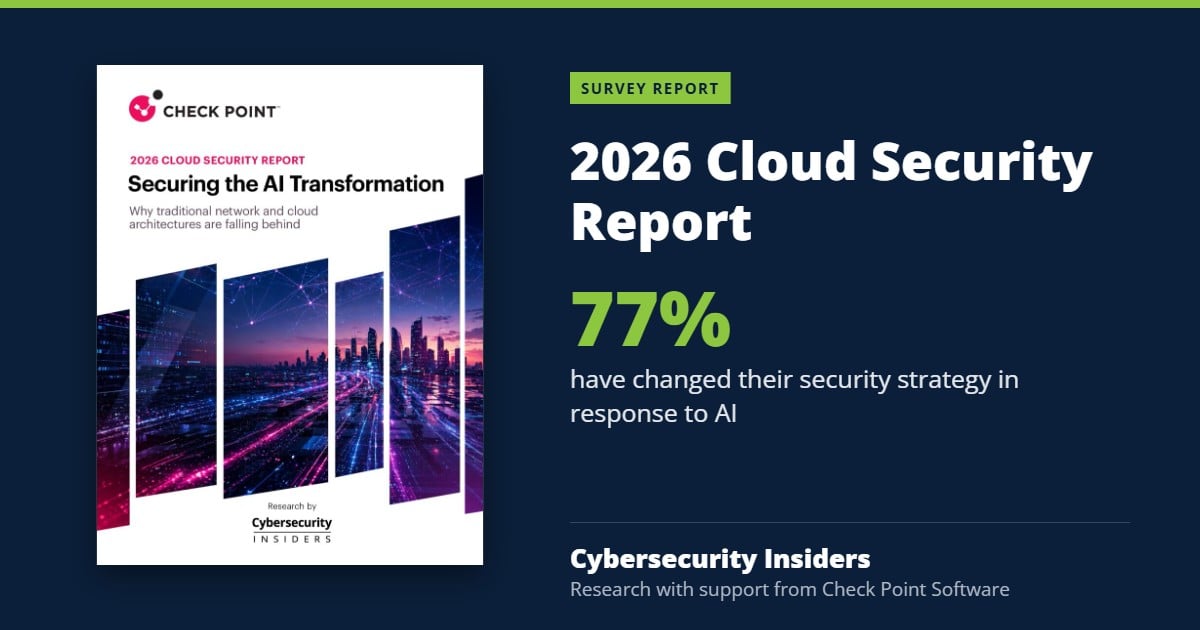
77%
have changed their security strategy in response to AI
26%
say they have the architecture to enforce that strategy
54%
have experienced an AI-related security incident
AI has moved past experimentation and into production. 70% of organizations run GenAI workloads in production, and 64% have AI agents in pilot or production inside live systems. Security strategy is responding: 77% have changed theirs because of AI. But only 26% say they have the architecture to enforce it. That 51-point gap between strategy and architectural readiness is already showing up as incidents, shadow AI usage, policy drift, and blind spots in AI traffic.
Inside the report:
- Incidents: 54% have confirmed an AI-related security incident, and another 24% suspect one but lack the telemetry to confirm it
- Visibility: only 5% have full visibility into AI tool usage, and only 13% can fully enforce policy on traffic to AI services such as ChatGPT, Copilot, and Gemini
- Infrastructure: why 67% report fragmented security policies across hybrid environments, and only 24% can fully inspect AI traffic without degrading performance
- Applications: 71% see more WAF false positives since adopting GenAI, and only 17% have broadly deployed runtime controls for LLM applications
- Data and governance: 44% cannot trace sensitive data through AI workflows, 42% say employees bypass AI controls that slow them down, and only 14% enforce and audit their AI security policies
- The path forward: an AI security maturity model and a five-step sequence toward consistent policy, shared visibility, and distributed prevention across the hybrid environment
Executive foreword from Check Point
The speed of AI adoption is no longer the main story. The gap it has opened inside enterprise security is.
AI is not just introducing new tools; it is invalidating the assumptions security architectures were built on – how users behave, how applications communicate, and where control points exist. Security built on those assumptions is not failing because it is outdated, but because the environment it was designed for has fundamentally changed.
Employees now interact with external copilots from any device, applications exchange model-driven traffic at volumes that did not exist twelve months ago, and agents operate inside live systems with credentials, access, and autonomy. On the other side of that shift, attackers are weaponizing the same capabilities – faster phishing, AI-generated malware, adversarial inputs against models in production. Traditional security control models were not designed for this level of speed, autonomy, and distributed activity.
The research in this report puts a clear number on what most security leaders already sense. Strategy and investment are advancing, but architectural capacity is not keeping pace. In that gap sit the incidents, the shadow usage, the policy drift, and the growing blind spots in AI traffic.
At Check Point, secure AI adoption requires a prevention-first architecture, built closer to where AI interactions occur. This means consistent policy enforcement, shared visibility across environments, and real-time controls applied across prompts, data flows, and agent execution. Detection that occurs after a prompt has been processed, data has left the perimeter, or an agent has already acted is not protection – it is a log entry.
This gap is not inevitable. It will not be closed by adding more controls, but by building security into the architecture itself.
Roi Karo, Chief Strategy Officer, Check Point
About the research
- Seniority
- Managers and team leads 26%; analysts, specialists and engineers 22%; directors 19%; senior directors and VPs 12%; C-suite 10%; consultants 6%; other 5%
- Department
- Information security 31%, IT operations and infrastructure 21%, network engineering and architecture 11%, IT leadership and strategy 10%, security operations (SOC) 9%, DevOps and DevSecOps 6%, risk management and GRC 5%, compliance and legal 4%, other 3%
- Company size
- Under 500 employees 4%, 500 to 999 9%, 1,000 to 4,999 30%, 5,000 to 9,999 27%, 10,000 to 24,999 19%, more than 25,000 11%
- Industry
- Technology and software 19%, financial services 18%, healthcare and life sciences 13%, government and public sector 10%, manufacturing 8%, professional services 7%, energy and utilities 5%, telecommunications 4%, other 16%
- How respondents were reached
- Responses were collected through the Cybersecurity Insiders practitioner community of more than 600,000 security professionals worldwide.
Percentages are based on the full respondent base unless otherwise noted. Select-all questions can total more than 100%.
Companion content and earlier editions
How to cite this report
Cybersecurity Insiders, 2026 Securing the AI Transformation Report, research with Check Point Software, May 2026. https://www.cybersecurity-insiders.com/portfolio/2026-cloud-security-report-check-point/
Permission to quote
Limited editorial citation (up to 100 words and one unaltered chart) is permitted with clear attribution to “Cybersecurity Insiders, 2026 Securing the AI Transformation Report” and a visible link to cybersecurity-insiders.com.
Security teams may use the findings and charts internally, including in board and leadership presentations, with attribution to Cybersecurity Insiders. The limit above applies to publication.
Share this report
Ready-made post text and an image for LinkedIn and other channels.

Research partner
This report was produced with support from Check Point Software.
Visit checkpoint.comCommission a report like this
Cybersecurity Insiders designs, fields and publishes original CISO survey research for security vendors.
See how survey reports workSubscribe to
Cybersecurity Insiders
Get new research reports and survey findings delivered to your inbox.
SubscribeResearch library
Practitioner surveys, CISO guides, product reviews and webinars
Browse the research libraryMore research with Check Point Software
Reports, guides, reviews and webinars Check Point Software has produced with Cybersecurity Insiders.

More research on Cloud Security
Reports, guides and reviews on this topic from other research partners of Cybersecurity Insiders.
2026 CISO Guide to Software Trust
CISO guide with CleanStart
The CISO Guide to Hybrid Mesh Firewall
CISO guide with Hewlett Packard Enterprise
2026 Cloud Security Report
Survey report with Fortinet
CISO Guide to AI Automated Cloud Security Operations
CISO guide with AiStrike
CISO Guide to CNAPP
CISO guide with FortinetGet original research for your company
Cybersecurity Insiders runs the whole project for security vendors, from survey design and fielding to the finished report and its promotion.