



The same AI making developers more productive is quietly making security as we know it obsolete. AI-generated code creates enormous value for the business, but it also increases the volume and velocity of software that security teams must protect.
Code is being cranked out so fast that teams are shipping it even though they know it’s vulnerable (75% of organizations, according to Checkmarx research). The challenge is not simply whether organizations can detect vulnerabilities. Most enterprises already have tools capable of identifying risk. The harder question is what happens after a problem is found.
A finding may still need to be reviewed, assigned, understood, corrected, tested, and rescanned. Developers may be asked to address issues individually, often after they have moved on to another task. Security teams remain caught between growing remediation backlogs and pressure to avoid slowing development.
That model was already under strain. AI-generated code makes it increasingly unsustainable.
The next phase of application security must therefore move beyond faster detection and one-click fix suggestions. Security must become an autonomous part of the development process, capable of identifying and resolving issues without requiring the developer to manage every individual finding.
This is the promise of self-healing code.
From assisted remediation to autonomous security
The term “self-healing” is often used loosely. It should not simply describe another AI assistant that waits for a developer to select a vulnerability and ask for a suggested fix.
That approach may save time, but it still places the developer in charge of orchestrating remediation one issue at a time. The developer must interpret each finding, initiate each correction, and determine when the work is complete.
Autonomous self-healing changes that relationship.
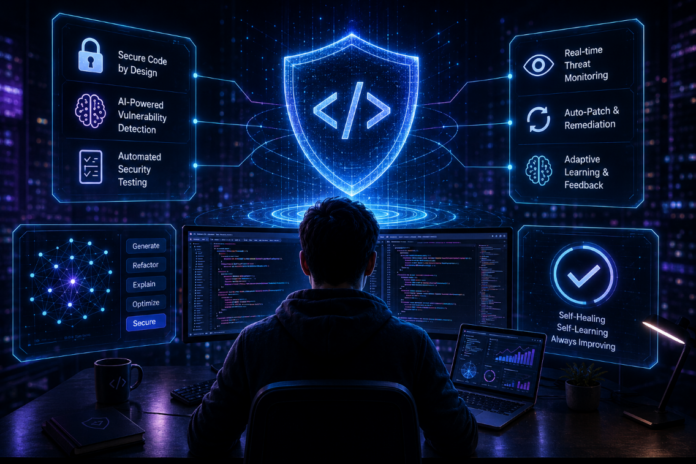
Checkmarx Developer Assist is designed to continuously evaluate code as it is created and changed. When it identifies an issue, it can remediate the problem directly within the developer’s workflow and continue working until the code satisfies the applicable security checks. At the end of the process, the developer receives a summary explaining what was found, what actions were taken, and what changed.
The key distinction is autonomy.
Self-healing across the AI coding experience
AI-native development no longer happens in a single interface. Using Developer Assist, developers write code directly in an IDE, generate and modify code through a command-line assistant such as Claude Code, or work with AI agents connected to development and security tools through the Model Context Protocol.
Developer Assist brings autonomous security into these workflows. In supported IDEs, it works within the coding experience developers already use. In Claude Code, it extends that experience into an AI-native command-line workflow, allowing security to participate as code is generated and changed through conversation and commands.
Checkmarx MCP broadens that model further. By making Checkmarx capabilities available to compatible AI assistants and agents, security can become part of the wider agentic development ecosystem rather than remaining tied to one interface or one coding tool.
The significance is not simply that developers have more ways to access a security product. It is that the same autonomous security model can follow development wherever it happens. Whether code is written directly, generated through an AI coding assistant, or modified by an agentic workflow, security can remain an active participant in the coding loop.
Why autonomy matters in the AI coding era
AI coding assistants have dramatically reduced the effort required to produce software. They can generate functions, update dependencies, create infrastructure definitions, and refactor entire sections of an application.
But code-generation speed does not automatically produce secure code.
AI-generated output may reproduce insecure patterns, select vulnerable packages, expose secrets, introduce configuration errors, or make changes without understanding the broader security context of the application. With as much as more than 80% of developers not applying AppSec as code is being created, there is a massive need for security to be an active, automated participant in the coding workflow.
Tools can no longer just help developers fix vulnerabilities, they must take responsibility for moving vulnerable code toward a secure state, addressing risk while code is still being written and context remains fresh. Findings don’t accumulate downstream. Security issues are corrected before they become tickets, pull-request blockers, or production exposures – reducing security debt and helping developers move faster.
Developer Assist handles more of the repetitive work to identify and resolve security issues and frees the developer to focus on business outcomes. This changes security from an interruption, or even a distraction, and into a capability embedded within the development experience.
It also helps address one of the most persistent sources of friction between security and engineering. Developers are not being asked to abandon their tools, move into another interface, or become experts in every vulnerability class. Security meets them inside the environments where they already work and gives them the visibility to understand what it’s doing to protect the code.
The platform makes autonomy more trustworthy
Autonomy alone is not enough. An AI system that generates a plausible-looking change without sufficient context can introduce as much risk as it removes.
For autonomous remediation to be trusted, it must be grounded in accurate detection, application context, organizational policy, and a broader understanding of risk. That is where the connection between Developer Assist and the Checkmarx One platform becomes critical.
Checkmarx One provides the security intelligence and governance layer behind the developer experience, helping ensure that autonomous actions are informed by more than a single code snippet or isolated finding. That foundation is being further strengthened through the Early Access rollout of Checkmarx Fusion, our new hybrid scanning approach combining our native AppSec engines and proprietary security with Anthropic’s leading frontier models.
This combination brings together the precision and consistency of deterministic security analysis with the broader reasoning capabilities of advanced AI models. It has produced a verified, industry-high F1 score of 0.741 – independently validated by a leading AI security and safety non-profit founded by the former head of AI Safety & Security at Google.
This matters because a useful remediation must do more than silence a warning. It should address a legitimate security issue, account for the surrounding code, align with organizational policies, and avoid creating a new problem elsewhere.
The same broader context used to identify and prioritize risk can help guide remediation earlier in development. The earlier issues are found, the faster and less costly they are to fix. Our own research estimates that the price to remediate a vulnerability increases 10x every time that vulnerability proceeds into the next stage of the software life cycle.
For security leaders, that connection provides greater confidence that autonomous actions are not occurring in isolation. They remain part of a governed security program with centralized visibility and oversight.
The objective is not uncontrolled AI making invisible changes. It is controlled autonomy: allowing security to act at machine speed while preserving transparency, policy, and accountability.
A new operating model for application security
For years, the application security industry has concentrated on improving detection. That work remains essential, but detection without action does not reduce risk.
In AI-native development, security must participate in the creation of software rather than simply inspecting the results. Tools must move from reporting problems to helping resolve them, and from waiting for human direction to autonomously completing well-defined security work.
This does not eliminate developers or security professionals. It allows both groups to operate at a higher level.
Developers can spend less time manually working through repetitive findings. Security teams can focus more attention on systemic risk, policy, architecture, and the issues that genuinely require human judgment. Application security moves from a collection of findings and handoffs toward a continuous, autonomous capability embedded in development and connected to the broader security platform.
As software creation becomes more autonomous, security must become more autonomous with it.
The organizations that make that shift will do more than find vulnerabilities faster. They will use the same AI accelerating their development to secure it, converting the force that drives risk into the strongest defense against it.
Join our LinkedIn group Information Security Community!