



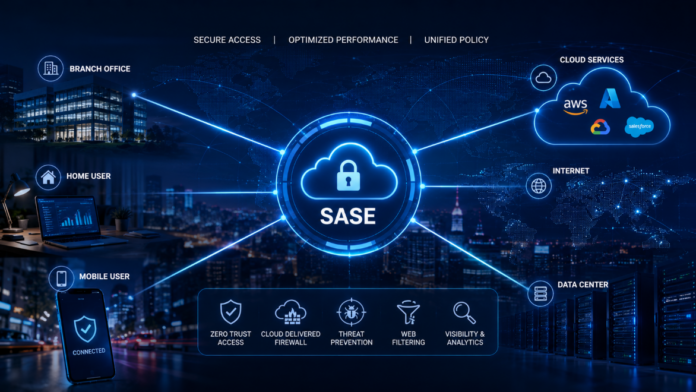
Network security has long supported networks that were distinct places – such as offices, branches, and data centers – which shaped how data flowed and how security protected it. But in today’s distributed reality, a network is basically wherever work is happening.
The new distributed networking world has turned every endpoint into its own network, and security models designed for centralized control can fracture, revealing gaps that attackers can exploit.
The Centralized Network of Yesterday
Traditionally, network security was built around control through concentration. Users, applications, and data could be consolidated in a small number of trusted locations, where IT and security teams could inspect traffic and enforce policies from the perimeter. The network had an inside and an outside, where users worked from inside offices and applications lived inside data centers. Security tools protected data from attackers on the outside. VPNs, firewalls, and other security software all emerged from this approach.
But today with cloud services, SaaS platforms, and remote work now necessary for the distributed world, traffic no longer flows through a single chokepoint. Applications have moved to the outside of the perimeter, with “inside” no longer clearly defined. Many security solutions still cling to the centralized idea of a single chokepoint, forcing distributed activity through a central control that can’t protect a network that no longer has a center.
Network Boundaries Become Infinite Edges
In today’s new distributed world, applications no longer reside in data centers with SaaS platforms – the default way for collaboration, finance, and operations. Business infrastructure now resides on the cloud as users, contractors, and third parties access systems without ever setting foot inside an office.
Infinite edges have replaced the traditional branch office, where networks stop having a fixed boundary and every user, device, and workload is now its own access point, generating traffic that moves in multifaceted, unpredictable paths to the internet, APIs, and cloud services. Traditional network boundaries have virtually dissolved.
SASE Was Designed for a Different World
Secure Access Service Edge (SASE) was created to modernize security for distributed networks, promising a unified, cloud-delivered security model. But many assumptions from early SASE architectures came from old, outdated models they were supposed to replace. They depend on redirected traffic to a centralized, limited number of cloud inspection points, often very far from where these connections originate. This approach simply moved the data center to the cloud.
Prior to today’s distributed-first environments, this made sense when remote access was the exception and traffic volume was predictable. As a result, many existing SASE models today backhaul traffic, adding latency and performance issues.
Latency Becomes a Security Risk
Latency is often related to performance issues and separate from security. But in distributed environments, the line between the two has now blurred. If security controls cause traffic to slow down, that can change user behavior. If friction becomes a problem, users will inevitably seek workarounds. They may bypass security practices and move files through unsanctioned tools or disable protection when possible. What began as a performance issue turns into a policy failure.
Forcing traffic through a centralized inspection point also amplifies this risk. This can add delay, particularly for SaaS applications and real-time services demanding low-latency connections. In today’s new distributed model, security that slows down work gets avoided.
The Cost of Forcing All Traffic Through the Cloud
Routing all traffic through a single centralized cloud inspection point may indirectly introduce complexity, albeit complexity that is harder to see until performance and reliability begin to suffer.
Backhauling traffic through inspection points can turn into bottlenecks and can cause inconsistent performance for users and applications. What might appear as centralized and clean on paper often turns into a network quagmire that impacts both performance and security resilience.
The New Threat Model with Highly Distributed Environments
When networks were centralized, location could be used to verify trust. Users inside the office or behind the firewall were essentially trusted. But in distributed environments, location has no meaning because users connect from anywhere, applications are accessed from the cloud, and traffic is routed through multiple locations.
Distributed environments now scramble the threat model. Instead of relying on where a connection comes from, security teams must now look at who is making it, under what conditions, using which device, and for what purpose. Continuous verification must be enforced in today’s new distributed model. Trust is not established just once; connections must be evaluated dynamically as conditions change and new resources are accessed.
The Distributed-First Security Approach
Modern network security understands that work, data, and users are dispersed across multiple regions, not concentrated behind a single perimeter. It knows inspection of traffic and policy enforcement must happen where traffic actually flows – at the edge, in the cloud, or right at the endpoint – rather than funneled through a single centralized point.
Locating security controls closer to users and workloads reduces latency and eliminates inefficiencies, making it easier for security teams to enforce consistent policies without sacrificing performance. Adopting a distributed-first mindset combined with identity-centric security means that access decisions are based on who or what is connected, not where they are located.
Small Teams and Limited Budgets – the Mid-Market Reality
Most mid-market organizations do not have large, dedicated security teams or unlimited budgets. Network and security can reside with a small group of generalists who already manage many other things for day-to-day operations. Complexity in this environment is unsustainable.
Network architecture that needs constant tuning and specialized expertise adds risk, since tools that are hard to deploy and operate can lead to partial implementation and enforcement inconsistency. Security must align with the available resources needed to run it.
Evaluating Distributed Security Models
When evaluating distributed security models, consider architectural assumptions more than features. Always ask where enforcement actually happens, since approaches that rely on centralized choke points often cause problems they aim to fix.
Organizations should favor effective distributed models that evaluate identity and context continuously, rather than relying on network location. Performance is also critical as well. If the architecture causes latency, it may result in workarounds that undermine security policy.
SASE Security for the Network You Actually Have
You can design security for a centralized network, but networks today are already de-centralized. Users, applications, and data are distributed, and architectures that ignore this reality fail through latency, blind spots, and inconsistent enforcement.
This is where traditional SASE breaks down. When security is built around assumptions instead of reality, protection weakens and complexity increases. When network architecture aligns with how work truly happens, security becomes simpler to use, more consistent to enforce, and stronger where it matters most. Organizations should look for modern SASE solutions that align with how their networks truly operate, delivering security where work happens, without adding friction, complexity, or compromise.
Join our LinkedIn group Information Security Community!