


What cloud threats actually look like today, why they keep slipping past mature programs and what security teams can do differently.
The operational reality of cloud security in 2026 looks different than in years prior: organizations with mature programs, real investment and deployed tooling are still getting breached. Not because their controls are wrong, but because part of the threat model has shifted in ways those controls were never designed to address. The shift we’re seeing isn’t about teams falling behind – it’s about an attack surface that has quietly outgrown the assumptions most programs were built on, and that deserves more attention than it’s currently getting.
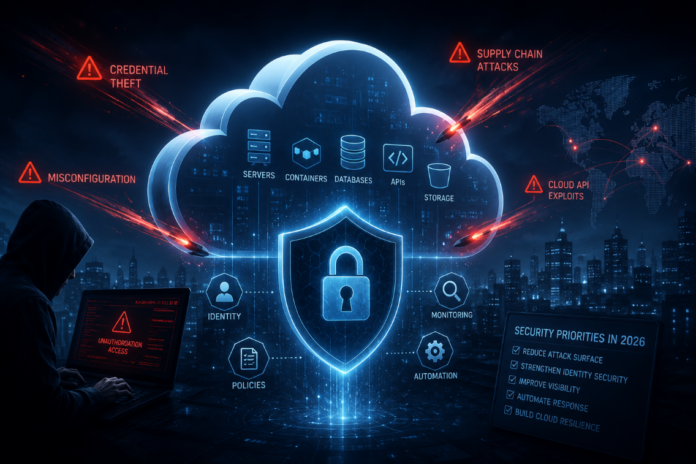
Today, modern cloud threats are organized around four categories that dominate the current incident landscape: identity and credential compromise (including human users, machine workloads and artificial intelligence (AI) agents at a scale most programs have never governed); Continuous Integration and Continuous Delivery/Deployment (CI/CD) and software supply chain attacks targeting the pipelines that carry the most privileged credentials in the environment; cloud-native living-off-the-land techniques that leave no malware behind and are invisible without behavioral baselines; and the deliberate targeting of backup and recovery infrastructure to deny organizations the ability to recover without paying.
Identity and Credential Compromise
Identity has become the primary attack surface in cloud environments – not just as an initial access mechanism, but as the means of lateral movement, privilege escalation and persistence across the entire incident lifecycle. Compromise a sufficiently privileged identity and you don’t just gain access; you gain the ability to rewrite who can access what. It becomes control-plane compromise.
Service accounts, API keys, OAuth tokens, CI/CD credentials and workload identities now significantly outnumber human users. Recent industry research by CyberArk puts the ratio around 82:1 in the average enterprise, and as high as 144:1 in cloud-native and DevOps environments according to Entro Security. AI agents add a new layer to this problem rather than replacing it. An agent operating entirely within its own legitimate permissions can be manipulated through prompt injection, tool misuse or chained actions, into taking actions a narrower, well-governed permission set would have blocked outright.
According to Veza’s 2026 State of Identity and Access Report, just 0.01% of non-human identities control 80% of all cloud permissions, making a small number of ungoverned machine accounts disproportionately powerful targets.
CI/CD and Software Supply Chain Compromise
CI/CD systems are where non-human identity risk becomes concentrated and operational. These pipelines carry some of the most privileged credentials in the environment. In most organizations, those credentials are ungoverned, unrotated and largely invisible. The tj-actions/changed-files incident of March 2025 is the clearest recent example at cloud scale. Over 23,000 repositories were potentially affected during the 15-to-24-hour window before the malicious commit was removed. Palo Alto Networks’ Unit 42 reports that SaaS supply chain attacks have increased 3.8x since 2022, accounting for 23% of all attacks in 2025.
The structural problem is always the same: the CI/CD pipeline sits at the intersection of development and cloud infrastructure, carries production-level credentials and is typically owned by neither the cloud team nor the security team. In most organizations, it’s genuinely difficult for any single team to maintain a complete inventory of what credentials the pipeline is carrying, where they’re stored, when they were last rotated or what level of access they actually provide – not because the work is being skipped, but because the pipeline spans organizational boundaries that ownership models haven’t caught up with yet.
Cloud-Native Living Off the Land
Living-off-the-land techniques aren’t new in endpoint environments. Endpoint Detection and Response (EDR) depends on an agent running on the host to observe process behavior. That agent is rarely deployed on managed and ephemeral cloud-native compute the way it would be on a traditional endpoint – short-lived containers spin up and down in seconds, serverless functions have no persistent host to install an agent on, and managed services don’t expose the underlying compute layer at all. The result is a visibility gap that has nothing to do with EDR being ineffective and everything to do with EDR simply not being present where the activity is happening. It’s not that detection failed; it’s that nothing was installed to detect anything in the first place.
This is precisely why cloud-native living-off-the-land techniques are so effective. Native automation primitives can be weaponized by an attacker with sufficient permissions, and there is often no agent anywhere nearby to observe the behavior. These actions are indistinguishable from legitimate cloud operations using standard API calls with valid credentials. They leave traces only in cloud audit logs – the same logs most subject to delivery delays, most likely to be deprioritized in cost-reduction exercises and least covered by existing detection rules.
Backup and Recovery Infrastructure Targeting
Ransomware operations have evolved from simple endpoint encryption-focused attacks to the systematic denial of an organization’s recovery capability. Sophos’ State of Ransomware in Enterprise 2025 report found that the use of backups dropped to a four-year low of 53%, down from 73% the previous year. Veeam’s ransomware data found that 96% of ransomware attacks specifically targeted backup repositories, with 76% of those attempts succeeding in compromising backups.
Backup systems, disaster recovery infrastructure and production workloads increasingly share the same cloud trust fabric – the same IAM system, the same network perimeter and the same management plane. A ransomware group that achieves cloud control-plane access can reach backup infrastructure through the same identity and permission paths they used to reach production.
What Effective Programs Are Doing Differently
The structural challenges above aren’t unsolvable. There are steps organizations should take to achieve an effective outcome:
- Redefine what counts as a crown jewel. Most asset classification frameworks focus on data and applications. In cloud environments, the assets that most warrant protection are the IAM management layer, the CI/CD secrets store, the backup management interface and the cloud provider’s root credentials. An attacker with access to any of these doesn’t just reach one asset; they can reach everything the control plane governs.
- Organizations must treat non-human identity governance as a program, not a project, and include AI agents in scope from day one.
- Build detection around attacker workflows, not compliance requirements. The ATT&CK techniques most commonly observed in cloud incidents – credential abuse, living-off-the-land execution via cloud APIs, CI/CD pipeline manipulation, lateral movement through trust relationships – are precisely the techniques with the lowest detection coverage in most SIEMs.
- Invest in behavioral baselines for cloud-native activity, and close the agent-visibility gap where it’s achievable.
- Architect recovery infrastructure outside the blast radius — and budget for it explicitly.
Cloud threats in 2026 don’t primarily defeat mature security programs through technical sophistication. They defeat them through structural gaps that no team fully owns, pipelines that carry production-level credentials with no governance, shared responsibility frameworks that define liability without defining operational accountability and telemetry decisions that quietly remove the visibility detection programs depend on.
The question for security teams and CISOs is not “Is our cloud environment secure?” It is “Does our security program reflect how cloud environments are actually attacked today?”
Join our LinkedIn group Information Security Community!