




A new chapter in automation is unfolding, one where AI agents are not just assisting humans but autonomously executing tasks, making decisions, and continuously adapting to context. These intelligent systems are transforming business workflows across industries, moving beyond static rules to deliver dynamic, situationally aware, reasoned actions. From cybersecurity and customer service to finance and operations, AI agents are shifting the paradigm from automation to autonomy.
The pace of adoption reflects their growing value. According to Gartner, 33% of enterprise software applications will include agentic AI by 2028, up from less than 1% in 2024. This rapid uptake underscores the tangible benefits AI agents bring: streamlined workflows, reduced errors, and faster, more intelligent decision-making.
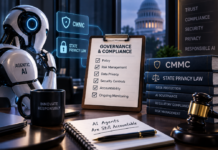
Yet as AI agents take on more critical roles, their rise introduces new challenges around governance, interoperability, and trust. Business leaders must now evaluate how to integrate these agents thoughtfully, balancing innovation with control, and autonomy with accountability.
AI agents in action
AI agents are rapidly reshaping how businesses handle repetitive and cognitively demanding tasks by taking on specialized roles that mirror human expertise. In cybersecurity, for instance, AI agents can autonomously simulate attacker behavior, validate security controls, and refine detection logic in real time. This significantly reduces alert fatigue for security operations centers, accelerates incident response, and ensures defenses remain aligned with evolving threats.
For example, AI agents can emulate lateral movement tactics used in ransomware attacks to test segmentation controls, or simulate phishing scenarios to identify gaps in email security and user awareness. By continuously learning from system telemetry, across SIEMs, EDRs, firewalls, and vulnerability scanners, these agents adapt their actions to reflect changing risk environments, closing security gaps before attackers can exploit them.
In customer service, AI agents are moving beyond basic chatbots to become intelligent problem-solvers capable of handling complex interactions. These agents analyze customer queries in context, route issues to the right teams, and even generate personalized responses. By integrating with CRM and support systems, they can resolve a large volume of tickets without human intervention, while escalating only the edge cases that require empathy or nuanced judgment. This shift not only boosts operational efficiency but also improves customer satisfaction through faster, more consistent service.
Finance and accounting teams are also benefiting from AI-driven agents. Whether it’s automating invoice processing, detecting anomalies in transactions, or reconciling accounts, these agents bring speed and accuracy to tasks that traditionally consumed hours of human effort. By leveraging natural language processing and data analysis, they can extract key information from unstructured documents, flag inconsistencies, and suggest corrective actions, enabling finance teams to focus on strategy rather than manual validation.
Moreover, AI agents are increasingly being embedded in product development workflows. From automating regression testing and monitoring deployment health to generating code snippets or documentation, these agents assist engineering teams in accelerating release cycles without sacrificing quality. In cybersecurity product teams, they can also simulate new attack techniques against dev environments, validating security features and accelerating secure coding practices. In marketing and sales, agents help personalize campaigns at scale by analyzing customer behavior, predicting engagement, and recommending next-best actions.
Across all these use cases, the common thread is a move toward context-aware autonomy, AI agents that don’t just execute commands but interpret intent, evaluate outcomes, and learn from experience. As organizations adopt these systems more broadly, the result is a shift from reactive operations to proactive, self-optimizing workflows that can scale with business needs.
Creating a foundation for innovation
AI agents represent a significant leap forward in enterprise automation. By infusing workflows with real-time intelligence and adaptive decision-making, they help businesses move from reactive processes to proactive, self-optimizing systems. The benefits, greater efficiency, accuracy, and responsiveness, are already reshaping operations and redefining roles.
However, meaningful implementation requires more than just deploying new tools. Organizations must ensure these agents align with business goals, maintain transparency, and evolve alongside changing environments. Those who approach adoption strategically will unlock not just operational gains but a foundation for innovation in an increasingly intelligent enterprise landscape.
Join our LinkedIn group Information Security Community!