



Closing the Gap Between Policy and Enforcement
When One Perimeter Became Many
Networks didn’t change overnight. Over the past decade, cloud-first strategies moved workloads to AWS, Azure, and GCP. Hybrid workforces scattered users across home offices, branch locations, and co-working spaces. DevOps teams containerized applications and deployed them at a pace the security team was never staffed to match. Each shift was the right business move. They made the organization faster, more flexible, and more competitive. They also added enforcement points that the existing firewall architecture was never designed to manage.
The next-generation firewall was engineered for a world with one perimeter. Traffic flowed through a central chokepoint. Policy was inspected and enforced in one place. That model worked. Then the environment multiplied around it. Organizations extended the same vendor’s firewall across every new environment – hardware on-prem, virtual in the cloud, containerized in Kubernetes. It looked unified on paper. In practice, each form factor runs different code, exposes different features, and requires its own console. A policy written for the data center does not automatically behave the same way in the cloud. What was manageable at three enforcement points becomes unsustainable at dozens. No security team can hold together a perimeter that has fragmented at this scale.
In a 2026 Cybersecurity Insiders survey of more than 400 cybersecurity professionals, only 7% report fully consistent firewall policies across multi-cloud, on-premises, and branch environments. Only 23% can push an emergency policy change across all enforcement points in under 30 minutes. When a breach hits and the team cannot respond in minutes, the blast radius expands, compliance attestations fail, and post-incident reporting becomes a forensic reconstruction across multiple consoles.
Volt Typhoon is what this looks like in practice. The China-affiliated actor has pre-positioned across US critical infrastructure for years, moving laterally between IT and operational technology, persisting in some victim environments for half a decade. CISA’s continuing advisories describe the kind of long-dwell, lateral movement activity that fragmented enforcement makes harder to detect, contain, and reconstruct. Architecture can determine whether teams contain this kind of lateral movement quickly or spend months reconstructing it across fragmented controls.
The question facing CISOs has shifted. It is no longer a question of whether each firewall is strong enough. It is whether the firewall architecture can hold together across a fragmented enterprise.
The architecture is what connects, manages, and orchestrates enforcement points across every form factor, and what determines whether policy stays consistent when traffic does not. Gartner has named this architecture the hybrid mesh firewall (HMF), describing it as a firewall model that delivers consistent policy across hardware, virtual, cloud-native, and cloud-delivered deployments, orchestrated from a single management plane.
Evaluating HMF platforms, and choosing one that delivers what the architecture promises, requires a clear framework. This guide provides it: what to evaluate, the right questions to ask during vendor selection, and how to build the business case for investment.
The Real Cost of Policy Fragmentation
Defenders are losing ground on two fronts at once. The environments under management keep adding enforcement points faster than security teams can integrate them. Adversaries probing those environments keep getting faster, using AI to find the gaps between consoles before SOCs can close them. Either pressure was manageable in isolation. Together, they make fragmentation untenable.
Environments Keep Multiplying
Every new cloud region, multi-cloud deployment, branch location, or containerized workload adds enforcement points to an already-stretched management model. The expansion that created the fragmentation has not slowed down — for most organizations, it is accelerating. M&A intensifies the pressure: acquire a business unit and the organization inherits a different vendor, different policies, different tools, different team and legacy credentials. Integration timelines stretch from months to years. The attackers do not wait for the integration to finish.
Each new environment also adds tooling complexity. The team adopts a new console with its own policy syntax, its own logging format, and its own integration patterns. Translation between consoles becomes routine work, and routine translation introduces drift. The organization is not just managing more enforcement points, it is managing more relationships between them, each one a place where consistent policy can quietly stop being consistent.
Adversaries at AI Speed
AI does not just give attackers speed. It gives them the ability to map an organization’s specific enforcement architecture, identify the weakest seam in it, and exploit that seam before any defender realizes which one mattered.
The asymmetry intensifies as the attack surface grows: more enforcement points, more relationships between them, more places an automated probe can find the gap. Defenders, meanwhile, are still limited by how fast a human can move between management interfaces.
How Fragmentation Fails Across the Breach Lifecycle
The most common response to this dynamic is to add a third-party firewall management overlay on top of the existing estate. The overlay does not solve the problem because it sits on top of the fragmentation rather than fixing it. Fragmented firewall estates fail in predictable ways. Drift between environments, translation gaps between form factors, sequential propagation through separate consoles, and evidence scattered across logging systems all surface in the same place — the operational moment when consistent enforcement would have mattered most.
The failures show up across the breach lifecycle: as chronic operational drag before the breach, as acute response paralysis during it, and as evidentiary and credibility damage after.
Before the Breach
Lateral movement blind spots: When firewall policies are defined independently per environment, attackers can move between cloud and on-prem through paths that exist only because the two environments enforce different rules. No single console sees the full picture.
Rule sprawl: As firewall estates grow, rulesets accumulate redundant, conflicting, and zero-hit policies that no one has time to clean up. Every rule added increases complexity. Every conflict undetected increases the chance of misconfiguration. Most teams manage this manually, and only when overstretched staff can find the bandwidth.
Application deployment drag: Nearly two-thirds of organizations, 64%, say a firewall policy change or approval process delayed the deployment of a new application or cloud workload in the past 12 months. For one in four, this happens monthly or more. The friction is not limited to developers. SaaS owners, business teams, infrastructure teams, and application teams all depend on connectivity approvals that can require manual review, translation, and implementation across multiple consoles. Security becomes the bottleneck, and teams route around it.
Talent pressure: Five consoles require five skill sets. In a market where experienced security professionals take months to hire and years to train, staffing a team to manage every console at full competency is rarely achievable in any tight talent market.
During the Breach
Policy propagation paralysis: A zero-day drops. Or the SOC detects lateral movement at 2 AM. The team needs to push an emergency policy change across every enforcement point, now. Without a shared control plane, that change propagates sequentially, console by console, environment by environment. The blast radius expands with every minute of delay.
Containment failure: When microsegmentation policies protect the data center but cannot be enforced wherever workloads actually run, containment in one environment fails to prevent propagation to another. The breach spreads into environments the containment strategy was never designed to reach.
Decision velocity loss: Containing a breach requires fast cross team agreement on where to push the policy first. But each team sees only its own slice of the incident through its own management interface.
The first hour goes to reconciling whose data shows what, instead of acting. Coordination cost is the silent multiplier on response time.
After the Breach
Forensic fragmentation: Investigating across multiple consoles with different logging formats and different query interfaces turns a four-hour investigation into a four-day investigation. Every hour spent reconciling data is an hour the attacker uses to move deeper.
Compliance exposure: Regulatory frameworks including the EU’s DORA and NIS2, alongside the US’s SEC disclosure mandates, require demonstrable policy consistency. Fragmented management makes that demonstration a weeks-long exercise, pulling senior staff into manual evidence gathering across multiple consoles.
Recovery credibility: After containment, the board wants to know if controls were in place.
Regulators want the same answer. Insurers are increasingly evaluating policy consistency at renewal. Organizations that cannot demonstrate consistent controls face more restrictive terms or coverage limitations.
HMF: One Policy, Every Firewall
The damage is clear: slower operations before a breach, slower containment during one, and unverifiable controls after one. Hybrid mesh firewall has emerged as the architectural response to this problem. The next sections walk through what makes one work, and what makes many fall short.
What It Is
The defining characteristic is the separation of enforcement from control. Firewalls protect traffic where it lives: in the data center, in the cloud, in containerized environments, at the branch. Enforcement stays distributed. The control plane is centralized — one policy model, one control plane, one operational source of truth.
HMF is not another firewall form factor or a management overlay for existing firewall sprawl. It is the architecture that allows one policy definition to be enforced consistently across hardware, virtual, cloud-native, and cloud-delivered firewalls. The goal is to reduce translation, policy drift, manual reconciliation, and uncertainty during an incident. Only 5% of organizations today say a firewall policy written for one environment behaves identically in another without manual adjustment. For 58%, policies require significant rewriting or depend on entirely different frameworks across environments.
Why Now
CISOs have heard about unified firewall management before. What changed is that the platforms now exist to deliver on what was previously a promise. Gartner’s inaugural Magic Quadrant for HMF1, published in August 2025, evaluated vendors against specific architectural criteria for the first time. HPE is among the vendors recognized in the inaugural MQ, with an architectural foundation comprising the single Junos codebase and unified HPE Networking Security Director orchestration. HMF is now an actionable architectural decision with established evaluation criteria and a growing body of independent testing data.
The threat landscape adds urgency. AI gives attackers tools to find policy gaps faster than fragmented teams can close them, which makes the unified control plane no longer optional but an operational necessity.
HMF Before, During, and After the Breach
Before the breach, HMF gives the team one place to write policy and a consistent mechanism for enforcing it across supported form factors. The compliance baseline becomes provable on demand instead of reconstructed under pressure.
During the breach, HMF turns global policy propagation into a single action. One change reaches connected enforcement points through a single workflow. Consistent microsegmentation across all form factors holds the blast radius to its starting zone. The hour-long scramble between consoles becomes a single operation that takes minutes.
After the breach, the investigation starts from a single console with unified flow data, turning a multi-day forensic exercise into a matter of hours. The compliance attestation that takes weeks under fragmented management becomes a straightforward evidence pull, because policy was consistent and provably enforced across all environments.
Six Requirements for Any HMF Platform
Every vendor in the hybrid mesh firewall market claims centralized management and distributed enforcement. The claims sound similar but the architectures behind them are not. That difference matters.
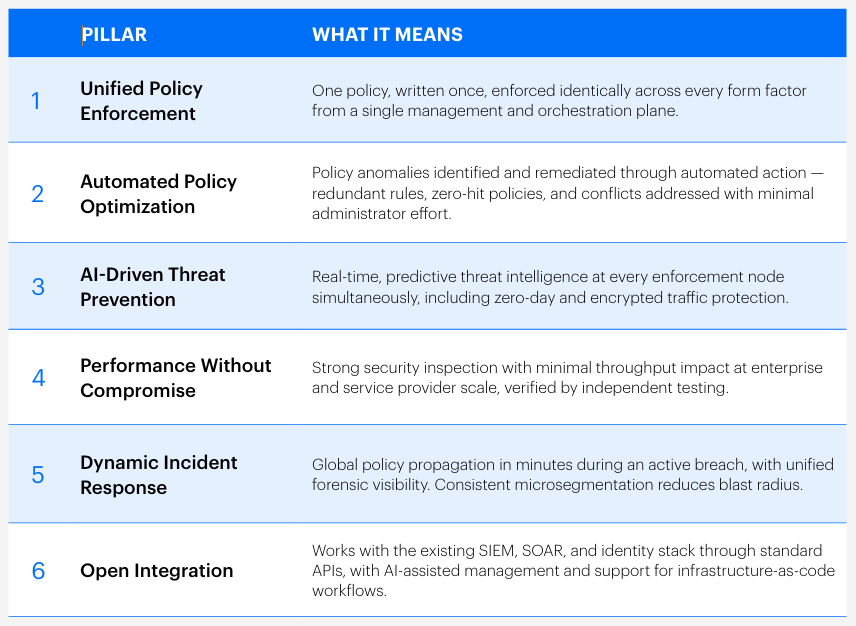
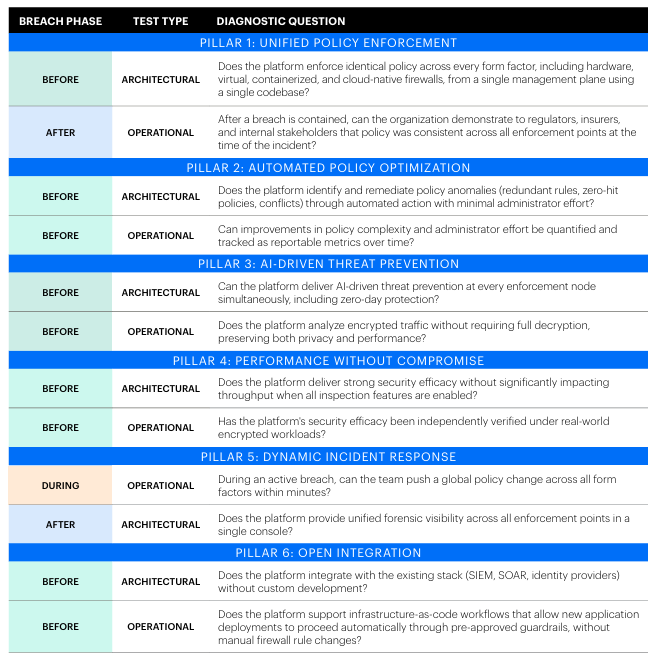
The following six pillars define what CISOs should demand from any HMF platform. They are vendor neutral: they describe capabilities, not products. Each pillar translates into a pair of diagnostic questions for scoring any platform or the current architecture – presented in the Appendix.
Twelve Questions Every CISO Should Ask
CISOs do not need another list of firewall features. They need a practical way to test whether an HMF platform can actually deliver consistent enforcement across fragmented environments. The twelve diagnostic questions in this guide translate the six HMF pillars into vendor evaluation criteria. Each pillar includes one architectural test and one operational test, giving security leaders a fast way to assess the current estate, pressure-test vendor claims, and identify where policy fragmentation still creates risk. Most organizations have not reached that level of clarity. Sixty-two percent either have not formally assessed firewall policy consistency or lack the visibility to do so. These questions turn that blind spot into a structured assessment.
The full twelve-question diagnostic appears in Appendix A. Pillars 1 and 5 are previewed below because they test the two failure points that matter most during an incident: whether policy is consistent before the breach, and whether containment can move fast enough once the breach is underway.
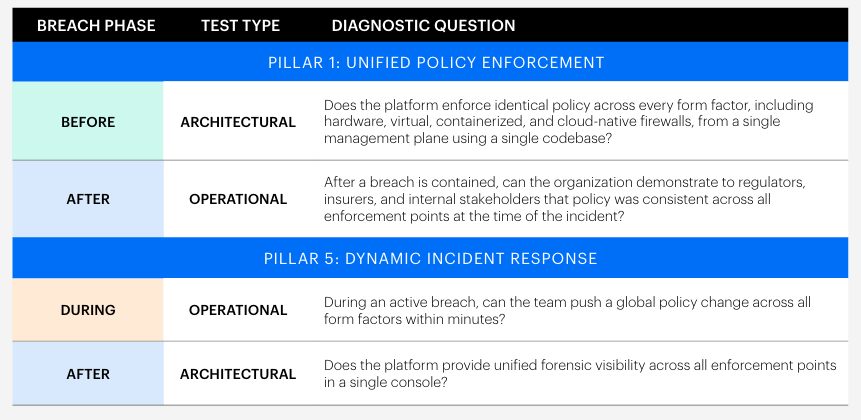
Use the full twelve-question diagnostic in Appendix A for vendor meetings, RFP scoring, and current-state assessment.
How to Use the HMF Diagnostic
Use the diagnostic process in three steps.
STEP 1: Score the six pillars
Start with Pillar 1, Unified Policy Enforcement, and work forward through the full diagnostic. For each pillar, answer both questions honestly: one tests the architecture, the other tests real world execution.
STEP 2: Find the first critical gap
The first pillar where the organization cannot answer both questions favorably is the priority area. Unified policy enforcement matters most because every later capability depends on it. Without consistent policy, automation has nothing reliable to optimize, threat prevention operates in silos, and incident response returns to console-by-console coordination.
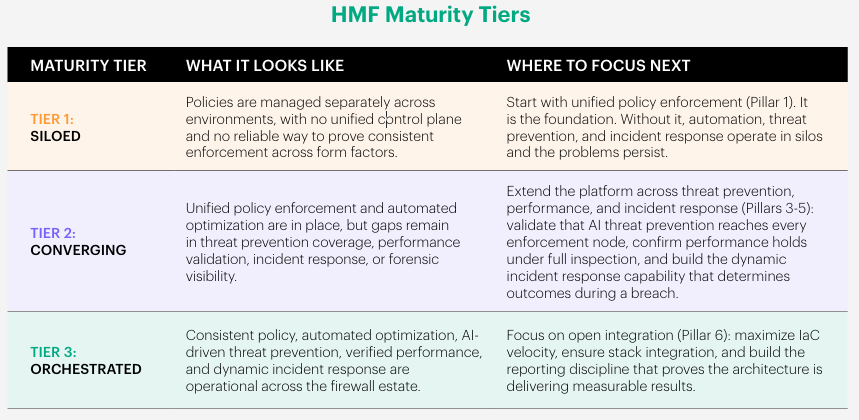
STEP 3: Use the HMF maturity tier as the roadmap
Most organizations show uneven maturity. They may be strong in threat prevention, performance, or integration while still weak in unified policy. The maturity tier should therefore be set by the weakest critical pillar, because that weakness determines how well the architecture performs under pressure.
How HPE Networking Delivers
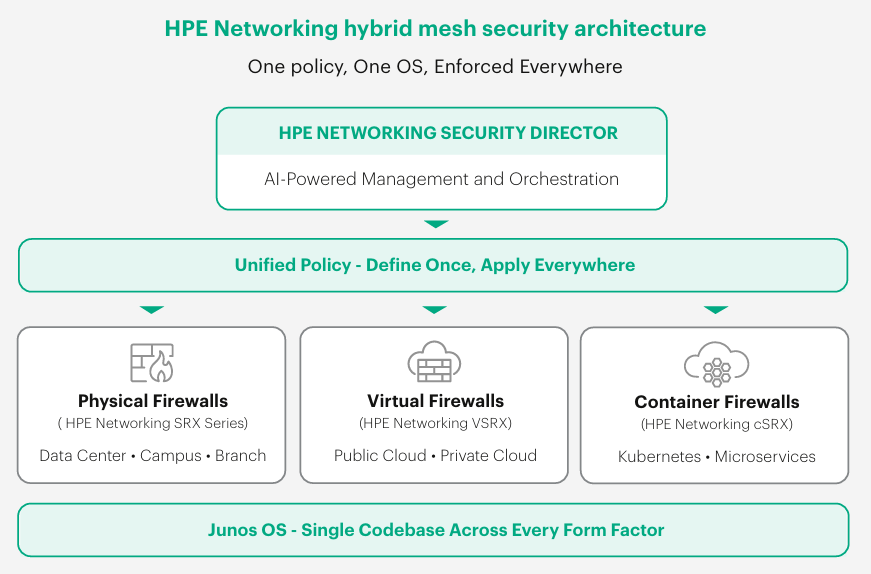
HPE Networking addresses HMF as an architecture, not as a management layer added on top of firewall sprawl. Its foundation: a common operating model across HPE Networking SRX firewalls, centralized orchestration through HPE Networking Security Director, AI-driven threat prevention, automated policy optimization, and verified performance under inspection. Policy stays consistent, enforceable, and auditable across hybrid, multicloud, and branch environments.
This architecture is supported by third-party validation across multiple dimensions: Gartner’s Magic Quadrant for Hybrid Mesh Firewall1, GigaOm for enterprise firewall platform leadership, and NSS Labs testing (published by CyberRatings.org) for SRX security efficacy and performance.
PILLAR 1 : Unified Policy Enforcement
The requirement: Can the platform enforce identical policy across every form factor from a single codebase and a single management plane?
How HPE delivers: Junos OS runs the same code across all SRX form factors. HPE Networking Security Director is the centralized orchestration plane for policy management and visibility across every enforcement point. Because every form factor runs the same OS and the same policy, the organization can demonstrate to regulators, insurers, and internal stakeholders that controls were consistent at the time of an incident.
Why it matters: Rules behave the same way everywhere, policies stay consistent over time, and the organization can prove it to regulators after an incident.
PILLAR 2: Automated Policy Optimization
The requirement: Does the platform actively remediate policy anomalies and reduce administrative effort, with improvements tracked as a reportable metric?
How HPE delivers: HPE Networking Security Director’s firewall policy optimization capability identifies policy anomalies that cause firewalls to operate inefficiently – including redundant rules, zero-hit policies, and rule conflicts. Administrators can remediate these anomalies with a single click, and automation ensures that new rules do not introduce additional anomalies. An AI assistant provides guidance to minimize misconfigurations and reduce the effort required to create and manage firewall rules.
Why it matters: Policy complexity drops, firewall performance improves, misconfiguration risk falls, and the time and effort required for administrators to manage and maintain policies is significantly reduced.
PILLAR 3: AI- Driven Threat Prevention
The requirement: Can the platform deliver AI-driven threat prevention at every enforcement node, including zero-day protection and encrypted traffic analysis without full decryption?
How HPE delivers: HPE Threat Labs delivers real-time threat feeds directly to every SRX enforcement point. A local inference model on the SRX itself makes immediate, in-line security decisions without relying on cloud latency, generating signatures for emerging threats and detecting new zero-day threats before signatures are available. Encrypted traffic is analyzed for suspicious behavior without decrypting user data, preserving payload privacy.
Why it matters: Lateral movement blind spots and containment failures exist partly because threats move faster than fragmented defenses can detect them. HPE applies AI across threat intelligence, enforcement, policy automation, and management workflows, helping the architecture detect and block threats consistently across enforcement points.
PILLAR 4: Performance Without Compromise
The requirement: Does the platform deliver strong security efficacy without significantly impacting throughput when all inspection features are enabled?
How HPE delivers: In testing conducted by NSS Labs and published by CyberRatings.org (2025 Enterprise Firewall evaluation), SRX achieved a 99.16% security effectiveness when tested across 3,326 exploits with zero false positives, all inspection features enabled. The result was independently verified under real-world encrypted traffic conditions. The HPE Networking SRX400 series extends this performance to branch and campus. Connected Security Distributed Services (CSDS) lets organizations add firewall capacity to the pool in minutes without redesigning the existing deployment.
Why it matters: Security teams stop choosing between protection and performance. The architecture delivers both, verified by independent testing under real-world encrypted workloads.
PILLAR 5: Dynamic Incident Response
The requirement: During an active breach, can the team push a global policy change across all form factors within minutes, with unified forensic visibility in a single console?
How HPE delivers: A single policy change through HPE Networking Security Director propagates to every SRX enforcement point in one action. No sequential console-hopping. The AI-powered dashboard provides real-time, contextualized visibility across all enforcement points. Microsegmentation policies follow workloads as they move, enforcing zero-trust controls consistently across data center, cloud, and branch.
Why it matters: When containment slows, the blast radius expands. With unified policy propagation, containment takes minutes. Consistent microsegmentation reduces the blast radius wherever workloads run. Unified flow data turns multi-console forensic exercises into single-pane analysis.
PILLAR 6: Open Integration
The requirement: Does the platform integrate with the existing stack (SIEM, SOAR, identity) through standard APIs and support infrastructure-as-code workflows without custom development?
How HPE delivers: SRX integrates with leading SIEM, SOAR, and identity platforms through standard APIs, without custom development. Policy changes are designed for IaC workflows, allowing DevOps teams to deploy automatically using pre-approved guardrails instead of manual approvals. HPE Networking Security Director’s AI-powered chatbot lets operators provision firewalls, translate policies, and verify consistency in natural language.
Why it matters: The existing security stack works with HMF rather than around it. The AI assistant reduces dependence on specialized console-by-console expertise.
How to Pressure-Test Any HMF Architecture
Every HMF vendor claims unified policy and distributed enforcement. Strong evaluation should look past the claim and test whether the architecture avoids the shortcuts that recreate fragmentation under a different name. The gaps surface in the same places: form-factor parity, performance under inspection, propagation under pressure, and what happens when marketing terminology meets procurement evaluation.
Five architectural shortcuts recur across the market:
- The translation layer: Different code on different form factors, with a translation engine rewriting policies between hardware, virtual, and cloud-native firewalls. Looks unified in the console. Introduces parity gaps and latency at exactly the moments that matter most: emergency policy propagation, cross environment micro segmentation, and post incident attestation.
- The single OS that cannot run hot: A common operating system across form factors, but full throughput requires disabling TLS inspection, IPS, or threat prevention. Performance benchmarks ship with security features off. The CISO is forced to choose between protection and throughput, then expected to defend that trade-off to auditors.
- Recommendation-only optimization: Rule cleanup tools that flag redundant, conflicting, and zero-hit policies but stop at the recommendation. Cleanup still requires manual follow-through across consoles. The platform automates the diagnosis, not the cure.
- Centralized management without propagation proof: A single console claims global policy push, but the vendor cannot demonstrate, with timestamps, how fast a policy change reaches every enforcement point or how the platform verifies it took effect. During an active incident, “global” turns out to mean sequential.
- Form-factor sprawl under one brand: Multiple firewall lines under the same logo, running different code, exposing different features, and supporting different policy constructs. The shared brand creates the appearance of architectural unity. The shared codebase does not exist.
HPE Networking is architected to avoid these shortcuts. Junos OS runs as a single codebase across SRX form factors. HPE Networking Security Director enables centralized policy orchestration across enforcement points. The SRX policy optimizer automates rule resolution, not just detection. Performance has been independently verified with inspection features enabled. The practical test for any vendor is direct: can it prove that policy is consistent, propagation is verified, optimization is actionable, and performance holds under real inspection?
That answer determines whether the architecture is real or aspirational.
Why HPE’s HMF Approach Extends Beyond Firewall Consolidation
HPE’s HMF position is strengthened by the broader networking and security platform around it. HPE Networking brings HMF into an integrated portfolio spanning campus, branch, WAN, data center, and cloud. That matters because firewall modernization rarely happens in isolation. It intersects with network refresh cycles, cloud expansion, branch transformation, and operational consolidation.
The HPE advantage is not only the HPE Networking SRX Firewall portfolio. It is the combination of a common enforcement architecture, centralized orchestration, AI-assisted operations, global support capacity, and long-term enterprise platform investment.
Proving It Worked: The Board-Ready Scorecard
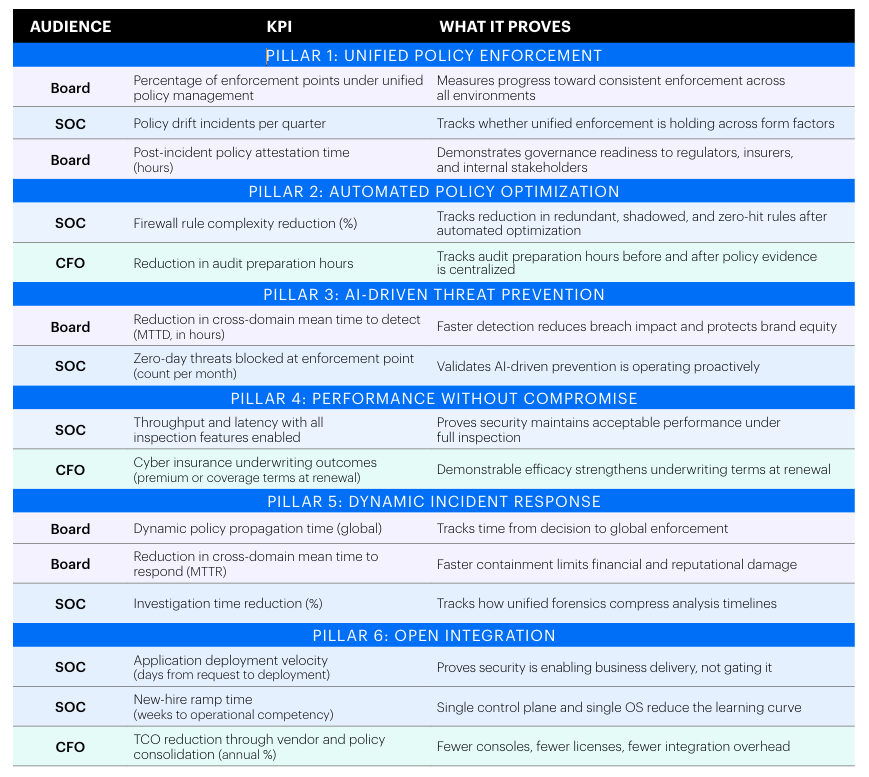
HPE’s answers to the twelve questions are only as strong as the results they produce in the organization’s environment. The KPIs below are how policy enforcement becomes auditable – measurable evidence that the architecture is delivering, tagged by the audience that needs to see it: the board, the CFO, or the SOC.
What Comes Next
Only 7% of organizations report fully consistent firewall policies today. Closing that gap requires more than stronger individual firewalls. It requires an architecture that can define, enforce, verify, and measure policy consistently across the environments where traffic runs.
Pick three KPIs from the scorecard, one for each audience, and start tracking them before deployment. The baseline captured today becomes the proof of progress six months from now.
NEXT STEP: Identify where the current architecture fragments, where consolidation should begin, and which KPIs will prove progress over time.
To see how HPE Networking delivers against the six HMF pillars in your environment, reach out for a customized HMF assessment. Learn more
Appendix A: HMF Diagnostic Questions
Use these questions to assess the current firewall architecture or pressure-test vendor claims during an RFP, workshop, or executive briefing. A strong HMF platform should answer each question clearly, with architectural proof, operational evidence, and measurable outcomes.
Appendix B: HMF Evaluation Scorecard
The scorecard below summarizes how HPE Networking maps to the six HMF requirements. Use it as a compact reference for evaluation teams comparing HMF platforms, preparing executive briefings, or aligning technical requirements with procurement criteria.
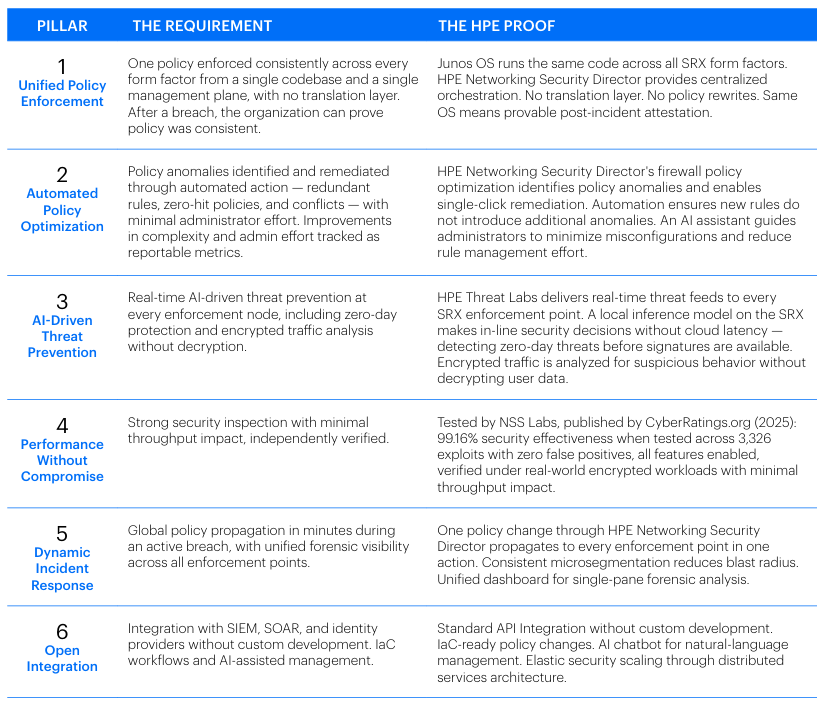
The strongest HMF platforms do more than centralized management. They reduce translation, drift, delay, and evidence gaps across the firewall estate. For evaluation teams, the practical test is simple: can the vendor prove that one policy can be defined, enforced, verified, optimized, and measured consistently across every enforcement point? That is the standard HPE Networking should be evaluated against.
Sources ¹ Gartner, Magic Quadrant for Hybrid Mesh Firewall, Rajpreet Kaur, Adam Hils, Charanpal Bhogal, Esraa ElTahawy, Feng Gao, Tiffany Taylor, 25 August 2025. Gartner does not endorse any vendor, product or service depicted in its research publications, and does not advise technology users to select only those vendors with the highest ratings or other designation. Gartner research publications consist of the opinions of Gartner’s research organization and should not be construed as statements of fact. Gartner disclaims all warranties, expressed or implied, with respect to this research, including any warranties of merchantability or fitness for a particular purpose. GARTNER is a registered trademark and service mark of Gartner, Inc. and/or its affiliates in the U.S. and internationally and is used herein with permission. All rights reserved.
Join our LinkedIn group Information Security Community!