




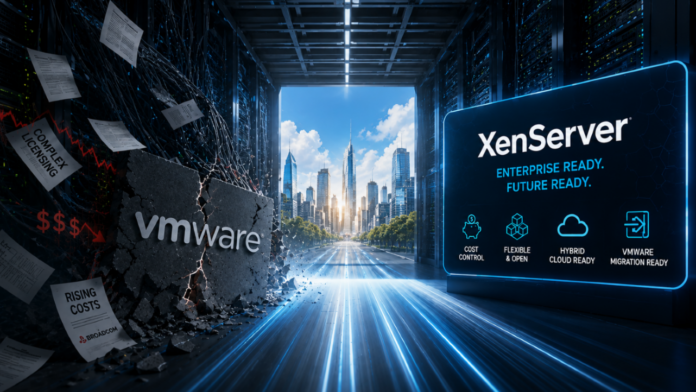
XenServer has quietly re-emerged as one of the most discussed alternatives in enterprise virtualisation circles, especially among organisations looking to reduce hypervisor costs without rebuilding their entire infrastructure stack. This is according to Troye managing director Helen Kruger.
What was once provided as a complimentary entitlement to Citrix desktop and application virtualisation deployments, is now being aggressively repositioned as a serious VMware replacement at the exact moment enterprises are questioning whether VMware’s new commercial model is financially sustainable. The result is a growing shift in the virtualisation market that few industry analysts predicted only two years ago.
“For more than a decade, VMware dominated enterprise virtualisation so completely that many organisations stopped evaluating alternatives altogether. Virtualisation became synonymous with VMware. But Broadcom’s acquisition fundamentally changed the conversation,” she explains.
The issue is no longer purely technical, it’s commercial.
Since the acquisition, enterprises worldwide have raised concerns around rising subscription costs, forced bundling strategies, licensing complexity, and long-term vendor dependency. Many organisations that once standardised exclusively on VMware are now reassessing their infrastructure strategy for the first time in years.
This is where Citrix and XenServer have found an unexpected opportunity. Rather than positioning XenServer purely as a supporting platform for virtual desktops, Citrix is now actively presenting it as a broader enterprise virtualisation platform capable of supporting mixed workloads, hybrid cloud environments, and modern infrastructure requirements.
Recent XenServer 8.4 announcements place significant emphasis on scalability, simplified management, enterprise workload support, and VMware migration readiness.
Kruger says the strategic timing is important. “Enterprises are no longer choosing hypervisors solely based on features. They are evaluating operational control, licensing predictability, cloud portability, AI readiness, and total infrastructure economics. That shift changes the market dramatically.”
According to multiple 2025 and 2026 infrastructure market analyses referencing Gartner aligned enterprise virtualisation trends, organisations are increasingly pursuing multi hypervisor strategies to reduce commercial risk and avoid dependence on a single infrastructure vendor.
This is precisely the environment where XenServer is regaining relevance. Unlike many newer VMware alternatives, XenServer benefits from years of enterprise maturity. The Xen based architecture has a long operational history, particularly in large scale Citrix deployments, cloud environments, and service provider infrastructures.
Citrix is now leveraging that maturity while simplifying migration pathways for VMware customers looking for alternatives that do not require a complete redesign of existing virtual machine environments.
Citrix is also simplifying migration through its Conversion Manager virtual appliance, which enables organisations to transform VMware ESXi and vCenter virtual machines to XenServer quickly and efficiently. By supporting the parallel migration of multiple virtual machines, organisations can significantly reduce migration timelines while minimising operational disruption.
“For organisations already invested in Citrix ecosystems, the financial logic becomes even more compelling,” she adds.
Historically, many enterprises ran Citrix workloads on top of VMware infrastructure, effectively layering one licensing model onto another. XenServer now offers an opportunity to consolidate infrastructure under a more tightly integrated platform while significantly reducing hypervisor related expenditure.
Several 2025 and 2026 industry reports now position XenServer among the leading VMware alternatives for enterprises focused on reducing virtualisation costs while maintaining enterprise grade functionality. But the bigger story extends beyond licensing costs.
The entire infrastructure market is changing. Modern enterprise environments increasingly combine virtual machines, Kubernetes platforms, AI workloads, containers, edge infrastructure, hybrid cloud services, and high-performance storage into unified operational environments. That weakens the historical assumption that a single hypervisor vendor should dominate the entire infrastructure stack.
Citrix appears to understand this shift. The company’s messaging around XenServer increasingly focuses on flexibility, operational efficiency, hybrid cloud readiness, and infrastructure simplification rather than attempting to compete with VMware feature for feature.
“That does not mean VMware disappears. VMware still maintains enormous enterprise market share, strong ecosystem maturity, and deep operational familiarity across IT teams globally,” Kruger concludes.
However, the psychological shift has already happened. For the first time in years, enterprises are openly questioning whether VMware remains worth the premium. And once enterprise customers begin questioning the default platform, the infrastructure market changes very quickly indeed.
Troye has extensive experience in virtualisation and partners with leading hypervisor platforms, including VMware, Nutanix AHV, and Citrix XenServer. This vendor agnostic approach enables it to assess requirements objectively and recommend the hypervisor solution that is best suited to any business needs.
______
More about Troye
Troye is a South African IT solutions and managed services provider specialising in secure digital workspaces, hybrid cloud, and modern IT infrastructure. Since 1998, it has helped organisations simplify IT environments, enhance user experience, and enable secure, high-performance operations across distributed workplaces.
The company delivers end to end solutions across digital workspace, virtualisation, cloud and hybrid infrastructure, networking, cybersecurity, data protection, and managed services, including design, implementation, support, and disaster recovery.
Through partnerships with leading vendors such as Citrix, Microsoft, Nutanix, VMware, Veeam, NetScaler, HPE Aruba, Arctic Wolf, and Check Point, Troye delivers tailored, vendor agnostic solutions backed by deep technical expertise and ongoing managed services.
Troye, a black empowered company, supports organisations globally in driving digital transformation, improving productivity, strengthening security, and optimising IT investments.
Join our LinkedIn group Information Security Community!