

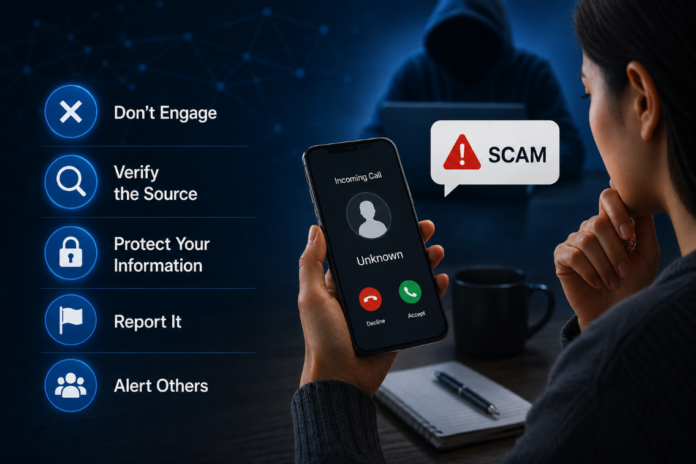
Spam calls, phishing texts, and elaborate scams arrive on our phones daily. For many people, the moment of panic that follows is matched only by confusion: What should I do right now? Who do I report this to? Will my report actually matter?
The Scale of the Problem
Undoubtedly, the threat landscape has transformed dramatically. Scammers are no longer bombarding random phone numbers; instead, they target you specifically. They now possess real personal information such as your name, your address, and even your financial details. They know enough about you to make their pitch believable.
Consider this:
- 31% of American adults report getting at least one scam call per day, with 21% receiving several scam calls daily (Pew Research Center)
- Consumer fraud losses totaled $15.9 billion in 2025 (FTC)
- Text scam losses reached $639 million in 2025 (MOAA)
- Imposter scams alone cost Americans a record $3.5 billion in 2025 (FTC)
These numbers make one thing clear: scams are no longer a background nuisance but a targeted, data‑driven threat that demands a new approach to protecting yourself.
Why the Threat Has Changed
For consumers, this shift means the old rules no longer apply, and neither do the old forms of protection. When scammers move from random targeting to personalized attacks, it’s because they’ve already done their homework. They’ve gathered details about you before they ever make contact, and that preparation changes the entire dynamic.
If You’ve Made a Mistake
If you picked up a scam call, answered a phishing text, or fell for an imposter scam, know this: Your mistakes don’t have to be permanent.
Victims often feel locked in. Those targeted by romance scams wonder if it’s too late. Those who responded to a phishing attempt fear the damage is done. But the truth is different. Your next action matters more than the moment you picked up the phone.
Why Your Report Matters
The data you provide when reporting a scam call or suspicious text is not lost in a void. When enough people report the same number or pattern, it creates a signal that reaches:
- National Spam Call Reporting Center
- Your carrier and other wireless companies
- Federal regulators including the FTC and FCC
- Law enforcement agencies that can take action against the operation
Real intelligence about real threats gets compiled, analyzed, and acted upon. The more data available, the more enforcement agencies can do. They can shut down operations, warn other consumers, and identify accomplices. When you report, you are not shouting into the void. You are feeding a system designed to protect everyone.
The Confusion Problem
But there is friction in the system. Currently, consumers face genuine uncertainty about where to report. Do you call your bank? Do you contact your carrier? Do you report to law enforcement, and if so, which agency? This confusion itself is a problem. Scammers count on this disorientation. They know that most people, after hanging up, will not go through the effort to report what happened. The burden falls on consumers, and the result is silence that protects the criminals.
What the system needs is clarity and centralization. Consumers need one clear place to report scam calls and suspicious texts, a single point of entry that removes the guesswork. That place does not need to be about promoting a product. It is fundamentally about solving a consumer problem. It is about taking the confusion out of the equation and making it easy for people to participate in their own defense and the defense of others.
What You Can Do
Beyond reporting, there are practical tools available to prevent ongoing harassment:
- Block numbers and prevent harassing voicemails. When scammers can’t reach you, they move on to the next target.
- Use out-of-service messaging. Let callers think you’ve changed your number, removing yourself from their target lists.
- Report the attempt. Add to the collective intelligence that helps protect your community.
If you have already interacted with a scammer, you may find yourself on their list. Your number gets recycled. The calls keep coming. Control becomes crucial. When you block numbers and they receive an out-of-service message, to them it appears you have changed your number. To you, it is a way to escape their contact list. For people dealing with persistent harassment or stalking, this kind of control provides genuine peace of mind and a measure of real recourse.
The Path Forward
When you receive a scam call, you have choices. Report it. Your report will matter. The infrastructure you are helping to build will protect others. And if you have already fallen for a scam, or if you are being repeatedly harassed, there are ways forward. The key is taking action, whatever that action may be.
The psychological burden of being targeted by scammers is real. But that burden is reduced when you know you are not alone, when you understand that your report is part of a larger system, and when you have practical options to take back control of your phone.
The next time you receive that unmistakable call from someone claiming to be from your bank, or a threatening message about your account, or a person on the other end playing a role they have perfected through countless attempts, you will know what to do. Report it. Make it count. Take back your phone.
Join our LinkedIn group Information Security Community!