



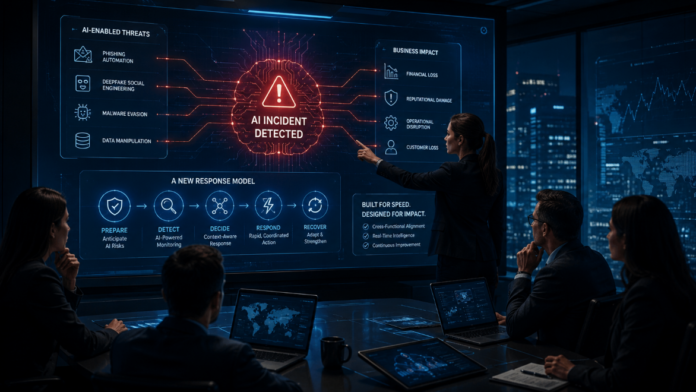
Over the past decade, cybersecurity threats have evolved from a technical issue into a key driver of business and operational risk. Artificial intelligence is accelerating that shift even further, changing the game once again. In 2026, AI in cybersecurity is multifaceted: a tool for defense and incident response, but also a powerful accelerator for attackers.
AI-enabled incidents rarely stay contained within the security function. A deepfake of a senior executive, a synthetic identity scam, a misinformation campaign, or an attack involving manipulated AI tools can quickly create legal, reputational, operational, and financial consequences.
Once again, business leaders need to adjust accordingly, and boards need to rapidly get up to speed on this new AI-enabled risk landscape because organizations need more than a technical response. They need coordinated crisis management across cybersecurity, legal, communications, risk, and executive leadership.
Understand the AI-enabled attack landscape
First, it’s important for business leaders to understand today’s AI attack landscape, including emerging AI-enabled cyberattacks that are gaining traction.
In July, a security researcher documented the first case of fully agentic ransomware – an end-to-end extortion attack driven entirely by a large language model (LLM). The preceding months appeared to foreshadow this development, as merging agentic LLM capabilities have repeatedly been reported to have helped threat actors automate stages of cyberattacks and scale their operations. Nation-state-sponsored actors, as well as actors with other origins and motives, have been observed manipulating LLMs to execute entire attacks: scouting targets, identifying weak spots, breaking in, stealing credentials, moving deeper into networks, and exfiltrating sensitive data.
Other risks come from an organization’s own AI environment and usage. Enterprise AI tools, development platforms, and workflows can expand the attack surface. Threat actors may use prompt injection, malicious files, or compromised AI services to manipulate a system’s behavior, leak sensitive information, or misuse connected tools. This creates new questions for security teams, as well as for legal, compliance, procurement, and business leaders responsible for how AI is deployed.
AI-enhanced phishing and social engineering present another fast-growing challenge. Attackers can study a target’s public presence, writing style, or communication patterns, then generate messages that sound authentic. They can respond in real time, maintain the momentum of a scam, and make impersonation far more convincing. Deepfakes add another layer of risk by making fake audio or video appear legitimate enough to deceive employees, customers, partners, journalists, or investors.
Employees are not only the targets of AI-enabled attacks. AI has created internal security and reputational risks when employees use it as a business enabler, including hallucinations in work product, disciplinary action in regulated industries, and data destruction by AI agents.
These threats may differ technically, but they create a common business problem: they make it harder to determine what is real, who can be trusted, and how quickly an organization can respond.
Shift the conversation from technology to business impact
For boards and executives, the most productive conversations about AI-enabled threats should focus less on how the technology works and more on what the AI-enabled threat landscape means for the company’s business. The reputational, operational, and financial impacts of a cyber attack are evolving and heightening, and business leaders should enable their organizations to meet this rapidly evolving risk.
From an enterprise risk perspective, AI can compress detection and response windows. Attacks may move faster, reach more targets, and overwhelm traditional controls. Internal AI systems may also introduce new vulnerabilities, including prompt injection, data poisoning, model theft, or adversarial inputs that produce harmful outputs.
From a legal and regulatory perspective, leaders need to demonstrate active oversight of AI risk as part of enterprise risk management. AI usage policies and employee education are useful, but they’re not enough on their own. Directors and executives should be able to show how the organization governs AI use, monitors emerging risks, and responds when an AI-related incident creates potential liability, disclosure obligations, or regulatory scrutiny.
From a reputation perspective, AI-enabled incidents can move at the speed of public opinion. A fake CEO video, fraudulent voice authorization, or viral misinformation campaign can trigger media attention, customer concern, and stakeholder confusion before the organization has a full picture of what happened.
This is why AI crisis readiness cannot live within cybersecurity alone. The response must connect technical validation, legal decision-making, and communications strategy from the start.
Make AI crisis response cross-functional
To prepare, organizations should update incident response plans and crisis playbooks around realistic AI scenarios, including deepfakes, voice cloning, synthetic content, prompt injection, and misinformation campaigns. These exercises should bring cybersecurity, legal, communications, risk, compliance, and executive leadership into the same room to pressure-test how quickly teams can verify an incident, preserve evidence, and decide what to say publicly.
Organizations should also test their preparedness and resilience through multiple methods, including tabletop exercises, full-scale crisis simulations, and disaster recovery exercises with measurable data points (e.g., RTO, RPO).
Leaders should also identify the outside experts they may need on short notice, including legal counsel, digital forensics teams, communications advisors, and platform escalation contacts. AI-driven attacks make incident response and forensic investigations significantly harder because they increase the speed, scale, adaptability, and stealth of malicious activity. Businesses should ensure their response team has the capability to address these challenges.
Minutes matter when fake or stolen content starts spreading, so organizations should prepare legal templates, takedown workflows, holding statements, escalation paths, and monitoring systems before an incident begins.
Employee training, policies, and guidance also need careful consideration. Organizations should require regular training on AI-enabled social engineering, apply secure-by-design principles to internal AI tools, third-party generative AI platforms, and embedded models; and provide robust operational guidance on appropriate AI usage.
The goal is to avoid building the response during the crisis. When AI-enabled incidents move quickly, companies need the people, processes, and decision paths already in place.
The organizations that prepare early will move faster when it matters
The organizations that prepare now will have an advantage. They’ll know who needs to be in the room, what evidence needs to be preserved, how decisions will be made, and how stakeholders will be informed. That preparation can help them respond faster, reduce confusion, and protect trust when an AI-driven crisis unfolds.
Ultimately, AI has changed the speed and scale of cyber risk. It’s up to business leaders to change the response model with it.
Join our LinkedIn group Information Security Community!