




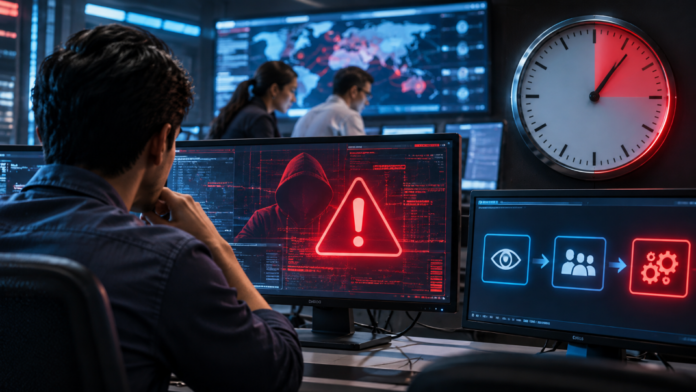
Picture the moment an intrusion becomes real. An analyst confirms the alert is malicious. The evidence is on the screen, and several people on the team see it. Then the room slows down. One analyst keeps hunting for another indicator. Another waits for a lead to weigh in. Nobody is sure whether isolating the host or disabling the account is their call to make.
That pause, between knowing something is wrong and acting on it, is one of the least examined stretches of time in security operations. It is also one of the most expensive.
Attackers do not wait for the pause to end, though. In its 2026 Global Incident Response Report, Palo Alto Networks Unit 42 found that the fastest quarter of the intrusions it investigated reached data exfiltration within 72 minutes of initial access, down from 285 minutes the year before. Unit 42 links that acceleration to attackers making greater use of AI and automation. Against that timeline, fast detection is necessary but not sufficient. A team that spots an intrusion quickly and then spends the next hour deciding what to do has gained little.
Where the time goes
Anonymized data from more than 600 timed, simulated incident response exercises shows how large that pause gets. Across exercises run by security operations center (SOC) teams from dozens of organizations between January 2025 and June 2026, the median interval between a team first detecting the attack and taking its first response action was 71 minutes. That is longer than the median time to detect the attack in the first place, which was 62 minutes across the full set of timed exercises. Once a team committed to a response, mitigation followed comparatively quickly.
Simulated exercises and real intrusions run on different clocks, so these figures do not compare directly with the Unit 42 numbers, and the data shows a pattern rather than a cause. Still, the pattern is hard to ignore, especially alongside a second finding from the same exercises. Individual analysts who re-practiced a scenario got faster, with median time to first detection falling from 48 to 37 minutes. The detection-to-response gap, however, did not narrow as teams logged more exercises. Practice made individuals sharper. On its own, it did not make teams quicker to act.
That points away from skills and toward coordination. In my experience, the stall rarely comes from teams who do not know what they can or should do. It comes from three kinds of friction that technical training does not touch.
- Nobody owns the next move. Everyone sees the problem, so everyone assumes someone else is driving. Without a named lead, the decision belongs to no one.
- Nobody knows how much evidence is enough. Without an agreed threshold for action, analysts keep investigating. Hunting feels productive, and it also postpones a decision with real consequences.
- The authority to act sits outside the room. The person who approves taking a server offline or locking an executive account is in a meeting, asleep, or unsure of the business impact. So the team waits.
Pressure compounds all three. Under load, experienced analysts sometimes freeze and skip steps they know well. Technical skill alone does not prevent that. Practiced coordination helps a team hold its performance when any one person is unsure or unavailable.
Five ways to close the gap between detection and response
Coordination is a skill a team builds, and most of the fixes cost time and attention rather than budget.
- Name an incident lead within minutes, every time. Treat the lead as a role, not a rank. The lead is not necessarily the most senior person or the strongest investigator; the job is to own the next decision and keep the team moving. Rotate the role during practice so several people are comfortable holding it.
- Pre-authorize the first moves. Agree in advance which containment actions responders take without escalating, such as isolating an endpoint, disabling an account, or revoking sessions, and what evidence justifies each. Most first-response actions are reversible. A short, unnecessary isolation costs far less than an hour of attacker activity, and leaders who say so explicitly remove a major source of hesitation.
- Put a clock on the investigation. Once the team confirms malicious activity, set a fixed checkpoint, for example 15 minutes later, at which the lead makes one of three calls: contain, keep investigating toward a stated goal, or escalate. A time-box does not rush the analysis. It stops analysis from quietly standing in for a decision.
- Make information flow visible. Run each incident in one shared environment (channel, shared document with a live timeline) and assign someone to keep it current. Structure every update around three questions: what we know, what we do not know yet, and what we are doing next. Clear updates shorten the time it takes a decision-maker to say yes.
- Rehearse the decision, not just the detection. Most exercises reward finding the attack. Design team exercises that also test the handoff: introduce ambiguity, take a key person out mid-scenario, and require sign-off from someone outside the SOC. Include the people who hold the authority to act, not only the analysts. Debrief decisions as rigorously as detections: who decided, when, and on what evidence. Aim scenarios at the threats your organization actually faces, and raise the difficulty as the team improves.
Measure the gap you want to close
Most SOCs report mean time to detect (MTTD), mean time to respond (MTTR), and mean time to mitigate (MTTM), and the response figure hides the handoff inside it. Split the clock into three intervals instead: detect, decide, and act. Track the decision interval on its own, in exercises and in real incidents, using the median so a few unusually long incidents do not distort the picture. Then watch whether it falls over time at the same level of difficulty. A team that does not see its hesitation in its metrics has no way to manage it.
What AI changes, and what it does not
AI tools are already taking on parts of triage and detection. To the extent they deliver, detection gets faster, and the decision to act becomes a larger share of the time that remains. Automation shortens the path to an alert but it does not decide whether to take a production system offline at 2 a.m. That judgment still belongs to people, and it improves only with repetition.
Readiness lives in the team
For years, the industry has measured readiness by hours logged, courses finished, and certifications earned. None of those numbers answers the question that matters during an incident: can this team detect, disrupt, and stop the adversary in front of it?
Hero analysts make a team look ready until the day they are on vacation, out sick, or gone. Readiness that lasts lives in how the whole team works together under pressure. Build it by rotating people through team exercises around a stable core, so coordination holds while more of the team practices making the call.
Start with one question for your team this week: when we confirm an intrusion, who decides what happens next, and how long does that take?
_______
About the author
David Etue is CEO of Cyberbit. He has led and scaled cybersecurity organizations from startups to global corporations, building offerings across cloud security, detection and response, encryption, identity, intelligence, and managed security services. He is a Certified Chief Information Security Officer (CCISO), a Certified Information Privacy Professional, and a Senior Fellow in the Cyber & Tech Center at the National Security Institute.
Join our LinkedIn group Information Security Community!