




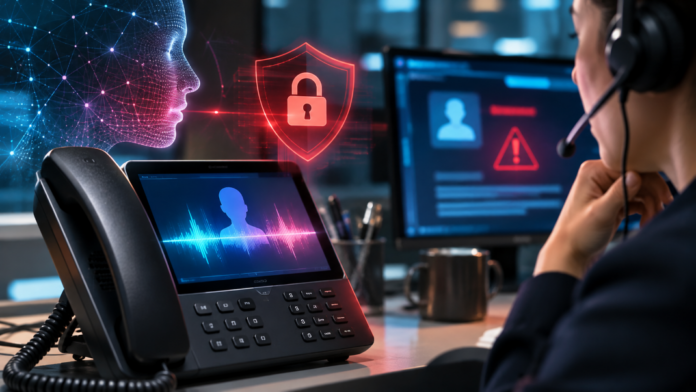
In August 2026, attackers used voice-cloning technology in calls targeting employees at Citadel, Point72 and Two Sigma. They were trying to talk their way into gaining access to the companies’ internal systems. These are some of the best-defended companies in finance, yet according to reports, the attempts relied on a convincing and familiar voice plus a plausible reason to be in a hurry. Much of the discussion since has focused on the detection of AI-generated voices. Detection matters, but for anyone running a contact center or an IT help desk, the more urgent question is why a voice is able to unlock a sensitive action at all.
Familiarity was never authentication
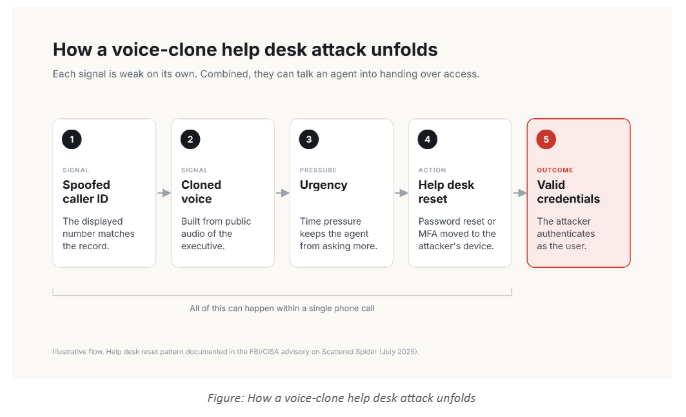
Most contact centers rely on two signals that feel like proof of identity. The caller sounds like the person they claim to be and the number on the screen matches the known number of the person. Neither signal was designed to act as authentication and both have become easier and cheaper to fake. The FTC has warned that a short clip taken from content posted online can be enough to clone someone’s voice. Furthermore, for executives such material is easy to find because they speak on earnings calls, podcasts and conferences.
Automated voiceprints do not close this gap. NIST’s digital identity guidelines describe biometric matching as probabilistic and allow biometrics only in combination with a physical authenticator. Within its scope, NIST SP 800-63B-4 also excludes voice-based biometric comparison for authentication. A low false-match rate only reflects how often a system confuses two real people, not how it holds up against deliberate spoofing.
Caller ID is an even weaker signal, because spoofing the displayed number is cheap. The STIR/SHAKEN framework helps carriers attest to information about the calling number, but it does not confirm the identity of the person who is actually speaking. A matching number shows at most which line a call came from, not who placed it.
How attackers combine the signals
A spoofed number creates the first impression, a cloned voice confirms it, and a sense of urgency discourages the agent from asking further questions. The joint FBI and CISA advisory on Scattered Spider describes where this can lead. For example, help desk staff were persuaded to reset passwords or to transfer MFA tokens to devices the attackers controlled. From then on, the attacker can authenticate using valid credentials.
Personally, I would not leave the detection of synthetic voices to the agent on the phone. Help desk agents already work under time pressure, and asking them to judge whether a voice is real or not adds a difficult and error-prone task right at the moment they are least able to perform it. Automated detection can support this job by running during the call and flagging suspicious audio. Its result should be treated as additional information for the decision, not as a replacement for any required authentication.
Move the proof out of the conversation
The goal is a process in which a high-risk request cannot succeed just because a voice sounds convincing, whether that voice is real or synthetic. Having worked on caller voice verification, I keep returning to one principle: the conversation can start a request, but something outside the conversation has to approve it.
For people with an enrolled app, the most straightforward option is an approval request in the app that names the exact action and expires within minutes. Alternatively, the request can start inside an authenticated app or web session that is linked to the support case. Passkeys and security keys go one step further. Because FIDO2 credentials are bound to the legitimate website or app, they resist classic phishing. However, they do not automatically confirm a support action, so the authenticated session still has to be linked to the specific support case and the requested action. Other methods carry their own risks. For example, one-time codes can be passed on to a caller, and victims can be talked into approving push requests.
For people without any of these, a callback to the number on file remains a solid baseline. The number must come from the existing record and never from the call itself. Calling back an independently stored number means that a spoofed caller ID alone is no longer enough to prove identity. However, a callback does not protect against a SIM swap, which is why NIST restricts phone-based verification. For the highest-risk requests, it should therefore be combined with an additional independent check.
Spend friction where the damage is
None of this means questioning everyone who calls about opening hours. A better approach is to list every action an agent can take and rank each one by its potential consequences. Sharing an account balance may only require a standard identity check, whereas replacing an MFA factor or changing payout details should always require approval outside the call. The FFIEC’s authentication guidance for U.S. banks calls for the same risk-based approach and explicitly covers call centers and IT help desks. In the end, a familiar voice should never reduce the required level of verification.
Where I would start
- Inventory what agents can trigger: Mark every place where a voice, a voiceprint or caller ID unlocks an action, starting with credential resets and payment changes.
- Enforce verification in the system rather than the script: If agents can skip a check with one click, attackers will talk them into that click.
- Design the lost-phone recovery process before launch: Attackers may exploit it to bypass stronger checks. Offer backup authenticators at enrollment. Never let a caller register a new authenticator and then use it to authorize the same request.
Detect it, but do not depend on it
In my view, synthetic voices and detection are locked in a permanent arms race in which every improvement in detection is answered by better clones. Detection can add value in high-risk calls and should keep improving, but its role is to flag a suspicious call for closer review, not to approve a sensitive action on its own. The stronger design assumes that any voice might be synthetic and ensures that even a convincing clone is not enough on its own to reset a password or move money.
_________
About Johannes Wiedemann
Johannes Wiedemann is the founder of Identity Phone, where he works on verified caller identity and deepfake voice fraud prevention. His focus is on how banks, insurers and help desks can verify high-risk requests made over the phone.
Sources
- Reuters: Major Wall Street hedge funds targeted in attempted cyberattacks (Aug. 5, 2026)
- Major hedge funds targeted in wave of attempted cyberattacks
- FTC: Scammers use AI to enhance their family emergency schemes (2023)
- NIST SP 800-63B-4: Authenticators
- FCC: Call Authentication Trust Anchor (STIR/SHAKEN)
- FBI/CISA: Scattered Spider joint advisory (July 2025)
- FIDO Alliance: Passkeys, The Journey to Prevent Phishing
- FFIEC: Authentication and Access to Financial Institution Services and Systems (2021)
Join our LinkedIn group Information Security Community!