




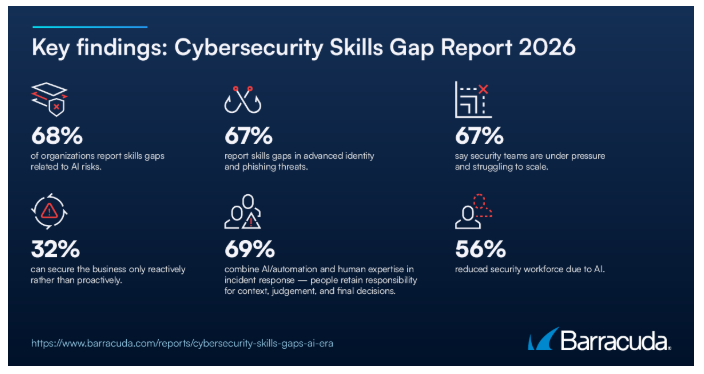
Barracuda Networks, Inc. has released its Cybersecurity Skills Gap Report, highlighting the growing challenges cybersecurity teams face as artificial intelligence, identity-based attacks, and expanding digital operations reshape security requirements. The research found that 94% of surveyed organizations experience cybersecurity skills gaps, with 68% reporting shortages in expertise related to AI risks and 67% identifying gaps in addressing advanced identity and phishing threats, including business email compromise, OAuth abuse, and multifactor authentication bypass.
Conducted by Barracuda Research, the international study surveyed 2,000 IT and security decision-makers and found that cybersecurity teams are increasingly struggling to meet operational demands with existing resources.
Half of respondents said security professionals are expected to support expanding digital operations without additional resources. Meanwhile, 40% reported that business expectations exceed their teams’ cybersecurity capabilities and available tools, while 35% indicated that staffing levels are insufficient to meet organizational demands.
These pressures are affecting security operations, with 67% of respondents reporting difficulties scaling their teams to support changing business requirements. Additionally, 32% acknowledged that their organizations can respond to security threats only reactively rather than taking a proactive approach.
“The findings show how the impact of AI is changing the cybersecurity landscape faster than many security teams can build the necessary skills, visibility, and governance,” said Siroui Mushegian, Senior Vice President and Chief Information Officer, Barracuda. “Organizations need to reshape their security teams, combining the power of AI and automation with human expertise, judgement, and visibility. We must nurture these critical skills in the next generation of cybersecurity professionals, building new development pathways and opportunities for hands-on experience.”
AI Reshapes Security Roles While Human Expertise Remains Essential
Artificial intelligence is already influencing cybersecurity workforce structures, with 79% of surveyed organizations reporting changes to security roles or head count associated with AI adoption.
More than half (56%) reported reductions in their security workforce linked to AI, with those reductions evenly distributed between entry-level and more senior positions.
Despite these workforce changes, organizations continue to recognize the importance of human oversight in cybersecurity operations. The research found that 69% use a shared decision-making approach during incident response, allowing AI to assist with investigations and analysis while security professionals remain accountable for contextual understanding, judgement, and final decisions.
Cybersecurity Career Paths Evolve as Demand for Advanced Skills Grows
The increasing adoption of consolidated security platforms and AI-driven automation is changing the responsibilities of cybersecurity professionals. As automated systems handle more routine security analysis and response tasks, human expertise is becoming increasingly focused on threat investigation, incident leadership, automation governance, and business risk management.
According to the report, 56% of surveyed organizations identified a need for stronger capabilities in incident response, decision-making under pressure, and risk management.
These shortages could become more pronounced as organizations automate responsibilities traditionally assigned to entry-level security professionals. Without structured career development opportunities and practical training pathways, businesses risk limiting the development of the next generation of cybersecurity talent.
The research also indicates that expectations for senior security professionals are expanding beyond traditional technical responsibilities. While technical proficiency remains fundamental, organizations increasingly require expertise in AI literacy, identity security, governance, and communication as cybersecurity becomes a strategic concern at the board level.
In particular, 61% of respondents identified skills needs in strategic security leadership, including AI governance and the ability to communicate technical cybersecurity risks in terms of business impact.
Methodology
Barracuda commissioned independent research firm Arlington Research to conduct a survey involving 2,000 mid- to senior-level IT and security decision-makers from organizations employing between 100 and 2,000 people.
Participants represented multiple industries across the United States, United Kingdom, France, DACH (Germany, Austria, and Switzerland), Benelux (Belgium, the Netherlands, and Luxembourg), the Nordics (Denmark, Finland, Norway, and Sweden), Australia, India, and Japan.
The study assessed cybersecurity skills shortages and organizational capability challenges encountered during the preceding 12 months.
_____
About Barracuda
Barracuda is a leading global cybersecurity company delivering complete resilience made easy to buy, deploy, and use through a partner-first model. Our intelligent BarracudaONE® platform provides cyber resilience across email, identities, AI, data, applications, networks, and managed XDR within an open ecosystem. Trusted by hundreds of thousands of organizations and partners worldwide, Barracuda delivers industry-leading solutions and support, powered by people and enhanced by AI, for all sized businesses.
Barracuda Networks, Barracuda, BarracudaONE, Barracuda IQ, Bailey with the AI stars logo, and the Barracuda Networks logo are trademarks or registered trademarks of Barracuda Networks, Inc. in the U.S. and/or other countries. All other names and brands may be claimed as the property of their respective owners.
Join our LinkedIn group Information Security Community!