

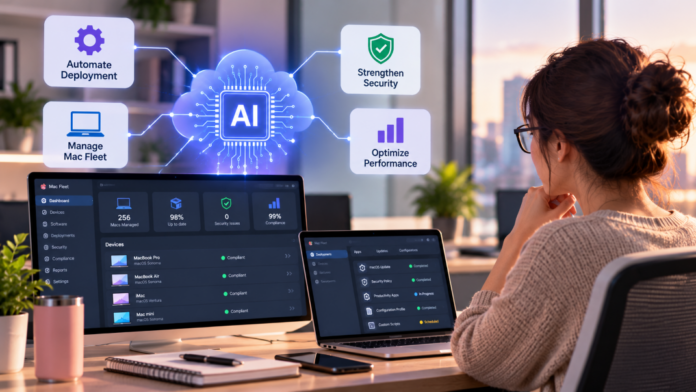
The traditional image of a Mac administrator clicking through an MDM console is becoming increasingly outdated. Enterprise Mac admins are writing code, working with CI/CD pipelines and using AI assistants to build configurations and troubleshoot problems, often operating more like platform engineers than traditional IT administrators.
New research from Fleet highlights just how far that shift has progressed. Its Apple in the Enterprise report, based on a survey of more than 250 enterprise IT practitioners managing Apple devices, found that 57% regularly use LLM assistants, 46% use a code editor and 42% work with CI/CD runners.
AI assistants are now used more frequently than MDM consoles, at 57% compared with 53%.
That change is also visible in the work administrators are producing. In the previous 30 days, 61% had used AI to author an MDM profile or configuration, 62% to write scripts or code and 68% for troubleshooting or log analysis. Overall, 86% allow AI-generated output to reach production devices after some form of review.
“Mac admins are basically engineers now, whether their job description calls them that or not,” said Mike McNeil, CEO and co-founder of Fleet. “They’re writing code, using AI and shipping changes to production, but they usually don’t have the safety net engineers take for granted.”
The career path is beginning to reflect that evolution. Nearly two-thirds of respondents, 64%, said they already see a defined progression from administrator to senior and staff engineer.
AI could accelerate that transition further. As assistants take on more of the work involved in creating scripts, configurations and first-pass troubleshooting, administrators can increasingly focus on managing business outcomes, reviewing changes and tackling more complex problems that depend on human judgment.
However, the infrastructure around them has not necessarily evolved at the same speed.
Nearly 70% of respondents said they cannot roll back a bad configuration change within an hour, and 43% need more than a day. About a quarter can recover within the same day, but only with manual intervention.
That gap becomes more significant as AI increases the speed and volume of changes reaching production. Software engineering teams typically rely on practices such as version control, peer review and automated deployment pipelines to provide a record of changes and make them easier to reverse. Just 28% of respondents currently combine human review of AI-generated changes with version control.
Apple itself is also pushing toward more modern management models. The research found 78% of respondents are using or piloting declarative device management, although 31% still identify Apple’s rapid release cadence as their biggest Mac administration challenge. And despite the report’s Apple focus, most administrators are dealing with a much broader estate: only 8% manage Apple devices exclusively.
The emerging role is therefore less about simply administering Macs and more about engineering reliable systems across devices. AI can handle more of the first draft, but humans remain responsible for the judgment, accountability and business outcomes behind what ultimately reaches production.
Join our LinkedIn group Information Security Community!