


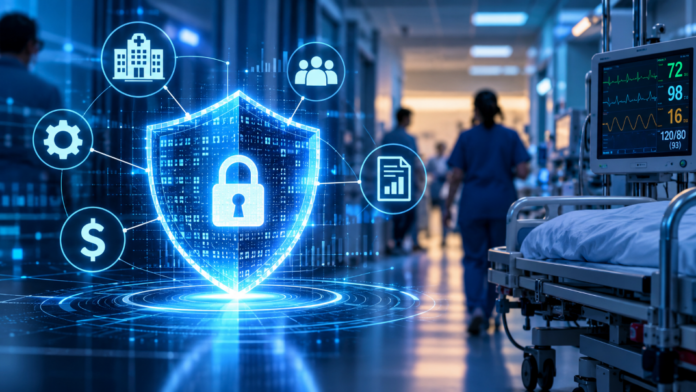
Healthcare cybersecurity programs tend to focus on their most visible layers, such as firewalls, endpoint detection, cybersecurity awareness training, and multi-factor authentication. While these controls matter, none tell you what happens to your organization when something fails or how to prioritize which systems receive which protections. That’s the job of the business impact analysis (BIA), and it’s the piece too many organizations still skip.
This gap occurs across organizations of all sizes from small rural hospitals to larger, better-funded healthcare systems. Nearly every major security initiative depends on the same foundation, which is a clear, current picture of what’s critical and happens when it goes down. Yet many organizations haven’t built one.
What a BIA does
A BIA identifies your organization’s critical business functions, processes, and systems, then quantifies what happens when each one goes down by reviewing financial loss, regulatory exposure, reputational damage, and impact on patient safety. It produces two numbers that every recovery and continuity plan depends on:
- Recovery Time Objective (RTO): how long a process can stay unavailable
- Recovery Point Objective (RPO): how much data loss is tolerable.
While those numbers sound tactical, they inform critical decisions across the security program. Saying “bring everything back up as quickly and with as little data loss as possible” is easy. But in reality, rapid recovery becomes far more complicated when systems compete for limited resources and attention. A BIA grounds those decisions in business and clinical reality, helping healthcare organizations determine what needs to be restored first and why.
How BIAs Strengthen the Broader Security Program
A BIA provides the operational context that security tools and testing often lack.
Vulnerability and Threat Management.
A scanner does not know what a finding is worth to your organization’s time and effort. It scores severity the same way regardless of what the affected asset supports.
A BIA turns that raw output into a real remediation priority list because it tells you which finding sits on a system that matters and which one doesn’t. The difference between a scan-and-report exercise and the risk-based, ownership-driven model is the BIA the organization built vulnerability and threat management (VTM) around.
Penetration Testing.
Every engagement starts with a scoping conversation, and its quality depends on knowing which systems matter most. A BIA answers that before testing begins, so effort and budget go toward the assets whose compromise would actually hurt clinical systems, PHI repositories, and revenue-critical applications.
A BIA also changes how findings land with leadership. When the penetration tester tells leadership that the finding sits on a system with a two-hour RTO because the BIA defines it as a critical system, the response is more urgent than the one a CVSS score alone receives. A BIA can also help identify systems that may be too sensitive for active exploitation testing, such as networks that incorporate patient monitoring devices, whose criticality may not be immediately obvious.
Incident Response.
This is the discipline where a BIA’s absence shows up fastest. An incident response (IR) plan tells you what to do. A BIA tells you what to do first. Restoration order, communication triggers, and executive decision points all depend on knowing what’s at stake for each system. A tabletop exercise built on that information surfaces real gaps instead of a comfortable discussion. Moreover, a good BIA should identify people responsible for systems or processes involved so that the organization can consult them when drafting the recovery or continuity plans that directly influence the IR plan itself.
If you don’t have a current BIA
A full BIA takes time, but that isn’t a reason to wait. In the interim, healthcare organizations can build a lightweight, directional view of criticality with a few targeted steps:
- Ask clinical and operational leaders which five to ten systems they could least afford to lose and for how long.
- Cross-reference that against what your VTM results, the asset inventory, and any existing risk register already show about exposure.
While this informal list will not replace a formal BIA, it is enough to start weighting VTM remediation timelines by business impact, sharpening penetration testing scoping conversations, and reordering IR restoration priorities around what matters as you work toward building or refreshing a BIA.
The larger picture
In most industries, a BIA answers “how much will this cost us.” In healthcare, it also answers, “who could this hurt.” An EHR outage isn’t just downtime. It’s clinicians reverting to paper, medication administration slowing down, and care teams operating with less information than they’re used to. Internet of Medical Things (IoMT) devices raise the stakes further since infusion pumps, imaging systems, and remote monitoring tools all depend on the network and, increasingly, on cloud connectivity. A BIA is what tells you ahead of time which systems carry that kind of weight, so you can plan for it instead of discovering it mid-incident.
A security program can look complete on paper without a BIA. But when something breaks, no amount of vulnerability management, penetration testing, or incident response planning can fully protect what an organization doesn’t understand is at stake. Building or refreshing that foundation is some of the highest-leverage work a healthcare security team can do. Ultimately, healthcare organizations need to understand not only which systems are vulnerable, but which systems matter most and what is at stake when they fail.
_____
About T.J. Ramsey
T.J. Ramsey, Senior Director of Threat Operations at Fortified Health Security, is a seasoned IT security professional with 18 years of experience focused on healthcare and defense intelligence. He served as a U.S. Army Military Intelligence Analyst for the Department of Defense and held security roles at Obsidian Solutions Group and SAIC/Leidos.
Join our LinkedIn group Information Security Community!