



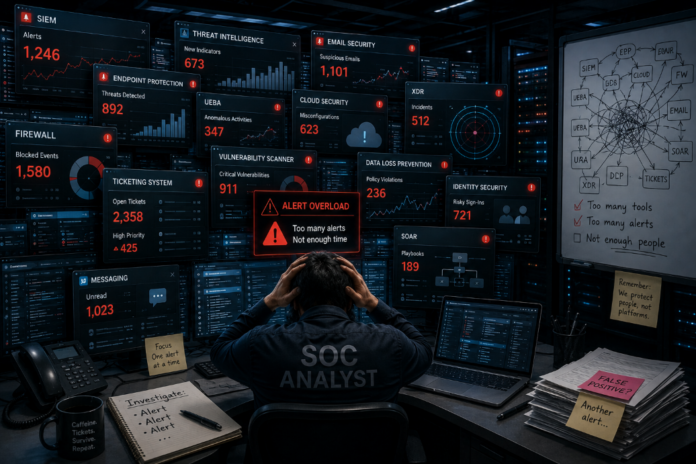
Ask a CISO what keeps them up at night, and “we don’t have enough visibility” isn’t like to be high on most lists these days. If anything, it’s often too far at the bottom to even bother listing. These days, the audible sigh that precedes “we have too much visibility and not enough time to understand what we’re seeing” is louder than any desperation about missing data.
Why is this so?
Endpoint agents, cloud-native detection, network monitoring, threat intel feeds. Security organizations have justified buying any and all of these, with each one a reasonable purchase in isolation. Stacked together, they produce a volume of alerts that no analyst team, however well-staffed, can realistically triage. The result isn’t better security. It’s a queue that never empties.
Slow Death Rather Than Sudden Failure
What makes alert overload dangerous is how gradually it sets in Attackers capitalize on alert overload not by breaching through your defenses, but by blending into them. No analyst team just simply stops investigating alerts. Rather, they stop responding to them in three distinct phases:
- Phase one – Analysts respond to every alert because that’s what they are paid to do.
- Phase two – As volumes rise above a team’s capacity, triage becomes intuition: a mental judgement call on whether an alert is worth fifteen minutes of an analyst’s time because there’s no way to properly investigate everything. Priority still gets assigned to each alert, but it gets based on gut feel instead of actual evidence.
- Phase three – Once analysts ignore enough low-value alerts that turn out to be benign, optimism steps in where data left off. An alert may not get investigated because its characteristics are identical to dozens that did happen to be malicious. It’s dismissed not because it was triaged, but because alerts like it almost always have been.
It’s this last phase where gaps open for attackers. It doesn’t matter how smart your detection stack is. It only matters if attackers can generate signals that resemble the harmless background noise your team has trained itself to ignore. Post-mortem reports that read “the alert fired, but we took no action” are almost exclusively describing phase three failures. Missing visibility isn’t the cause.
Alert Volume Isn’t Just an Efficiency Problem, It’s a Balance Sheet Problem
This isn’t a story about analyst inconvenience anymore. A Forrester Consulting study commissioned in 2020 found the average SOC fields more than 11,000 alerts per day, with over half turning out to be false positives, and every industry survey since points to that number climbing, not shrinking.
The downstream effect is measurable. IDC research conducted with FireEye found more than a third of analysts and managers simply skip alerts once the queue backs up, which is a straightforward description of an open door for attackers. And IBM’s Cost of a Data Breach Report puts a number on what that door costs: an average of $4.44 million per breach globally, against roughly $1.9 million in savings and an 80-day shorter breach lifecycle for organizations that have adopted AI-driven detection and response. Alert fatigue isn’t a morale issue for the SOC team. It’s a line item, and it’s one that compounds every quarter it goes unaddressed.
Buying Another Tool Makes This Worse, Not Better
The instinctive fix is to add more firepower in the form of new tools. But every new detection tool, logging endpoint and SIEM rule adds yet another silo that analysts must manually compare against all the other silos to understand how alerts are related.
Solving alert fatigue requires rethinking what happens to an alert before it ever reaches a human, and that comes down to four capabilities most stacks don’t have today.
First, correlation must occur before notification. One authentication failure can trigger dozens of related alerts in applications, servers, and monitoring systems. Most tools present each alert as an unrelated ticket. Understanding the topology of how systems rely upon each other allows you to collapse those dozens of alerts down to a single event. The tricky part is scoping correlation: correlate everything against everything else and you’ll be drowning in noise masquerading as insight. Correlate within sets of systems that have true dependencies and you’ll find the signal.
Second, the window of time you use to correlate events must be flexible. An alert for a compromised credential may occur within seconds of a related alert. Data exfiltration may not be detected for hours. Setting a single correlation window either smooshes unrelated incidents together or you’ll miss actual incidents. Successful systems learn how different event types propagate throughout the system and scale the window based on context.
Third, build confidence thresholds into your correlation, not just connect everything to everything else. Two types of alerts being able to correlate doesn’t always mean they should. Factoring in contextual information like time of day, day of week, severity, and importance of assets allows you to identify true patterns from the background noise. For example, a backup job that fails every Monday at 1am will blend in with legitimate traffic over the course of a week. But if you only look at Mondays, that failure suddenly becomes anomalous. Better correlations are trustworthy, not exhaustive.
And finally, once you’ve validated a correlation, start using it to predict events before they occur. If you see a spike in outbound traffic followed by resource exhaustion or a certain pattern of failed jobs that always causes a particular outage that impacts compliance, you’ll want to know about that leading indicator before the incident occurs, not after.
Treating Correlations as Assets, Not Costs
To be clear, this article isn’t about stealing humans away from SecOps until they’re lean enough to watch everything. Automating everything just shifts your bottleneck to whatever comes after automation. Noise reduction and correlation aren’t about replacing analysts but rather ensuring that when something DOES need a human you’ve got someone available to address.
Rule-setting, timing window adjustments, and configuring confidence thresholds IS time-intensive, but only when executed poorly. Doing it right once means you never have to touch those rules again unless something changes in how applications operate or you onboard a new asset type. Instead, your team gets to spend more time doing the thing they logically best: turning alerts into actionable incidents by applying business context, weighing response tradeoffs, and owning those responses.
Redefining Visibility from the Ground Up
Taken together, alert volume doesn’t need to be inevitable. Visibility has become a strawman term that security leaders equate with coverage: more endpoints, more logs, more solutions that feed into your SIEM. But coverage that can’t be digested in real time isn’t visibility, it’s wasted effort too noisy to matter.
Clear visibility empowers your analyst to look at their monitored environment and instantly know what’s happening and what merits investigation. That doesn’t require scrapping your existing stack. It’s about approaching correlation and noise reduction as foundational to your SOC, not something to bolt on when you’ve got a spare firewall acting as a log forwarder. Once you tune your correlations carefully, scale your timing windows appropriately, and only surface your highest confidence signals. True visibility will follow.
Join our LinkedIn group Information Security Community!