



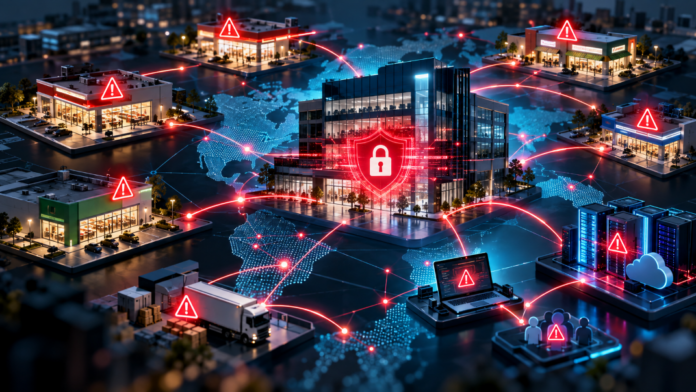
New research from VikingCloud, a cybersecurity and compliance company trusted by more than 4 million business locations worldwide, shows that 86% of distributed enterprises experienced a cyberattack during the past 12 months. Among organizations that suffered an attack, 77% reported that the incident spread beyond its original point of entry, reaching other brand locations, corporate systems, or shared vendor relationships.
VikingCloud’s 2026 Cyber Threat Landscape Report: The Distributed Enterprise Illusion found that the likelihood of an attack spreading varies depending on how cybersecurity policies are managed across distributed organizations. Among brands with independent franchisees operating some or most locations, attacks spread in 89% of cases where corporate headquarters did not enforce a unified security standard. That figure fell to 64% when a company mandated a single security standard across its locations.
Despite this difference, only 51% of distributed enterprises currently enforce one security standard across every location. The remaining organizations operate with varying degrees of cybersecurity fragmentation: 33% allow individual locations to determine how corporate guidelines are implemented, while 15% allow each location to establish its own cybersecurity policy.
Despite these security gaps, 83% of cybersecurity leaders surveyed said they were confident or very confident in their organization’s security posture.
“Distributed enterprises are among the most targeted and exposed organizations in the world,” said Kevin Pierce, President and Chief Operating Officer at VikingCloud. “Each of their hundreds or thousands of locations is a way into the broader footprint. Leaders have tried to contain the blast radius by investing heavily in technology. But investment without enforcement leaves the gaps open. Strong governance narrows them and keeps one location’s incident from becoming a brand-wide breach.”
VikingCloud based its research on a survey of cybersecurity and IT decision-makers at large, multi-location brands with at least 5,000 employees and 500 or more locations across the United States and Europe. The organizations surveyed included supermarkets, quick service restaurants, and mass-market retailers.
The research identified five key cybersecurity challenges facing distributed enterprises:
• Limited visibility across locations. Forty-eight percent of respondents lack real-time visibility across all their locations. Forty percent said they would likely fail to detect an active threat at their least-monitored sites, while 5% said a breach could remain undetected for several days.
• New locations create additional exposure. Eighty percent of enterprises do not completely integrate new locations into centralized cybersecurity monitoring and enforcement before or on opening day. Forty-seven percent require more than a week to complete the process, while 18% take more than a month. Another 3% take more than 90 days or have no mandatory integration protocol.
• Ransomware and AI-generated attacks are increasing. Eighty-eight percent of respondents said ransomware attacks that originate at or spread across individual locations have become more frequent, more severe, or both over the past 12 months. AI-generated phishing and deepfake attacks targeting location managers and frontline employees followed at 87%. Sixty-three percent said at least one of their locations had already received a deepfake or cloned-voice attack impersonating a corporate executive.
• Cybersecurity incidents are frequently not escalated. Ninety-one percent of respondents acknowledged that at least one material cybersecurity incident during the past year was not reported to executive leadership or the board. Seventy-nine percent said multiple incidents went unreported, while 43% acknowledged five or more unreported incidents. According to VikingCloud, fear of professional repercussions, cited by 47%, has been a factor contributing to this silence for the third consecutive year of its research.
• The potential financial and operational impact is significant. Forty-seven percent of respondents estimated that a breach affecting a majority of their locations would cost at least $11 million, while 22% estimated the potential cost at $101 million or more. Beyond direct financial losses, respondents identified loss of consumer confidence (40%), workforce reduction (36%), and location closures (36%) as the leading consequences.
Addressing these risks requires more than technology alone. Nearly all enterprises surveyed (98%) have a formal cybersecurity policy covering their location footprint. However, the average organization currently uses 5.6 of the 13 security technologies measured in VikingCloud’s research. Respondents expect that figure to nearly double to 11 technologies over the next 12 months.
Among the most commonly planned technology investments are a centrally managed next-generation firewall deployed across all locations (46%), a 24×7 Managed Detection & Response (MDR) service covering every location (46%), and third-party vendor risk monitoring for suppliers with access to corporate systems (43%).
The research also points to growing interest in external security partners. While only 33% of organizations currently outsource day-to-day security operations to a Managed Security Services Provider (MSSP), 38% plan to adopt an MSSP contract covering all locations within the next 12 months.
When assessing security partners, respondents placed the greatest importance on having a single platform that provides visibility across all cyber threats (45%), standardized security configurations throughout the enterprise (42%), and always-on connectivity with automatic failover (36%).
“Distributed enterprises are making the right investments,” Pierce said. “But a security program is only as strong as its weakest location. The most secure brands back their technology investments with security mandates and partners built to enforce them everywhere. That’s what contains the blast radius.”
The full 2026 Cyber Threat Landscape Report: The Distributed Enterprise Illusion is available for download.
_____
About VikingCloud
VikingCloud delivers cybersecurity and compliance solutions that simply work. Our expert-led approach combines proven technology and AI-driven insights with dedicated support—keeping businesses secure, audit-ready, and uninterrupted. VikingCloud is trusted by over 4 million business locations in 70+ countries to stop threats before they stop business, so they can work on what matters most. For more information, visit www.vikingcloud.com and follow us at www.linkedin.com/company/vikingcloud/.
Media Contact Jake Scearbo, Corporate Ink for VikingCloud 508.561.2449 | vikingcloud@corporateink.com
Join our LinkedIn group Information Security Community!