



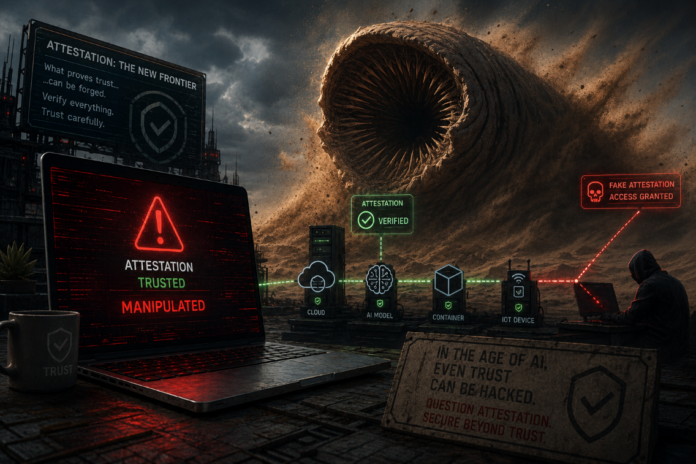
For the better part of a decade, the software security community has been constructing a cathedral of trust out of SBOMs, provenance records, signed builds, and enough acronyms to qualify as a federal agency.
The idea was sound: document what went into the software, record where it came from, and cryptographically prove who built it. Do those things faithfully, we were told, and the software supply chain would become less like a back-alley flea market and more like a properly supervised pharmacy.
Then Mini Shai-Hulud came crawling through the front door with its paperwork in perfect order.
Consider this central fact: Mini Shai-Hulud is a documented npm worm whose malicious packages carried valid SLSA Build Level 3 provenance attestations. Let that sentence sink in for a moment.
Build Level 3 is supposed to represent meaningful supply chain integrity: unforgeable provenance produced by a hosted, isolated build platform. It is the sort of credential organizations display when asked whether the software they ship, or consume, can be trusted. (SLSA Build requirements)
Mini Shai-Hulud did not crack the cryptography. It did something both simpler and more instructive: it compromised the machinery the cryptography was operating. The attackers poisoned the build cache, extracted an OIDC token from the GitHub Actions runner, and used the legitimate publishing path to distribute malicious packages. (TanStack’s incident postmortem)
The signature was real. The provenance was authentic. The package was poison.
This is not proof that SLSA is useless. A passport is not useless because criminals sometimes carry one.
Mini Shai-Hulud offers a glimpse of our fast-approaching future: one in which attackers do not merely evade attestation systems. They exploit the trust those systems create.
Attestation Was Always Phase One
To be clear, the push for SBOMs, provenance records, and build-integrity frameworks was the right call.
During the 2010s, incidents such as Heartbleed and Shellshock exposed the risks accompanying the software industry’s exploding dependence on open source. SolarWinds Sunburst and 3CX later demonstrated how effectively attackers could compromise trusted software before it reached customers. Log4Shell then supplied the industry with a particularly expensive reminder that many organizations had little idea which components were buried inside the software they depended on.
SBOMs created a shared vocabulary and a useful list of ingredients. Provenance records created an audit trail. Signing made unauthorized alteration harder. These were necessary advances.
But they were always inventories and receipts—not understanding.
An SBOM can tell you which ingredients are listed on the package. It cannot tell you whether the cook added arsenic. Provenance can tell you which kitchen produced the meal. It cannot tell you whether the meal was cooked right.
Neither control explains what the software actually does when it runs, whether that behavior matches its stated purpose, or whether it has suddenly developed habits no previous version exhibited.
Mini Shai-Hulud illustrates the distinction with unusual clarity. The provenance was valid because the malicious packages really did pass through the trusted release infrastructure. The attestation did not lie. It truthfully documented a poisoned process.
That is the uncomfortable part. The control worked within its defined scope and still delivered something many consumers interpreted as assurance for malicious code.
AI Makes the Gap Urgent
AI did not invent careless maintainers, porous build pipelines, compliance theater, or npm. Humanity managed all four without machine assistance.
What frontier models are doing is lowering the cost of exploiting them.
Tasks that once required deep ecosystem knowledge, patient reconnaissance, custom tooling, and sustained effort can increasingly be accelerated by AI assistance. Attackers can inspect workflows, adapt public techniques, generate plausible code, rewrite payloads, test variations, and troubleshoot failures at a pace previously reserved for well-resourced teams.
Whether AI wrote any particular line of Mini Shai-Hulud matters less than the economics it represents. The skill threshold is falling. The development cycle is shrinking. Sophisticated tradecraft is becoming cheaper, faster, and more reusable.
The Shai-Hulud campaign family shows the resulting pattern: probe a defense, study the response, refine the technique, and return before the defenders have finished scheduling a post-mortem meeting.
The tradecraft is also escaping into the wild. On May 12, 2026, a GitHub repository appeared to contain the complete Shai-Hulud worm source code, malware designed to compromise the development environment. Its README invited users to substitute their own keys and command-and-control infrastructure. It was signed “TeamPCP,” the threat actor believed to be behind the original campaign.
Whether that repository was a genuine release, a recruiting flyer, or merely criminal theater, the operational consequence is the same: the blueprint is no longer scarce. Copycats do not need to invent the attack. They need only to customize it.
That is what democratization looks like when the product being democratized is malware.
Organizations still treating SLSA compliance as a destination rather than a baseline are operating on borrowed time.
From Attestation to Verification
The Shai-Hulud campaigns make the central problem difficult to ignore: trust in the software supply chain cannot be delegated to a signature, an SBOM, a provenance record, or any other single control carrying an impressive acronym.
The path forward requires layers of verification that attestation was never designed to provide.
Deep content, package, and binary analysis
Provenance tells you where software came from. Artifact analysis helps determine what it contains and what it is capable of doing.
Static inspection should examine complete package contents, compiled binaries, embedded scripts, installation hooks, obfuscated logic, unexpected dependencies, secrets access, persistence mechanisms, and network behavior. When attackers can obtain legitimate-looking attestations for malicious artifacts, inspecting the artifact itself becomes the difference between evidence and paperwork.
Contextual behavioral understanding
Software behavior must be evaluated against declared purpose and historical behavior.
A formatting utility that suddenly reads cloud credentials and establishes outbound connections is suspicious, regardless of how handsome its provenance record may be. A package that begins writing into CI workflows, harvesting tokens, or installing persistence mechanisms has not become “innovative.” It has become compromised.
Context-aware analysis connects what software claims to be with what it actually does.
Continuous verification
An attestation describes a particular artifact and build event. Attackers, regrettably, do not need to disagree.
Packages change. Maintainers are compromised. Build workflows drift. Dependencies mutate. Worms propagate. Malicious modifications can enter at publication, during an update, through a poisoned dependency, or from inside the build system itself.
Verification therefore must continue across versions and throughout the software lifecycle. Every meaningful change should be evaluated for new capabilities, anomalous behavior, suspicious relationships, and divergence from prior releases.
Trust is not a ribbon awarded at publication. It is a condition that must be continuously re-earned.
The Signature Is Not the Verdict
The lesson of Mini Shai-Hulud is not that attestation frameworks should be abandoned. It is that they were always the beginning of the answer, not the end.
SBOMs remain valuable. Provenance remains valuable. Build isolation and signed attestations remain valuable. Each narrows the attacker’s options and makes certain classes of fraud more difficult.
But none establishes benign intent. None substitutes for examining the software itself.
Organizations treating SLSA Build Level 3 as the ceiling of software assurance are discovering, expensively, that adversaries read the specifications too. More importantly, they read the assumptions hiding between the lines.
The question every software publisher and consumer must now answer is brutally simple:
What happens inside your trust boundary when the signature is real, but the intent is not?
Join our LinkedIn group Information Security Community!