




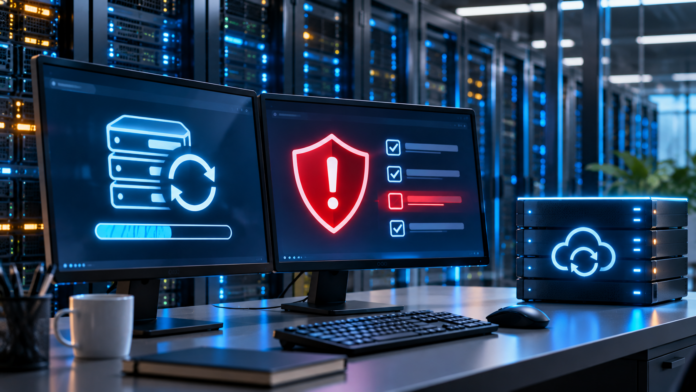
The tension between uptime and security: why organizations often leave their most critical infrastructure untouched because they’re afraid of breaking it.
Every infrastructure team knows the unwritten rule: if it works, don’t touch it.
Nowhere does that rule hold more firmly than in storage and backup. These are the systems that hold the crown jewels: transaction records, customer data, the last clean copy of everything. They run 24/7, and downtime is measured in lost revenue, regulatory exposure and very uncomfortable conversations with the board.
So when a firmware update or a configuration change land on the to-do list, the question isn’t “is it important?” It’s “what if it breaks something?” And too often, the answer is to wait for the next maintenance window. Then the next one. Then the one after that.
The paradox: the more critical a system is, the less it gets protected
This is the uncomfortable truth at the heart of enterprise infrastructure. The systems that matter most are often the ones that are patched and hardened least.
The reasons are understandable:
- Fear of downtime. A failed update on a storage array or backup platform can cascade across the entire environment.
- Complex dependencies. Multi-vendor estates mean one change can affect hosts, networks, applications and recovery workflows.
- Limited maintenance windows. Change freezes, audit cycles and business-critical periods shrink the time available.
- Unclear ownership. Storage, backup, security and infrastructure teams each own a piece, and nobody owns the whole picture.
- No safe way to prioritize. Without clear visibility, every vulnerability looks equally urgent, or equally easy to defer.
None of this is negligence. It’s rational behavior in a system that rewards uptime and rarely rewards the quiet work of reducing risk.
But attackers don’t respect your change freeze
The problem is that attackers know exactly how this works. They know storage and backup systems are often neglected, and they know that compromising them is the most effective way to turn an incident into a catastrophe. Wipe the backups, and recovery stops being an option.
At the same time, the time between a vulnerability becoming known and being exploited has been narrowing for years, and many security teams expect AI-assisted tooling to push that further. A patching cadence built for a slower era may struggle to keep up.
Every deferred update, every default setting left in place and every drifted configuration quietly widens the gap. The infrastructure you’re protecting by leaving it alone becomes the infrastructure most likely to be used against you.
Patching alone is not the answer
Here’s the good news: you don’t have to choose between uptime and security. But getting there means rethinking the question.
Patching is only one piece of security posture. Many of the risks in storage and backup environments aren’t missing patches at all. They’re misconfigurations: weak access controls, insecure protocols left enabled, unhardened management interfaces, immutability and protection features that were never switched on, or settings that drifted away from a known-good state over time.
These can often be fixed with low-risk, targeted changes, but only if you know where they are.
Continuous hardening: security that keeps pace with change
A one-time assessment or an annual audit gives you a snapshot. But infrastructure is never static. Firmware is updated, new systems are added, teams make quick changes under pressure, and the snapshot is out of date almost immediately.
Continuous hardening replaces the snapshot with a live picture. The approach is simple:
- Establish a hardened baseline. Define what “secure” looks like for each storage and backup platform, based on vendor guidance and recognized standards.
- Validate against it, continuously. Assess every system against that baseline on an ongoing basis, rather than once or twice a year.
- Detect and fix drift. When a configuration deviates from the baseline, or a new vulnerability appears, you know straight away and can act on what matters most.
The result is that security work becomes smaller, safer and more predictable. Instead of big, risky remediation projects, teams make precise, prioritized changes with a clear understanding of the risk they are addressing.
From “don’t touch it” to “know exactly what to touch”
The instinct to protect critical infrastructure from change is a good one. But protecting it from risk requires something different: knowing precisely where your exposure is, and having a safe, repeatable way to reduce it.
Infrastructure that’s too critical to patch is too critical to leave unmanaged. The answer isn’t more fear of change. It’s more visibility, so that every change you make is deliberate, prioritized and worth the risk.
About the Author:
Gil Hecht is the founder and CEO of Core6. Previously, Gil was the Founder, Chairman and CEO of Savantis Systems, the leading provider of database virtualization solutions, Gil was also the Vice President of Business Development at Aladdin Knowledge Systems.
Join our LinkedIn group Information Security Community!