



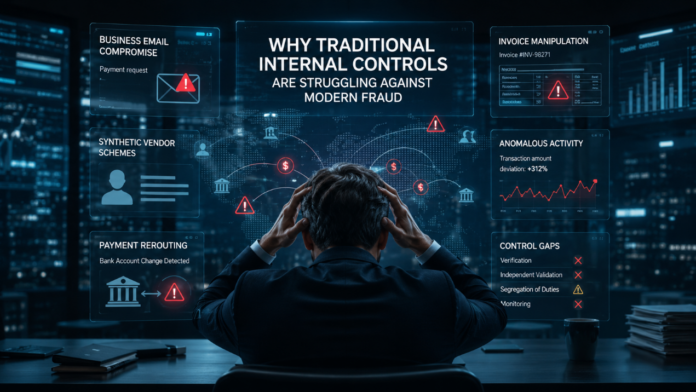
Internal controls have served as the foundation of corporate financial governance for decades. Segregation of duties, approval hierarchies, reconciliation procedures, and audit trails were designed to create accountability, reduce errors, and prevent misconduct. In largely manual finance environments, these controls proved highly effective.
But financial operations no longer resemble the environments these frameworks were built to protect.
Today’s organizations process enormous volumes of digital transactions across global supplier networks, cloud-based platforms, and interconnected financial ecosystems. Payment activity moves faster. Vendor relationships are more dynamic. Fraud schemes are more sophisticated. And attackers increasingly understand how to exploit the gaps between traditional controls and modern financial operations.
The result is an uncomfortable reality: controls designed for paper-based and procedural workflows are struggling to keep pace.
From Manual Fraud to Process Exploitation
Historically, fraud risks involved direct manipulation of records, forged signatures, or unauthorized access to physical assets. Traditional controls addressed these risks through procedural safeguards — one employee entered invoices while another approved payment, check stock was physically secured, and reconciliations identified irregularities after the fact.
These approaches were highly effective when transaction volumes were lower and fraud was easier to detect visually or procedurally.
Modern fraud operates differently. Today’s attackers leverage social engineering, compromised credentials, synthetic identities, and transaction manipulation techniques that blend seamlessly into normal business operations. Fraudsters do not necessarily need to circumvent controls entirely. Instead, they manipulate legitimate workflows in ways that make fraudulent activity appear routine.
This creates a significant challenge for traditional internal control models, because many controls focus on validating that procedures were followed rather than analyzing whether the underlying transaction itself is suspicious. That distinction is becoming increasingly important.
How Business Email Compromise Exploits Approval Workflows
Business email compromise (BEC) attacks have become one of the most financially damaging forms of fraud affecting organizations today, precisely because they exploit trusted communication channels and established approval processes.
In a typical BEC scenario, attackers impersonate executives, suppliers, or trusted partners using spoofed or compromised email accounts. The request appears urgent and legitimate — a payment request, a bank account update, or a time-sensitive matter requiring expedited processing.
What makes these attacks effective is that they frequently fit within existing operational workflows. An accounts payable employee may receive what appears to be a legitimate request. The invoice amount may not trigger additional approvals. The payment request may align with expected business activity. Approvals are obtained. Documentation may exist. Payment thresholds are respected. Yet the transaction was fraudulent.
Traditional controls often struggle here because the process itself was technically followed. Remote and hybrid work environments have amplified this challenge, making verbal verification less common and digital approvals the norm. Organizations that rely solely on procedural approvals without incorporating stronger verification practices may find themselves increasingly vulnerable.
Synthetic Vendor Schemes and Onboarding Weaknesses
Vendor onboarding has traditionally been viewed as an administrative process rather than a frontline fraud prevention function. That mindset is changing.
Synthetic vendor fraud schemes involve fraudsters creating fictitious suppliers or manipulating legitimate vendor information to facilitate unauthorized payments. Sometimes, external actors submit fake vendor applications using fabricated credentials. In other cases, insiders collaborate with external parties to establish shell vendors designed to receive fraudulent payments.
These schemes exploit a common weakness. I’m referring to the onboarding controls that rely on documentation collection rather than independent verification. Organizations may collect W-9 forms, banking information, and incorporation documents, but collecting documentation is not the same as validating legitimacy.
Fraudsters increasingly create convincing vendor profiles using fake websites, synthetic identities, and manipulated documentation that can pass superficial review. Once fraudulent vendors are established within enterprise systems, they appear legitimate to downstream payment workflows. Invoices are processed normally. Approvals are obtained. Payments are released. Again, the fraud succeeds because the process appeared compliant.
Payment Rerouting Fraud: When the Transaction Is Real but the Destination Isn’t
Payment rerouting fraud represents another area where traditional controls fall short. In these schemes, attackers manipulate legitimate payment instructions to redirect funds to fraudulent accounts, often through compromised vendor communications or social engineering targeting accounts payable personnel.
The danger is that the underlying transaction is usually entirely legitimate. The supplier is real. The invoice is valid. The payment is authorized. The only fraudulent component is the destination account.
Historically, vendor bank account updates were treated as low-risk administrative changes. In today’s threat environment, they represent one of the highest-risk control points in financial operations. Fraudsters understand that changing payment instructions can produce immediate financial gains while avoiding the scrutiny associated with entirely fictitious vendors or invoices.
Many organizations still rely on outdated verification processes for bank account changes — email-based confirmations or manual reviews that are vulnerable to manipulation. As digital payments accelerate and settlement windows narrow, the window to identify and recover fraudulent transfers is shrinking.
Invoice Manipulation: Fraud Hidden in the Details
Modern invoice fraud has evolved well beyond simple duplicate billing. Today’s schemes often involve subtle alterations designed to evade procedural review while embedding fraudulent charges within otherwise legitimate transactions — inflated quantities, unauthorized fees, manipulated line items, duplicate services spread across multiple invoices, or misclassified expenses.
Invoice fraud exploits a different vulnerability. Namely, limited scrutiny at the transaction-detail level. Many approval processes focus on validating totals, matching purchase orders, or ensuring invoices route through the correct workflows. But fraud frequently hides within the underlying data itself.
As invoice volumes grow, manual review becomes increasingly difficult. Approvers may review summaries rather than line-item detail. Processing speed takes priority over deeper analysis. This creates opportunities for fraudulent charges to blend into normal operational activity — particularly in organizations with large vendor populations or complex service-based billing arrangements.
Rethinking Internal Controls for Modern Fraud
Traditional internal controls were largely designed around procedural integrity: Was the process followed? Was approval obtained? Was documentation collected? Those questions still matter. But they are increasingly insufficient on their own.
Modern fraud prevention requires organizations to also ask: Does the transaction itself make sense? Is the behavior consistent with historical patterns? Is the vendor relationship legitimate? Are there anomalies hidden within normal-looking activity?
This represents an important evolution in internal control thinking. Finance, audit, and compliance leaders don’t need to abandon traditional controls, but they do need to modernize how they apply those controls.
Several priorities are becoming essential. Vendor governance should be treated as a core financial control function, not an administrative task, with stronger processes around verification, ownership validation, bank account changes, and ongoing monitoring. Employees should be trained to normalize verification rather than view it as an operational obstacle. And organizations should shift toward greater scrutiny of transaction-level patterns and behavioral anomalies, rather than relying exclusively on procedural approvals.
Fraud prevention increasingly depends on contextual awareness. As financial operations become more digital and complex, the organizations best positioned to stay ahead of fraud will be those that recognize the limits of procedural controls and build the operational intelligence needed to evaluate not just whether the process was followed, but whether the underlying transaction deserves trust.
Join our LinkedIn group Information Security Community!