



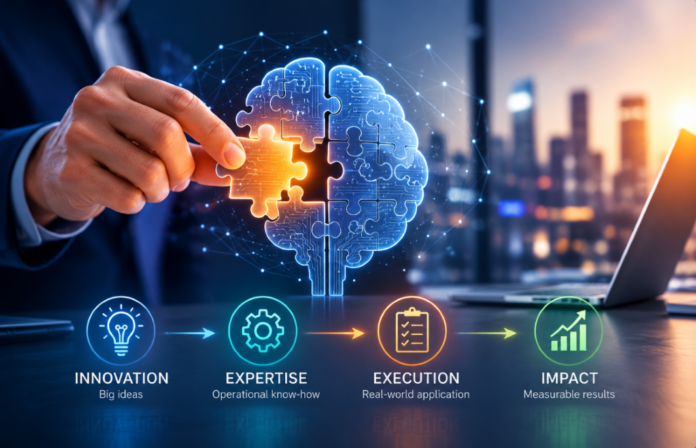
Artificial Intelligence has moved beyond experimentation.
Today, organisations across virtually every industry have access to increasingly sophisticated AI tools capable of automating tasks, enhancing customer experiences, improving decision-making, and driving operational efficiencies at scale. Yet despite the rapid pace of innovation and investment, many businesses are finding themselves in a familiar position: impressive proof-of-concepts that struggle to deliver meaningful business outcomes.
The challenge is no longer access to AI.
The challenge is deployment.
The AI Deployment Gap
The enthusiasm surrounding AI is well founded. According to McKinsey’s latest global AI survey, 78% of organisations now use AI in at least one business function, a significant increase from 55% just two years earlier. Yet adoption alone does not guarantee success.
Research from Gartner suggests that as many as 85% of AI projects fail to deliver their intended outcomes, while a RAND Corporation study found that more than 80% of AI initiatives fail, nearly double the failure rate of traditional IT projects.
This raises an important question: if the technology is advancing so rapidly, why are so many deployments falling short?
The answer often lies beyond technology itself.
Many AI initiatives begin with strong intentions and cutting-edge capabilities. However, once organisations attempt to integrate these solutions into day-to-day operations, they encounter unexpected challenges. Processes fail to align. Employees struggle with adoption. Customer journeys become fragmented. Expected efficiencies fail to materialise.
In many cases, the technology works exactly as intended. The problem is that the solution was designed without sufficient operational context.
An AI application developed in isolation from the realities of customer service, sales, collections, back-office processing, technical support, or workforce management may look impressive in a controlled environment. But when introduced into a live operational setting, it often struggles to generate measurable value.
Why Domain Expertise Matters
Successful AI deployment requires more than data scientists, engineers, and software developers.
It requires people who understand the operations the technology is intended to improve.
The organisations generating the strongest returns from AI investments are those that combine technical innovation with deep domain expertise. They understand customer journeys, operational bottlenecks, workforce dynamics, compliance obligations, service-level expectations, and the countless variables that influence performance every day.
This operational understanding helps ensure AI is solving genuine business challenges rather than simply showcasing technological capability.
Equally important is the ‘tribal knowledge’ that exists within every operation. While AI models are trained on data, much of the context that drives successful outcomes resides in the experience of frontline teams and operational leaders. They understand customer behaviours, recurring exceptions, process nuances, and regional differences that rarely appear in documentation. Incorporating this operational knowledge into model design, testing, and optimisation helps bridge the gap between technical performance and real-world business impact.
Consider a customer service environment where an AI-powered agent assistant is trained using interaction data. The model may accurately recommend response based on previous conversations yet still fail to account for nuances that experienced advisors recognise instinctively, such as escalation triggers, customer sentiment shifts, or regional communication preferences. By incorporating insights from frontline teams during model development and optimisation, organisations can significantly improve both adoption and customer outcomes, ensuring the technology reflects operational realities rather than historical patterns alone.
Research from PwC estimates that AI could contribute up to US$15.7 trillion to the global economy by 2030. However, capturing that value depends on organisations moving beyond experimentation and embedding AI into business processes that directly influence customer outcomes and operational performance.
Technology alone does not create transformation.
The application of technology in the right operational context does.
Turning Insight Into Action
One of the biggest differentiators in successful AI adoption is the ability to identify where technology can create measurable impact.
This requires robust insight generation.
Organisations often focus on what AI can do rather than where AI should be deployed. The distinction is critical. Without operational insights, businesses risk solving problems that have little influence on customer experience, employee productivity, or commercial performance.
Deloitte’s State of Generative AI report found that organisations achieving the highest value from AI initiatives are significantly more likely to prioritise business process transformation alongside technology deployment.
The most effective AI programmes begin with a deep understanding of operational realities before introducing technology as the solution.
They identify friction points, inefficiencies, customer pain points, and process bottlenecks first. AI then becomes an enabler of transformation rather than the starting point.
The Role of Operational Leadership
AI transformation should not sit exclusively within technology teams.
Successful deployments are typically guided by leaders who have spent years managing complex operations across multiple geographies, customer segments, and service environments.
These leaders understand the realities of scaling change while maintaining service quality, employee engagement, compliance standards, and commercial performance.
Their experience enables them to anticipate adoption challenges, align stakeholders, manage organisational change, and ensure AI initiatives remain connected to business objectives throughout the deployment lifecycle.
At CCI Global, our Digital Transformation team is built around this philosophy. Alongside technology specialists, the team includes operational leaders who have successfully managed large-scale front-office, middle-office, and back-office environments across the United States, United Kingdom, Australia, Africa, and APAC markets.
This operational DNA ensures every solution is grounded in real-world execution.
Because technology decisions should be informed by operational realities, not separated from them.
From Strategy to Adoption
One of the most overlooked factors in AI success is ownership.
Too often, responsibility is fragmented across consultants, technology providers, operational teams, and business stakeholders. The result is a disconnect between strategy, deployment, and adoption.
MIT Sloan research has consistently shown that organisations achieving stronger digital transformation outcomes establish clear accountability across the entire implementation journey.
Successful organisations take a different approach.
They create ownership from pre-sales and solution design through to deployment, optimisation, and long-term adoption. This ensures that the same experts who help define the solution remain invested in delivering measurable business outcomes.
Combined with disciplined project management, operational expertise, executive sponsorship, and change management, this approach significantly increases the likelihood of success.
AI is not simply a technology project.
It is an operational transformation initiative.
The Future of Transformation
The future of AI is not about replacing human expertise.
It is about amplifying it.
Technology can automate routine tasks, accelerate decision-making, uncover patterns within vast datasets, and improve efficiency at unprecedented scale. However, human experience remains essential in determining where AI should be applied, how it should be implemented, and how organisations can maximise value from their investments.
As AI capabilities continue to evolve, the organisations that will lead are not necessarily those with access to the most advanced technology.
They will be the organisations that combine world-class innovation with operational excellence.
Because in the end, AI success is not measured by the sophistication of the technology.
It is measured by the outcomes it delivers.
And outcomes are achieved when innovation is supported by operational expertise, accountability, and a relentless focus on execution.
Sources
- McKinsey Global Survey on AI, 2025: https://www.mckinsey.com/capabilities/quantumblack/our-insights/the-state-of-ai
- Gartner AI Project Failure Research: https://www.gartner.com/en/articles/how-to-avoid-ai-project-failure
- RAND Corporation, “Why AI Projects Fail”: https://www.rand.org/pubs/research_reports/RRA2680-1.html
- PwC, “Sizing the Prize: What’s the Real Value of AI for Your Business and How Can You Capitalise?”: https://www.pwc.com/gx/en/issues/artificial-intelligence/publications/artificial-intelligence-study.html
- Deloitte State of Generative AI in the Enterprise: https://www2.deloitte.com/us/en/insights/focus/cognitive-technologies/generative-ai-in-the-enterprise.html
- MIT Sloan Management Review, Digital Transformation Research: https://sloanreview.mit.edu/tag/digital-transformation/
- Deloitte, State of Generative AI in the Enterprise https://www2.deloitte.com/us/en/insights/focus/cognitive-technologies/generative-ai-in-the-enterprise.html