




Introduction / Product Overview
Enterprise networks have grown increasingly fragmented over the past decade. Driven by cloud-first strategies, hybrid workforces, and rapid DevOps application deployment, organization workloads and users are scattered across diverse environments like AWS, Azure, GCP, branch locations, and home offices. This rapid expansion has multiplied enforcement points beyond what legacy, perimeter-focused next-generation firewalls (NGFWs) were engineered to sustain.
When organizations extend a vendor’s firewall across hardware, virtual, and containerized form factors, they often inherit differing codebases, distinct feature sets, and disparate management consoles. According to a 2026 Cybersecurity Insiders survey of over 400 professionals, a mere 7% report fully consistent firewall policies across multi-cloud, on-premises, and branch environments, while only 23% can push emergency policy changes across all enforcement points in under 30 minutes.
The HPE Networking Hybrid Mesh Security Architecture addresses this operational crisis by implementing Gartner’s Hybrid Mesh Firewall (HMF) model. Rather than introducing a superficial management overlay on top of firewall sprawl, the HPE framework separates the centralized control plane from distributed enforcement nodes. By pairing a single codebase across all form factors with AI-driven orchestration, the solution aims to eliminate policy drift, streamline application deployment, and significantly compress incident response times.
Key Features and Capabilities
The platform is structured around six core capabilities designed to establish policy continuity and advanced threat protection across the enterprise:
- Unified Policy Enforcement: Driven by a single operating system codebase, the architecture allows security teams to define a firewall policy once and deploy it identically across hardware, virtual, and containerized form factors without relying on manual adjustments or translation layers.
- Automated Policy Optimization: Utilizing integrated firewall policy optimization capabilities, the solution automatically scans for rule anomalies. It targets redundant rules, zero-hit policies, and rule conflicts, allowing administrators to remediate issues via single-click execution.
- AI-Driven Threat Prevention: Real-time threat feeds from HPE Threat Labs feed directly into every enforcement node. Nodes utilize a local inference model to make inline security decisions without cloud latency, facilitating signatureless zero-day threat detection and behavioral analysis of encrypted traffic.
- Performance Under Inspection: Optimized to deliver deep security inspection without severe throughput degradation, ensuring security posture does not compromise network performance.
- Dynamic Incident Response: Global policy changes are pushed simultaneously across all connected enforcement points. Centralized orchestration maintains consistent microsegmentation policies that follow workloads as they move.
- Open Integration and AI Operations: The architecture connects natively to existing SIEM, SOAR, and identity platforms through standard APIs. It supports infrastructure-as-code (IaC) workflows and features an AI-powered chatbot capable of processing natural language queries for provisioning and policy verification.
Deployment and User Experience
The architecture centers around the combination of the Junos OS single codebase and HPE Networking Security Director as the centralized orchestration plane.
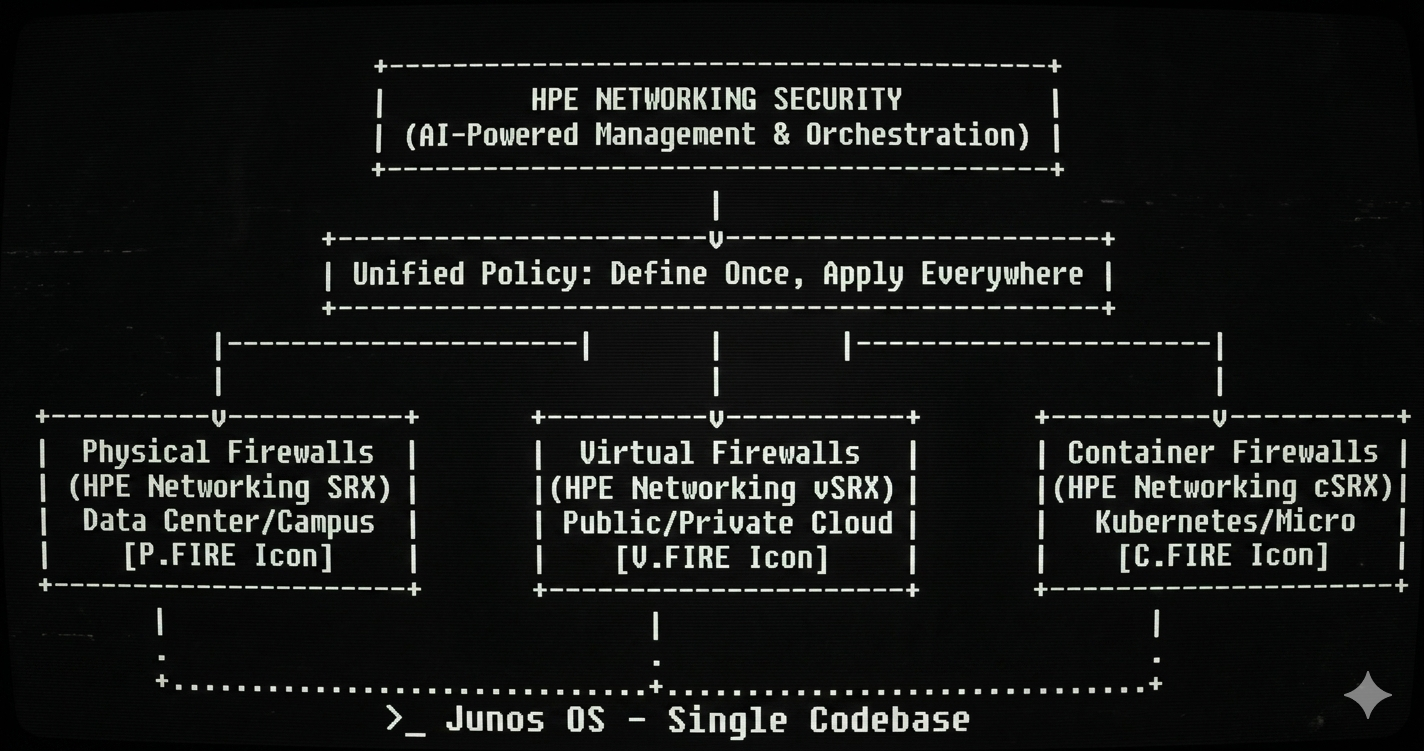
Instead of requiring security professionals to maintain distinct skill sets for multiple management consoles, the centralized plane consolidates operations. Administrators interface with a single operational source of truth. For DevOps teams, the platform enables automated deployment via pre-approved guardrails within IaC pipelines, removing the traditional bottleneck of manual connectivity approvals. Security operators can also utilize the integrated AI assistant to manage rules and verify configuration consistency using natural language.
Security and Compliance Considerations
Policy fragmentation routinely compromises regulatory posture, as compiling proof of consistent controls across disparate environments during audits can take weeks. HPE’s architecture mitigates this compliance exposure by ensuring policies act identically across all nodes, making the baseline provable on demand. This simplifies compliance obligations for frameworks such as the EU’s DORA and NIS2, as well as US SEC disclosure mandates.
From an active defense perspective, the architecture works to eliminate lateral movement blind spots. In legacy environments, threat actors like Volt Typhoon can exploit translation gaps between cloud and on-premises rules to persist undetected. By maintaining unified microsegmentation and consolidating forensic flow data into a single console, the platform limits the blast radius of a breach and reduces post-incident forensic investigations from days to hours.
Performance and Scalability
A common historical failure point for firewalls is the performance penalty incurred when enabling deep security features. In third-party evaluations conducted by NSS Labs and published by CyberRatings.org (2025 Enterprise Firewall evaluation), the HPE Networking SRX series achieved a 99.16% security effectiveness score across 3,326 exploits with zero false positives. Crucially, this security efficacy was maintained under real-world encrypted traffic conditions with all inspection features active.
For scalability, the portfolio utilizes Connected Security Distributed Services (CSDS). This feature enables enterprises to dynamically scale firewall capacity by adding nodes to the pool in minutes, bypassing the need to redesign existing network deployments. Hardware options like the HPE Networking SRX400 series extend these high-throughput capabilities out to branch and campus environments.
Strengths
- True Architectural Parity: By deploying Junos OS as a single codebase across physical (SRX Series), virtual (vSRX), and containerized (cSRX) deployments, the platform eliminates the translation layers and feature disparities common in multi-console estates.
- Validated Security Efficacy: Strong performance under full inspection, independently verified with a 99.16% exploit block rate and zero false positives under real-world encrypted workloads.
- Actionable Automation: The policy optimizer moves beyond mere recommendation by allowing single-click remediation of rule sprawl, conflicts, and zero-hit policies.
- Rapid Policy Propagation: Eliminates sequential console-hopping during emergencies, enabling global policy changes to deploy across all form factors in minutes.
- Local AI Inference: Localized threat intelligence processing on the SRX firewalls enables inline, low-latency zero-day protection without relying entirely on cloud-loop communication.
Potential Limitations
Dependency on Complete Ecosystem for Maximum Value: While the architecture offers open API integration for SIEM and SOAR tools, the core HMF benefits—such as no translation layers, instant policy propagation, and unified code parity—are strictly realized when utilizing the HPE Networking SRX series and Junos OS ecosystem. Organizations managing inherited, mixed-vendor firewall estates due to active M&A activity will still face initial integration timelines until they transition enforcement points to the supported HPE architecture.
Recommended Use Cases
- Highly Distributed and Multi-Cloud Enterprises: Ideal for organizations executing workloads concurrently across on-premises data centers, branch offices, and public cloud providers (AWS, Azure, GCP) who require centralized governance.
- DevOps-Heavy and Containerized Environments: Highly suited for fast-paced continuous deployment environments utilizing Kubernetes and microservices where security policy must be embedded directly into IaC pipelines.
- Strictly Regulated Industries: Well-suited for enterprises subject to stringent compliance audits, insurance renewals, and strict incident disclosure mandates (e.g., DORA, NIS2, SEC) requiring rapid, definitive validation of security controls.
Final Verdict
The HPE Networking Hybrid Mesh Security Architecture represents a mature, highly integrated realization of Gartner’s HMF vision. By enforcing a single codebase across all form factors and pairing it with robust centralized orchestration via HPE Networking Security Director, it systematically corrects the operational drag, rule drift, and response delays caused by fragmented firewalls. Backed by impressive independent performance validations, it successfully avoids the “performance vs. protection” tradeoff. For security leaders looking to regain architectural control over a sprawling enterprise footprint, HPE delivers a highly credible, evidence-based foundation for zero-trust enforcement.
Join our LinkedIn group Information Security Community!