


Application security teams are not short on findings. In many organizations, the opposite is true.
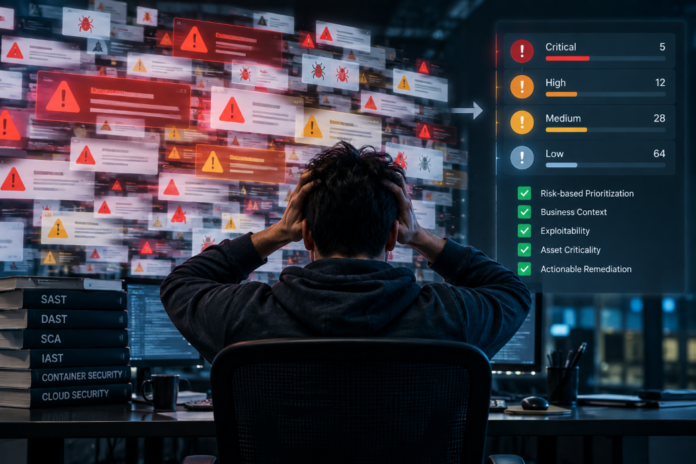
SAST, SCA, DAST, Secrets Scanning, Penetration Testing and Bug Bounty programs can all generate issues at the same time. The result is often a long queue of findings spread across different teams and applications. That visibility is useful, but it creates another problem. When everything looks important, developers can lose sight of what matters.
I have seen this happen more than once. A development team receives many findings, several marked high or critical. Security expects quick action, developers have release commitments, and the team starts working through whatever looks most urgent. Scanner severity alone, however, does not always tell the full story. A Finding can be technically severe but difficult to exploit in the real environment. Another issue may look less serious in a tool but affect an internet-facing application handling sensitive data. If both are treated the same way, AppSec becomes a ticket-processing exercise instead of a risk-management function.
Severity Is Only the Starting Point
CVSS scores and scanner severity are useful, but they should not be the final decision. AppSec teams need to add context.
Imagine two vulnerabilities. The first is rated critical in an internal application available only to a small group of authenticated users. The second is rated high in a public-facing application and affects authorization around sensitive customer information.
If the team sorts only by severity, the critical finding may automatically go first. Once the environment is considered, however, the second issue may represent the more immediate business risk.
Before deciding priority, security teams should ask: Is the application internet-facing? Is the vulnerable functionality reachable? Does the issue affect authentication, authorization or sensitive data? Is there a realistic path to exploitation? Is the application business-critical?
Those questions often change the order in which issues should be fixed.
Too Many “Urgent” Findings Create Fatigue
One of the easiest ways to lose developer attention is to label too many findings as urgent. If every issue is presented as critical, teams eventually stop reacting to the label.
I have seen teams receive dozens of findings with similar remediation deadlines even though the actual risk was very different. Developers may start fixing the easiest findings first rather than the riskiest ones.
From a reporting perspective, the numbers improve. From a risk perspective, not much may have changed.
A better approach is to create a smaller group of findings that genuinely require immediate attention and make it clear why. If developers know that a “Priority 1” issue really means something, they are more likely to treat it that way.
Exploitability Should Matter More
A vulnerability may exist in code, but that does not always mean an attacker can realistically reach it. AppSec teams should look at the path between the attacker and the vulnerable functionality.
For example, a vulnerable library may be present, but the vulnerable function may never be called. In another case, the same library could be exposed through an internet-facing API. The package name and CVE may be identical, but the risk is not.
This is where security teams need to move beyond simply forwarding tool output. The value of AppSec is not only in finding an issue, but in helping the organization understand how much that issue matters in its actual environment.
Business Context Changes Priority
Security tools generally do not know enough about the business. They may not know which application supports a critical customer process, which one is about to be retired, or which system holds the most sensitive information
A medium-severity issue in a high-value business application may deserve more attention than a higher-severity issue in a low-impact internal tool. Technical severity still matters, but it should be combined with business context.
I have found this becomes easier when AppSec teams work closely with application owners. Security understands the vulnerability; the application team understands how the system is used. You need both views to make a good decision.
Recurring Findings Should Be Escalated Differently
Prioritization is not only about the severity of an individual finding. Sometimes the bigger problem is that the same weakness keeps appearing.
Imagine a team that repeatedly gets findings for missing authorization checks in new APIs. Each finding may be fixed, but if the issue keeps returning, the real problem is the development pattern.
Creating more tickets is unlikely to solve that. The team may need a reusable authorization component, stronger design reviews, better code examples or a security check in the pipeline. Repeated findings should often be treated as a signal that the process needs attention.
Give Developers Enough Context to Act
Prioritization also depends on how findings are communicated. A scanner output that says “SQL Injection – High Severity” is not always enough. Developers need to understand where the issue is, how it can be exploited, why it matters and what a reasonable fix looks like. A vague security ticket creates questions and delays before remediation begins.
Good prioritization is not just deciding what should be fixed first. It is also making it easy for the right team to understand why it is first.
AppSec Should Reduce Noise, Not Add to It
The goal of an AppSec program should not be to send every scanner finding to developers as quickly as possible. The goal should be to help teams focus on the issues that create the most meaningful risk.
That requires more than severity scores. It requires technical context, exploitability, application exposure, business importance, recurrence and clear communication.
Security teams should still collect broad visibility from their tools, but they should avoid turning that visibility into noise. If developers trust the prioritization process, they are more likely to respond quickly to serious issues.
A good AppSec program does not simply produce more findings. It helps the organization know which findings deserve attention first.
______
About the Author:
Udaya Bhaskar Vemuri is a Senior Application Security Analyst with over 13 years of experience in application security and DevSecOps. He specializes in secure software development, vulnerability management, CI/CD security integration, and helping organizations improve application security programs without slowing software delivery. His work focuses on practical risk prioritization, developer enablement, and embedding security into modern development processes.
Join our LinkedIn group Information Security Community!