



A few years ago, a convincing fake face took a skilled editor and hours of work. Today it takes one image, a text prompt, and a generative model that hands back a fully animated face, one that blinks, turns its head, lip-syncs, and reacts on cue, ready to drop into a selfie check or a live video call.
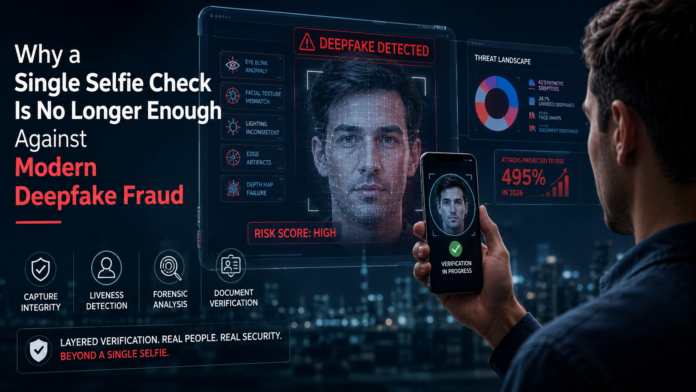
That shift, from craft to assembly line, is the most important thing to understand about deepfake fraud heading into 2026. When fraud becomes software, it scales like software. And the data has caught up to that reality: according to Shufti’s Deepfake Fraud Index, which analyzed fraud attempts across our global identity verification network, AI-driven attacks are projected to rise 495% in 2026 over 2025, close to a sixfold increase, and the sharpest year-over-year acceleration we have on record.
For years, the deepfake conversation centered on manipulated videos and synthetic media circulating online. Those risks haven’t gone away. But they’re now the smaller part of a much broader problem: AI-generated identities, fabricated documents, and real-time impersonation engineered specifically to slip past digital verification.
The deepfake fraud stack
The Index breaks modern AI fraud into four categories. What stands out is that no single technique dominates anymore: the threat has diversified, which is exactly what makes it harder to defend against.
Synthetic identities: 42.3%. Entirely AI-generated faces of people who do not exist, often paired with a fabricated paper trail. The largest category, and still climbing, is projected to grow roughly 73% in 2026.
Live video deepfakes: 28.1%. Manipulated video streams fed into a verification session in real time. The longest-running of the four threats, and now firmly established.
Face swaps: 17.6%. A victim’s face mapped onto an attacker’s head, live, during the check. A newer category, projected up around 21% in 2026.
Document deepfakes: 11.9%. AI-produced or AI-altered identity documents submitted as genuine. The smallest share today, and by far the fastest growing.
The takeaway isn’t that any one of these is the threat to watch. It’s that a verification system now has to anticipate all four at once, often in combination.
Document deepfakes: small today, exploding tomorrow
If one category captures where this is heading, it’s document fraud. Document deepfakes are growing faster than anything else in the dataset, projected to rise nearly 3,900% year over year in 2026.
A word on method, because a number that large demands one: these 2026 figures are annualized from the run rate over the first five months of the year and labeled as an estimate, not a confirmed total. But even with conservative framing, the trajectory is unambiguous. Generative tools have collapsed the cost of producing a convincing document from specialist forgery work into something that can be automated and run at volume. What used to require skill now requires a model and a prompt.
How the attacks actually reach the camera
Organizations tend to picture a deepfake attack as a single trick. In practice, attackers reach the verification camera in three distinct ways, and the most effective campaigns combine them.
The first is the presentation attack: holding something up to a genuine camera (a printed photo, a silicone mask, or a deepfake playing on a screen). The second is the injection attack, which skips the physical camera entirely and pipes an AI-generated feed straight into the verification app through virtual-camera or emulator software. The third stitches a synthetic face to fabricated documents to manufacture an identity that never existed.
Because these methods overlap, defeating one in isolation accomplishes little. The chain has to be broken at more than one point.
Why human review can’t keep up
When automated systems hit uncertainty, many organizations fall back on manual review. It feels like a reasonable safety net. The Index suggests it no longer is.
The uncomfortable finding: human reviewers are markedly worse at spotting a high-quality live video deepfake than a deepfake still image, and they tend to overestimate how good they are at telling the difference. As synthetic media improves, the human eye becomes a weaker line of defense, not a stronger one, and that overconfidence is what makes the gap dangerous.
This doesn’t make human judgment worthless. It does mean review has to be backed by technical controls that can read the signals the eye cannot: the artifacts, depth cues, and provenance markers that separate a real capture from a generated one.
Three layers, not one check
The central conclusion of the Index is straightforward: effective deepfake detection is layered. No single signal is sufficient, so resilient systems stack independent checks that an attacker has to defeat simultaneously. Three layers do most of the work, and each answers a different class of attack.
Capture integrity verifies the hardware path, confirming the video originated from a real smartphone lens rather than an injected or virtual feed. This is the first defense against injection attacks.
Liveness confirms a real person is present, combining passive cues (3D head depth, the way real skin responds to light) with active challenges (follow a moving dot, blink on command) that a pre-recorded deepfake can’t improvise. This is what catches manipulated streams and face swaps in the moment.
Forensics hunts the traces humans miss: the unnatural blending where a swapped face meets a jawline, the loss of a camera sensor’s unique noise fingerprint, the patterns that GAN and diffusion models stamp into generated media, and broken cryptographic provenance.
Each layer closes a gap the others can’t. Together, they turn a single point of failure into a sequence of obstacles.
The pressure is external, too
This isn’t only a problem fraud teams are choosing to solve. Three forces outside the fraud team are converging on the same conclusion.
Gartner predicts that by 2026, 30% of enterprises will no longer treat identity verification as reliable on its own because of AI-generated deepfakes, and notes that injection attacks rose 200% in 2023 alone.
Regulation is arriving. Under the EU AI Act, the Article 50 transparency obligations covering AI-generated and manipulated content begin to apply in 2026, turning the detection of synthetic inputs into a compliance requirement, not just a security preference.
The losses are real. Deloitte’s Center for Financial Services estimates that generative AI could drive fraud losses of up to $40 billion in the US by 2027, up from $12.3 billion in 2023.
Read together, these signals point the same way: detecting synthetic inputs is shifting from a competitive differentiator to a baseline expectation.
The bottom line
The question facing organizations is no longer whether deepfake fraud is real; the data settles that. The question is whether identity verification can adapt to an environment where synthetic content gets more convincing, more accessible, and more widespread every year.
A single selfie check can’t carry that weight anymore. It was built for a world where faking an identity was hard. That world is gone. In its place is one where layered verification (capture integrity, liveness, and forensics working together) is no longer an enhancement to identity systems.
It’s becoming the price of trusting them at all.
Join our LinkedIn group Information Security Community!