

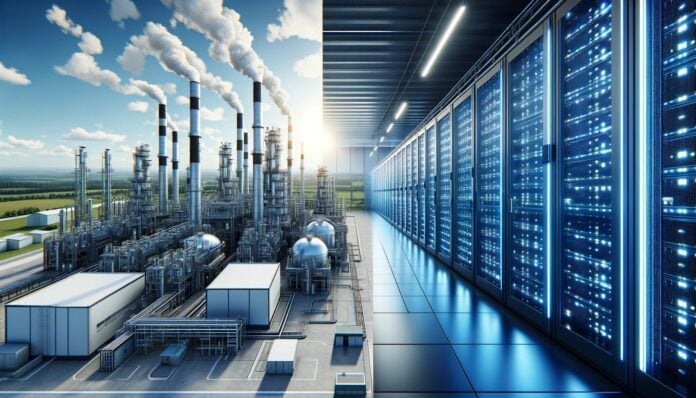
The growing public backlash against data centers in the United States could become an unexpected obstacle for the country’s cybersecurity ambitions. While concerns over electricity consumption, water usage, noise and environmental impact are legitimate, widespread opposition to new data-center projects could also slow the expansion of the digital infrastructure needed to support secure cloud computing, artificial intelligence and critical services.
A Gallup survey conducted in March 2026 found that 71% of Americans opposed constructing an AI data center in their local area, with 48% strongly opposed. Environmental concerns were among the primary reasons behind the resistance.
Data Centers are more than AI Infrastructure
Modern data centers are the backbone of cloud platforms, financial services, healthcare systems, government applications, communications and cybersecurity operations. Security technologies increasingly depend on large-scale computing infrastructure to process enormous volumes of telemetry, identify anomalies and respond to cyber threats.
AI is further increasing this dependence. Security operations centers are adopting AI for threat detection, malware analysis, automated incident response, behavioral analytics and vulnerability management. Consequently, insufficient computing capacity could eventually affect how quickly organizations can detect and respond to sophisticated cyberattacks.
The concern becomes particularly important as cybercriminals themselves increasingly use automation and AI to accelerate attacks.
Stronger opposition could create an Infrastructure Bottleneck
Public opposition can result in lengthy permitting processes, stricter local regulations and delays in data-center construction. Current developments already indicate the scale of the problem: reports suggest that dozens of U.S. data-center projects have faced delays or cancellations amid community opposition and concerns about resources.
At the same time, global data-center electricity consumption is projected to reach 565 TWh in 2026, representing a 26% increase from 2025, according to Gartner.
If the United States cannot expand computing infrastructure at the required pace, organizations could face limited access to high-performance computing resources. This could affect AI-powered cybersecurity platforms, cloud services and the ability to rapidly scale infrastructure during major cyber incidents.
Cybersecurity vs Sustainability
However, dismissing public concerns would be counterproductive. Data centers genuinely consume substantial electricity and can place pressure on water resources and local infrastructure. Research also shows that environmental impacts vary significantly depending on location, electricity sources, cooling technology and grid conditions.
The solution therefore should not be to build data centers without restrictions. Instead, technology companies and policymakers need to pursue sustainable and secure data-center development.
Developers can invest in renewable energy, water-efficient cooling, advanced power-management technologies and energy-efficient computing. Governments can establish transparent standards requiring operators to demonstrate their impact on local communities while recognizing data centers as strategically important digital infrastructure.
Finding the perfect balance
Cybersecurity cannot exist independently of infrastructure. Secure cloud platforms, AI-powered defense systems, government networks and critical infrastructure protection all require resilient computing facilities.
Therefore, the growing negative sentiment among U.S. voters should be treated as a signal for better planning rather than simply an obstacle. If policymakers, technology companies and communities can agree on responsible development, the U.S. can expand its data-center capacity without ignoring environmental and social concerns.
Ultimately, data-center security, sustainability and public accountability must evolve together. Failure to strike that balance could leave the United States facing an unusual cybersecurity problem—not because defensive technologies are unavailable, but because there is insufficient infrastructure to run them at the scale required.
Join our LinkedIn group Information Security Community!